
The right looper can turn a simple instrument or vocal setup into a complete performance rig. These loop stations range from compact pedals for practice to advanced tabletop and floor-based units built for layered live arrangements.
Our selection covers beginner-friendly options, dedicated guitar loopers, and multi-track workstations, so you can match recording time, controls, connectivity, and performance features to the way you create.
Best 10 Loop Stations Picks for 2026
Simple Starter

- Easy controls for recording, overdubbing, and playback
- 12 minutes of stereo recording with memory retention
- Clear 24-segment loop-status indicator
Best For: Beginners and straightforward live looping
Budget Flexibility
LEKATO Looper Pedal With Tuner

- Nine loops with 40 minutes of total recording
- Built-in tuner with uninterrupted switching
- USB WAV import and export for PC workflows
Best For: Practice setups and value-focused loopers
Advanced Pedalboard Pick

- 13 hours of stereo recording and 99 phrase memories
- 57 rhythms, A/B variations, and seven drum kits
- Multicolor LCD, MIDI, USB, and external control support
Best For: Performers needing rhythms and advanced connectivity
Performance Workstation

- Dual-track design with four looping modes
- Stores up to 128 loops and over three hours of audio
- USB audio interface for recording and streaming
Best For: Gigging singer-songwriters and multi-track performers
Simple Stereo Looping

- Up to 12 minutes of stereo recording
- Circular LED shows loop status
- Includes power adapter and cables
Best For: Beginners and straightforward stereo looping
Tabletop Performance Hub

- Five stereo looping tracks
- Two XLR mic inputs with phantom power
- Rhythm generator and line inputs
Best For: Layered vocal and electronic performances
Dual-Track Control

- Two tracks and 13 hours of stereo recording
- Onboard rhythms and color LCD
- XLR, 1/4-inch, and USB connectivity
Best For: Performers building extended layered arrangements
Flagship Performance
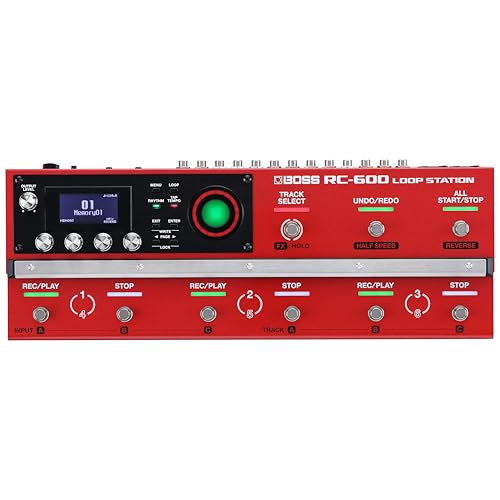
- Six simultaneous stereo phrase tracks
- 32-bit processing and extensive effects
- Nine assignable footswitches
Best For: Complex live performances and hands-free control
Compact Tabletop Control

- Two simultaneous stereo phrase tracks
- 64 phrase memories across eight banks
- Hands-on input and track effects
Best For: Tabletop looping with direct, fingertip control
Advanced Tabletop Mixing
- Five stereo tracks with independent faders
- Dual effects sections and extensive sound shaping
- XLR mic inputs with phantom power
Best For: Detailed tabletop arrangements and live mixing
Simple Starter – BOSS RC-1 Loop Station
The BOSS RC-1 is a straightforward choice for musicians who want dependable loop stations without a complicated interface. It supports guitar, bass, and keyboard, with stereo connectivity, intuitive controls, and a clear loop-status indicator.
Best For: Beginners and players who want an easy-to-use pedal for building layered loops.
Pros:
- Simple record, playback, overdub, undo, and redo functions.
- 12 minutes of stereo recording time with memory retention after power-off.
- 24-segment LED indicator shows the current looping mode.
- Includes a 9-volt battery and supports an optional PSA-series adapter.
Cons:
- Only one loop track and no listed onboard rhythm library.
- The AC adapter is sold separately.
The RC-1 focuses on accessible looping rather than advanced production features. It is a practical pedalboard-friendly option for rehearsals, practice, and live layering.
Budget Flexibility – LEKATO Looper Pedal With Tuner
This LEKATO pedal combines loop stations functionality with a built-in tuner and USB file transfer. Its multiple loop memories, long recording capacity, and lossless 48 kHz/24-bit sampling make it useful for practice and compact performance setups.
Best For: Players seeking generous loop storage, a built-in tuner, and PC-based loop importing.
Pros:
- Offers nine loops, up to 10 minutes per loop, and 40 minutes total recording time.
- Built-in high-sensitivity tuner supports continuous switching without interrupting the phrase.
- USB connection allows WAV loop import and export.
- Includes a USB cable and a 9V power supply.
Cons:
- Operates from corded power rather than a listed battery option.
- Single-knob volume control and one-button foot commands may require practice.
For the price-conscious musician, the LEKATO emphasizes recording time and practical utility. The tuner and USB workflow add flexibility beyond basic looping, although its controls are less expansive than more advanced units.
Advanced Pedalboard Pick – BOSS RC-5 Loop Station
The BOSS RC-5 brings advanced capabilities to compact loop stations, including high-quality 32-bit processing, extensive phrase storage, rhythms, MIDI, and USB connectivity. Its display and control options make it suitable for musicians who need more than basic phrase looping.
Best For: Performers and creators who want deep control, onboard rhythms, and integration with other equipment.
Pros:
- Provides 13 hours of stereo recording and 99 phrase memories.
- Includes 57 rhythms with A/B variations and seven drum kits.
- Uses 32-bit AD/DA conversion and 32-bit floating-point processing.
- Offers a multicolor LCD, MIDI I/O, USB, and external control support.
Cons:
- Its larger feature set may take more time to learn than a basic looper.
- The PSA adapter is optional, and battery use may be less convenient for extended sessions.
The RC-5 is a strong step up for players who want a compact pedal with professional-oriented storage, rhythm, and connectivity features. It balances pedalboard efficiency with a broad creative toolkit.
Performance Workstation – Sheeran Looper +
The Sheeran Looper + is a performance-focused option among loop stations, pairing dual-track operation with a full-color display, rugged dual pedals, and multiple looping modes. It also supports vocals, instruments, loop storage, and USB recording or streaming.
Best For: Gigging singer-songwriters and performers who need dual-track looping and broad input options.
Pros:
- Four modes support single, multi, sync, and song-based workflows.
- Stores up to 128 loops with more than three hours of total audio.
- Functions as a 2-in/2-out USB audio interface for recording and streaming.
- Includes microphone input, stereo instrument inputs and outputs, and MIDI connectivity.
Cons:
- Its 1.7 kg chassis and larger footprint take more pedalboard space.
- The manufacturer warranty is listed as one year.
With dual pedals, a color screen, and flexible storage, the Sheeran Looper + is designed for active stage use rather than minimalist pedalboards. Its battery operation and USB features also support mobile performance and home-studio workflows.
Simple Stereo Looping – Boss RC-1 Loop Station
Boss RC-1 Loop Station | Bundle with Gearlux Power Supply, Instrument Cable, Patch Cable, and Picks
Check Price On AmazonThe Boss RC-1 is a straightforward choice for musicians who want dependable loop stations without a complicated interface. Its circular 24-segment LED shows Rec, Overdub, and Play status at a glance, while stereo inputs and outputs support compatible instruments, effects, and amplifiers.
Best For: Beginners, guitarists, and performers seeking an easy-to-operate stereo looper with useful included accessories.
Pros:
- Up to 12 minutes of stereo recording time.
- Clear 24-segment loop-status indicator.
- Recorded phrases remain in memory after power-off.
- Bundle includes a power adapter, instrument cable, patch cable, and picks.
Cons:
- Single 9-volt battery provides approximately 4.5 hours of battery life.
- Optional AC-adapter use is supported, but the PSA-series adapter is sold separately from the standard pedal.
The RC-1 focuses on accessible controls and essential stereo looping. It is a practical starting point for live practice, songwriting, and simple performance setups.
Tabletop Performance Hub – Boss RC-505 Mk2 Loop Station
The Boss RC-505 Mk2 is a tabletop loop station designed for more elaborate vocal, instrumental, and electronic performances. Five stereo tracks, two XLR microphone inputs with phantom power, stereo line inputs, onboard effects, and a rhythm generator give performers a broad hands-on setup.
Best For: Vocalists, beatboxers, electronic musicians, and performers who prefer tabletop controls and multiple simultaneous stereo tracks.
Pros:
- Provides five stereo looping tracks.
- Includes two XLR microphone inputs with phantom power.
- Offers two stereo line input pairs and a rhythm generator.
- Includes a footswitch, dual footswitch, expression pedal, and AC adapter.
Cons:
- Its tabletop format is less suited to players who specifically want a compact pedal.
- The supplied dimensions indicate a larger setup than a traditional stompbox.
With multiple tracks and dedicated microphone connectivity, the RC-505 Mk2 is built for layered arrangements and hands-on performance control. It makes the most sense when a tabletop workflow is part of your setup.
Dual-Track Control – BOSS RC-500 Loop Station
The BOSS RC-500 is a dual-track loop station for musicians who need more recording capacity and connectivity than a basic looper provides. It combines up to 13 hours of stereo recording, onboard rhythms, XLR and 1/4-inch inputs, USB import/export, and a color LCD in a pedal-style unit.
Best For: Performers who want dual-track looping, extended stereo recording, rhythm accompaniment, and USB file transfer.
Pros:
- Offers two looping tracks and up to 13 hours of stereo recording time.
- Includes onboard rhythm tracks for performance accompaniment.
- Provides XLR and 1/4-inch inputs.
- Color LCD and USB import/export add control and file-management flexibility.
Cons:
- Uses an AC adapter as its listed power source rather than battery power.
- Its feature set may be more than needed for simple one-track looping.
The RC-500 balances pedal-format operation with substantial recording time and modern connectivity. It is a strong fit for performers who want room to build arrangements while keeping a compact floor-based setup.
Flagship Performance – BOSS RC-600
The BOSS RC-600 is a powerful choice for looping musicians who need substantial real-time control. With six simultaneous stereo tracks, advanced editing, extensive effects, and assignable footswitches, it is built for complex live performances.
Best For: Guitarists, singer/songwriters, multi-instrumentalists, and performers who want a full-featured floor-based loop station.
Pros:
- Records and edits up to six stereo loops in real time.
- Uses 32-bit AD/DA conversion and 32-bit floating-point processing.
- Includes 49 Input FX types and 53 Track FX types, with four usable at once in each section.
- Nine freely assignable footswitches and three pedal modes offer flexible control.
Cons:
- Its extensive feature set may require more setup and learning time.
- The floor-based unit weighs 8.2 pounds and has a large footprint.
The RC-600 stands out among loop stations for layered, effects-heavy performances where hands-free control and routing flexibility matter more than compact size.
Compact Tabletop Control – BOSS RC-202
The BOSS RC-202 is a compact tabletop option for musicians who want direct access to loop controls while playing. Its two stereo phrase tracks, real-time saving, and hands-on effects make it a practical entry in the loop stations category.
Best For: Performers who prefer tabletop operation for guitar, keyboards, and other instruments, especially those building layered loops with DJ- or sampler-style effects.
Pros:
- Provides two simultaneous stereo phrase tracks with dedicated controls.
- Offers four input FX and four track FX simultaneously.
- Stores 64 phrase memories across eight banks.
- Supports optional footswitches, an expression pedal, and MIDI connectivity.
Cons:
- It has fewer phrase tracks than the RC-600 and RC-505mkII.
- Tabletop operation may be less convenient for performers seeking direct foot control.
With its small tabletop format and real-time memory saving, the RC-202 suits hands-on performers who want accessible looping without moving to a larger multi-track setup.
Advanced Tabletop Mixing – BOSS RC-505mkII
The BOSS RC-505mkII is designed for performers who want detailed tabletop control over layered loop stations performances. Five stereo phrase tracks, independent faders, broad effects, and extensive connectivity make it well suited to vocalists, beatmakers, and multi-part live arrangements.
Best For: Tabletop performers who need five-track layering, precise mixing, microphone connectivity, and extensive performance customization.
Pros:
- Provides five simultaneous stereo phrase tracks with independent volume faders.
- Delivers 32-bit AD/DA conversion and 32-bit floating-point processing.
- Includes 49 Input FX types and 53 Track FX types across dual effects sections.
- Offers two XLR microphone inputs with phantom power plus multiple stereo line inputs and outputs.
Cons:
- Its 23.4-inch width requires substantial tabletop space.
- The large control layout may be more than casual loopers need.
The RC-505mkII is a strong choice when hands-on mixing and input flexibility are priorities. Its five tracks and customizable controls provide room for intricate live arrangements and evolving performance workflows.
How We Picked These Loop Stations
We focused on the features that most directly affect looping: recording capacity, track organization, overdub control, footswitch or tabletop ergonomics, sound quality, connectivity, and ease of use. The list includes compact pedals for straightforward phrase looping as well as larger units for performers who need multiple tracks, effects, rhythm parts, or hands-free control.
We also considered the needs of different users. A simple looper can be the better choice for learning and practice, while a more capable model may justify its size and cost for live solo work, vocal looping, beat production, or complex arrangements.
Quick Comparison
| Best For | Look For |
|---|---|
| Beginners and practice | Simple controls, clear status indicators, and reliable undo/redo |
| Guitar pedalboards | Compact size, durable footswitches, tuner or rhythm features |
| Solo live performers | Multiple tracks, hands-free control, effects, and strong I/O |
| Tabletop beatmakers | Dedicated track controls, hands-on mixing, and microphone support |
| Long-form arrangements | Extended recording time, memory, phrase storage, and USB connectivity |
Key Buying Factors for Loop Stations
Track Layout and Workflow
Decide whether you need one basic loop, two synchronized tracks, or several independently controlled parts. Single-track pedals are quick to learn; multi-track models provide more control over verses, choruses, percussion, and transitions.
Recording Time and Storage
Check both the maximum recording time and how many phrases or memories can be saved. Short loops may be enough for practice, but extended performances benefit from generous internal storage and USB transfer.
Controls and Synchronization
Footswitch spacing matters when you are performing. Look for dedicated stop, overdub, undo, and track controls if you need to make changes without menus. MIDI, synchronization, and external control can be important for keyboards, drum machines, and larger rigs.
Inputs, Outputs, and Power
Make sure the looper supports your setup, including instrument, microphone, stereo, auxiliary, or external-pedal connections. Also confirm whether it uses batteries, an adapter, or both, and check the required power rating before connecting it to a pedalboard supply.
Sound Quality and Effects
Higher-resolution recording can preserve more detail, while built-in rhythms and effects may reduce the need for extra gear. Prioritize the features you will actually use rather than paying for complexity that slows down your workflow.
Who Should Buy Which Loop Stations?
Choose a compact single-track pedal if you are learning to loop, practicing at home, or adding simple layers to a guitar or other instrument. These models are generally the fastest to operate.
Choose a dual-track pedal if you want separate control over foundational and lead parts, longer arrangements, or more flexible live transitions without moving to a tabletop unit.
Choose a tabletop looper if your performance involves vocals, instruments, beatboxing, or hands-on manipulation. The layout is easier to access with your fingers, especially when controlling several synchronized tracks.
Choose an advanced floor-based workstation if you perform solo and need extensive effects, multiple inputs, deep routing, long recording times, and foot-controlled arrangement changes. Before buying, sketch your typical signal chain and performance sequence; the best looper is the one that lets you execute that sequence without menu diving.