
The right looper can turn a solo musician into a complete live arrangement, adding rhythm, harmony, and texture without requiring a full band. The best choice depends on how many layers you need, how quickly you must control them, and whether built-in rhythms or effects matter onstage.
We selected 10 loop stations across pedalboard, desktop, and performance-focused formats, including options for guitarists, singers, beatmakers, and electronic performers.
Best 10 Loop Stations for Live Performances Picks for 2026
Flagship Creative Control
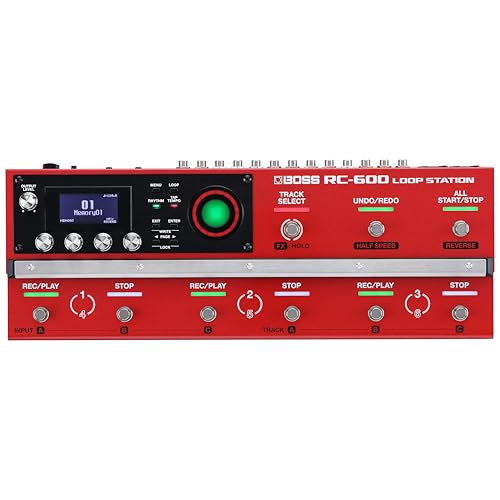
- Six simultaneous stereo phrase tracks
- 32-bit processing and extensive effects
- Nine assignable footswitches
Best For: Complex, effects-heavy live looping
Extended Stereo Looping

- Dual looper with stereo I/O
- 24-bit/48kHz recording
- Three hours and 50 recallable loops
Best For: Stereo performers needing stored loop material
Versatile Dual-Track Workhorse

- Two tracks with 13 hours of stereo recording
- Onboard rhythms and color LCD
- XLR, 1/4-inch, and USB connectivity
Best For: Compact vocal and instrument performances
Rugged Essential Looping

- Six minutes with unlimited overdubs
- Double-, half-speed, and reverse modes
- Includes adapter and three patch cables
Best For: Guitarists wanting simple, durable looping
Professional Tabletop Control

- Two simultaneous stereo phrase tracks
- Eight simultaneous input and track FX
- 64 phrase memories with MIDI support
Best For: Layered live performers who prefer tabletop control
Compact Pedal Value
LEKATO Guitar Looper with Tuner

- Nine loops and 40 minutes total recording
- Built-in tuner with uninterrupted switching
- USB WAV import and export
Best For: Guitarists wanting compact looping and tuning
Rhythm-Driven Song Building
BOSS RC-10R Rhythm Loop Station

- 280 preset rhythm styles and 16 drum kits
- Six hours of stereo recording
- Two-track song operation with MIDI I/O
Best For: Solo performers building structured rhythm-backed sets
Best Expandable Looper

- 77 save slots across 11 banks
- About 300 minutes of stereo recording
- Auto Record and Fade Out controls
Best For: Guitarists and bassists needing extensive loop storage
Best Modulation Companion

- 12 modes and 28 modulation types
- 96kHz sampling with 32-bit processing
- Up to 297 patch memories
Best For: Looping rigs that need extensive modulation effects
Best All-in-One Performance Looper

- 100 stereo drum-machine options
- Seven customizable loop effects
- USB and headphone connectivity
Best For: Solo performers wanting drums and looping in one pedal
Flagship Creative Control – BOSS RC-600
For performers seeking highly capable loop stations for live performances, the BOSS RC-600 combines six simultaneous stereo tracks with extensive real-time editing and effects. Its floor-based design and assignable controls suit complex, layered sets.
Best For: Guitarists, singer/songwriters, and multi-instrumentalists building intricate live arrangements.
Pros:
- Records and edits up to six stereo loops in real time.
- Uses 32-bit AD/DA and 32-bit floating-point processing for class-leading sound quality.
- Includes 49 Input FX and 53 Track FX types, with up to four usable in each section.
- Nine freely assignable footswitches and three pedal modes support flexible control.
Cons:
- Its 8.2-pound, floor-based design is larger and heavier than simpler loop pedals.
- The extensive feature set may require more setup and learning time.
The RC-600 is the strongest choice here for performers who need maximum track count, effects variety, and hands-on control rather than a minimalist looping setup.
Extended Stereo Looping – Pigtronix Infinity 3
The Pigtronix Infinity 3 is a dual looper with stereo inputs and outputs, making it a practical option for loop stations for live performances that need two looping sections without the footprint of a larger flagship unit.
Best For: Performers who want dual-loop operation, stereo connectivity, and substantial onboard storage.
Pros:
- Provides dual looper operation with stereo inputs and outputs.
- Records at 24-bit/48kHz.
- Offers up to three hours of record time and 50 recallable loops.
Cons:
- Supplied notes do not list onboard rhythm tracks or USB connectivity.
- The unit-only package does not mention included accessories beyond the pedal.
With long recording capacity and recallable loops, the Infinity 3 fits performers who value saved material and stereo flexibility while keeping the control concept focused on dual-loop operation.
Versatile Dual-Track Workhorse – BOSS RC-500
The BOSS RC-500 balances practical stage features with a compact pedal format. For loop stations for live performances, it offers two tracks, onboard rhythms, long stereo recording time, and both XLR and 1/4-inch inputs.
Best For: Singers, instrumentalists, and performers who need dual-track looping with microphone-friendly connectivity.
Pros:
- Provides two-track looping with up to 13 hours of stereo record time.
- Includes onboard rhythm tracks for adding a rhythmic foundation.
- Offers XLR and 1/4-inch inputs plus USB import/export.
- Uses a color LCD and 32-bit audio quality.
Cons:
- Two tracks provide less layering capacity than the RC-600’s six tracks.
- A separate BMIDI-5-35 adapter cable is available separately.
The RC-500 is a well-rounded middle ground: more capable than a basic looper, but more compact and approachable than a six-track floor-based system.
Rugged Essential Looping – MXR M303 Clone
The MXR M303 Clone is a straightforward, durable choice among loop stations for live performances. It supports unlimited overdubs, reverse and speed controls, and arrives bundled with a 9V adapter and three patch cables.
Best For: Guitarists who want a compact, rugged looper with essential performance effects and included cabling.
Pros:
- Provides up to six minutes of looping with unlimited overdubs.
- Offers double-speed, half-speed, and reverse options.
- Supports an optional MXR Tap Tempo switch or DVP volume pedal.
- Bundle includes a Dunlop ECB003 9V adapter and three MXR patch cables.
Cons:
- Its six-minute loop time is much shorter than the RC-500’s 13 hours.
- Supplied notes do not list stereo inputs and outputs or onboard rhythm tracks.
The M303 makes sense for players who prioritize durable construction, basic loop manipulation, and a useful ready-to-connect bundle over extensive track management.
Professional Tabletop Control – BOSS RC-202 Loop Station
For performers seeking loop stations for live performances, the BOSS RC-202 provides a hands-on tabletop workflow with two simultaneous stereo phrase tracks, onboard effects, and real-time loop saving. Its interface is designed for operating while playing guitar, keyboards, or other instruments.
Best For: Musicians who want advanced tabletop looping, layered stereo phrases, and flexible effects control without relying solely on foot operation.
Pros:
- Two independently controlled stereo phrase tracks support layered performances.
- Four input effects and four track effects offer extensive sound processing.
- Stores 64 phrase memories with custom effects and playback settings.
- Supports optional footswitches, an expression pedal, and MIDI connectivity.
Cons:
- The tabletop design may be less convenient than a traditional floor pedal for foot-only control.
- Its advanced controls may require more setup time than a basic looper.
The RC-202 is a strong choice when performance flexibility and hands-on control matter more than a minimal pedal layout. Its phrase storage, effects, and external-control options make it well suited to elaborate live arrangements.
Compact Pedal Value – LEKATO Guitar Looper with Tuner
The LEKATO Guitar Looper is a compact option for players comparing loop stations for live performances. It combines looping, tuning, USB file transfer, and a visual time indicator in a small pedal format, with up to 40 minutes of total recording time.
Best For: Guitarists who want an affordable-feeling, space-conscious looper with a built-in tuner and straightforward foot-command operation.
Pros:
- Provides nine loop locations and up to 40 minutes of total recording time.
- Supports 48 kHz/24-bit sampling and unlimited overdubbing.
- Built-in tuner supports continuous switching without interrupting the phrase.
- USB connectivity enables WAV loop import and export with a computer.
Cons:
- Single-knob operation provides less direct control than more advanced multi-control loopers.
- The supplied notes identify a single looper effect rather than broader onboard effects processing.
With its tuner, USB workflow, and generous recording capacity, the LEKATO offers useful essentials in a compact pedal. It is a practical fit for guitarists who prioritize simple looping and portability.
Rhythm-Driven Song Building – BOSS RC-10R Rhythm Loop Station
The BOSS RC-10R combines song-based looping with dynamic rhythms, making it a distinctive choice among loop stations for live performances. Its two-track operation, 280 preset rhythm styles, and six hours of stereo recording support structured performances across many genres.
Best For: Solo performers who want programmed drum parts, song sections, and loop transitions in a compact pedal.
Pros:
- Includes more than 280 rhythm styles with sections, fills, and transitions.
- Offers 16 drum kits and six hours of stereo looper recording.
- Serial two-track operation supports building performances from two song parts.
- Provides 99 phrase memories, 50 user rhythms, and full MIDI I/O.
Cons:
- Its rhythm-focused feature set may be more than needed for simple overdubbing.
- The compact pedal has less physical control surface than a tabletop looper.
The RC-10R stands out for performers who need more than repeating loops. Its rhythm library, song-oriented structure, and MIDI connectivity make it especially useful for solo sets with defined sections and dynamic accompaniment.
Best Expandable Looper – MOOER Looper X2 Stereo Looper
The MOOER Looper X2 is one of the more storage-focused loop stations for live performances, offering 77 save slots across 11 banks and approximately 300 minutes of stereo recording. Its dual-foot-switch layout, auto-record trigger, and fade-out control make it practical for building and ending layered parts without abrupt stops.
Best For: Guitarists and bassists who need extensive loop storage, stereo operation, and hands-free control for live sets or practice.
Pros:
- 77 save slots and approximately 300 minutes of stereo recording time.
- 44.1kHz/24-bit recording with stereo 1/4-inch inputs and outputs.
- Auto Record and adjustable Fade Out functions support smoother performance transitions.
- Imports MP3, WAV, FLAC, and APE files and exports WAV files through editor software.
Cons:
- Longer 10-minute-per-slot recordings are limited to banks 10 and 11.
- External footswitch is required for expanded track-cycling control.
- Requires a 9V DC, center-negative adapter.
The Looper X2 stands out when capacity and organized loop recall matter more than a built-in drum machine or broad onboard effects. Its stereo recording, file compatibility, and optional external control make it a flexible choice for prepared live arrangements.
Best Modulation Companion – BOSS MD-500 Modulation Pedal
The BOSS MD-500 is primarily a high-end modulation pedal rather than a dedicated looper, so it is best considered an effects companion to loop stations for live performances. It combines 12 modes, 28 modulation types, high-resolution 96kHz conversion, and extensive patch memory for shaping layered parts.
Best For: Performers who already have a looper and want studio-level modulation effects with extensive preset storage.
Pros:
- Offers 12 modes and 28 modulation types.
- Uses 96kHz sampling, 32-bit AD/DA conversion, and 32-bit floating-point processing.
- Provides up to 297 patch memories in the listed configuration.
- Includes modulation effects such as chorus, phaser, and flanger.
Cons:
- It is not presented as a looper or loop-recording pedal.
- Adds a separate effects unit to a live performance setup.
- Requires a 9V, 300mA AC adapter.
The MD-500 makes sense alongside a dedicated looper when tonal variety and preset recall are priorities. It should not be selected as the main loop station, but its processing quality and large memory complement a loop-based rig.
Best All-in-One Performance Looper – VALETON VLP-400 Loop Station
The VALETON VLP-400 combines looping with a stereo drum machine and seven customizable effects, making it a versatile option among loop stations for live performances. Color-coded LEDs, dedicated drum and effect controls, and double-tap footswitch actions are designed to keep loop changes visible and manageable on stage.
Best For: Solo performers who want synchronized drums, loop effects, headphone practice, and computer connectivity in one pedal.
Pros:
- Includes 100 stereo drum-machine options with 24-bit/48kHz audio and tempo sync.
- Seven assignable effects include Octave, Reverse, Freeze, Half, Fade, Once, and Solo.
- Multi-colored LEDs show recording, playback, and overdub status.
- USB connectivity supports software updates, audio import/export, and project management.
Cons:
- Its feature-rich control layout may require more setup familiarity than a basic looper.
- Headphone connectivity is provided through a 3.5mm output rather than the listed 1/4-inch guitar connections.
- Requires a 9V DC power supply rated at 0.5A.
The VLP-400 is a strong fit for performers who want rhythmic backing and creative loop manipulation without adding separate pedals. Its AUTO tempo mode, visual status indicators, and USB workflow broaden its usefulness for both stage performance and recording.
How We Picked the Best Loop Stations for Live Performances
We evaluated these loopers for the demands of actual performance: hands-free control, recording capacity, track organization, sound quality, rhythm support, connectivity, and reliability. We also considered different playing styles, from simple verse-and-chorus layering to complex arrangements with multiple independent parts.
Because no single unit suits every musician, the roundup includes advanced floor controllers, dual-track pedals, compact rhythm loopers, stereo models, and more affordable entry-level choices. Features such as USB connectivity, onboard memory, footswitch assignment, and MIDI support were treated as practical advantages rather than automatic requirements.
Quick Comparison
| Best For | What to Prioritize | Ideal Format |
|---|---|---|
| Solo live performers | Multiple tracks, reliable foot control, ample memory | Advanced floor looper |
| Guitarists building basic layers | Simple operation, clear overdub controls | Compact pedal |
| Rhythm-driven performers | Drum patterns, fills, tempo control | Looper with rhythm engine |
| Stereo rigs and keyboards | Stereo I/O, flexible routing, sync options | Stereo or desktop looper |
| Budget-conscious players | Usable recording time and dependable switching | Entry-level pedal |
Key Buying Factors for Loop Stations for Live Performances
Track Layout and Loop Control
Decide whether you need one continuous loop, two independent tracks, or a larger arrangement with separate sections. Independent start, stop, undo, redo, and track-level controls are especially useful when performing full songs rather than layering indefinitely.
Footswitches and Stage Workflow
A looper with too few controls may force you to double-tap or reach down during a song. Look for clearly assigned switches, an intuitive overdub process, and options for external footswitches when you need hands-free access to more functions.
Recording Time, Memory, and Audio Quality
Check both the maximum loop length and the number of stored phrases. High-resolution recording can preserve detail, but practical features such as automatic tempo handling, fast phrase recall, and dependable saving may matter more than specifications alone.
Rhythms, Effects, and Connectivity
Built-in drums can provide a stronger performance foundation, while effects may reduce the need for extra pedals. Stereo inputs and outputs suit wider rigs, and USB or MIDI can help with backups, computer recording, synchronization, and preset management.
Who Should Buy Which Loop Stations for Live Performances?
Choose an advanced floor-based unit if you perform complete solo arrangements, need several simultaneous parts, or want extensive control from one device. A dual-track pedal is a better fit for musicians who want song sections without the complexity of a large workstation.
Pick a compact looper with rhythms if you want quick setup, portable practice, and beat-supported performances. Stereo and desktop designs make more sense for keyboardists, electronic musicians, and players who need flexible routing or hands-on controls. Finally, an affordable basic pedal is the sensible starting point for anyone learning live looping before investing in a larger system.