
A good direct box can help connect vocal-related instruments, playback sources, and other line or instrument-level gear to balanced microphone inputs while reducing hum and signal problems.
These 10 DI boxes for recording vocals include passive, active, stereo, and multi-channel options, so you can choose the right balance of connectivity, headroom, noise control, and portability for your setup.
Best 10 Di Boxes for Recording Vocals Picks for 2026
Reliable Stereo Isolation

- Passive two-channel stereo DI
- Transformer isolation with ground lift
- 15dB pad and XLR/1/4-inch connections
Best For: Compact recording setups needing passive stereo signal handling
Studio-Scale Expansion

- Eight-channel active direct box
- Mains or phantom-powered operation
- Impedance matching and XLR/TRS/TS connectivity
Best For: Multi-source studios, film sets, and live production
Flexible Dual-Channel Value
Bolanle D2 Premium Passive Stereo DI

- Passive two-channel operation without power
- Independent -15dB pads and polarity switches
- Thru outputs plus ground lift in a metal enclosure
Best For: Home studios and mobile setups with stereo or hot sources
Four-Channel Mixing Control

- Four independent DI channels
- 20dB pad and ground lift per channel
- Volume and pan controls for line-mixer output
Best For: Multi-source recording rigs needing integrated mix control
Rugged Passive Pick

- Passive mono transformer design
- Rugged stainless-steel construction
- 2-year warranty
Best For: Studio and live instrument setups feeding consoles or snake systems
Studio Routing Choice

- Passive XLR signal conversion
- Ground lift reduces buzz and hum
- Thru output supports parallel routing
Best For: Project studios connecting instruments or line sources to interfaces
Budget Utility Option

- Compact passive direct box
- Balanced output with parallel thru jack
- Metal enclosure at 8.16 ounces
Best For: Affordable home-studio and live signal matching
Best Dual-Channel Value
Pyle-Pro PDC22 Dual Passive Direct Box
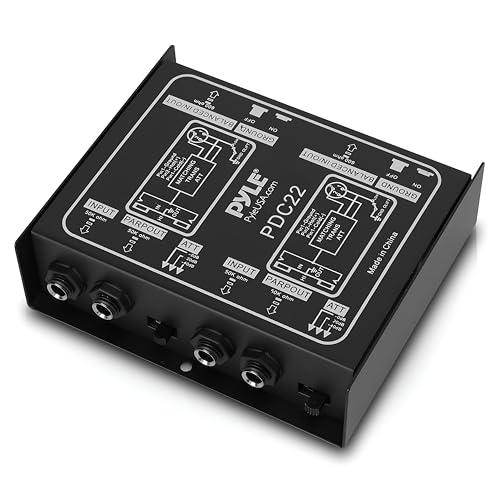
- Two passive channels for flexible routing
- Ground lift helps reduce buzz and hum
- Steel chassis for regular use
Best For: Home studios and live setups needing two DI channels
Best for Noise Control
Passive DI Box with Merge Function

- Balanced XLR output helps reduce noise
- Ground lift addresses connection hum
- Attenuator aids level matching
Best For: XLR-based live, PA, DJ, and recording systems
Best Compact Instrument DI
Pyle Premium PDC21 Passive DI Box

- Compact design for portable rigs
- 1/4-inch input with XLR connectivity
- Input attenuator supports level matching
Best For: Small studios and live rigs connecting instruments to mixers
Reliable Stereo Isolation – Radial ProD2
For recording vocals, the Radial ProD2 is a practical choice when you need a passive stereo DI with transformer isolation. Its ground-lift function and attenuation pad can help integrate instruments and line-level sources with mixers or interfaces.
Best For: Recording setups needing a compact, passive two-channel DI with isolation and flexible connectivity.
Pros:
- Passive stereo design requires no dedicated power.
- Transformer isolation and a ground-lift switch help address connection-related noise.
- Includes a 15dB pad for managing hotter signals.
- Supports 1/4-inch and XLR connections.
Cons:
- Only provides two channels.
- Its 1.2-pound, compact design may offer fewer routing features than active multi-channel units.
The ProD2 suits vocal-recording rooms that also track stereo keyboards, instruments, or other sources and want straightforward passive signal handling with isolation.
Studio-Scale Expansion – Behringer DI800 V2
The Behringer DI800 V2 is designed for recording environments that need several direct connections at once. With eight channels, active circuitry, and support for mains or phantom-powered operation, it can help match instrument signals to mixers and amplifiers in larger setups.
Best For: Recording studios, film sets, and live events requiring eight channels of DI coverage.
Pros:
- Provides eight independent DI channels.
- Can operate from mains power or phantom power.
- Offers impedance and signal matching for direct instrument connections.
- Uses XLR, TRS, and TS connectivity with an ultra-flat response described in the notes.
Cons:
- At 5 pounds, it is less portable than compact two-channel options.
- Requires access to mains or phantom power because it is an active unit.
- Eight channels may be more than needed for a simple vocal-recording rig.
The DI800 V2 is most compelling when a recording setup has multiple sources to route simultaneously and benefits from a centralized, rack-oriented DI solution.
Flexible Dual-Channel Value – Bolanle D2 Premium Passive Stereo DI
The Bolanle D2 is a passive stereo DI for recording vocals and other sources when you want two channels without relying on batteries, charging, or phantom power. Independent pads, polarity switches, ground lift, and thru outputs give it useful flexibility for instruments, keyboards, and interface-based setups.
Best For: Home studios, church systems, and mobile rigs handling stereo instruments or two separate sources.
Pros:
- Passive design needs no batteries, charging, or phantom power.
- Independent -15dB pads help accommodate hot signals.
- Includes ground lift and per-channel polarity reversal controls.
- Two channels feature 1/4-inch thru outputs for local monitoring.
Cons:
- It is limited to two channels.
- Its 1.94-pound enclosure is heavier than some compact DI options.
- The supplied notes do not specify a frequency-response figure.
With its practical signal-control features and rugged metal enclosure, the D2 is a versatile choice for vocal-recording setups that also need to accommodate keyboards, synths, or other hot sources.
Four-Channel Mixing Control – dbx DI4 Active 4-Channel DI
The dbx DI4 combines four independent direct-box channels with a built-in line mixer. For recording vocals alongside multiple instruments or feeds, its channel-level volume and pan controls provide more routing control than a basic single-channel DI.
Best For: Recording and live setups that need four DI channels plus per-channel mixer controls.
Pros:
- Provides four independent DI units in a half-rack package.
- Each channel has its own 20dB pad and ground-lift switch.
- Per-channel volume and pan controls support line-mixer output management.
- Accepts 1/4-inch and RCA inputs and provides XLR outputs.
Cons:
- It uses corded electric power rather than passive operation.
- Its 20dB noise-level specification may matter in particularly quiet recording chains.
- Four channels may be unnecessary for a minimal vocal setup.
The DI4 is a strong fit when a vocal-recording system needs several direct inputs and basic mix control in one compact unit, rather than separate DI boxes and a standalone mixer.
Rugged Passive Pick – Radial Pro DI
For recording vocals, a DI box is useful when you need to convert a compatible instrument or line signal to a balanced XLR feed for a console or interface. The Radial Pro DI is a passive mono direct box with transformer isolation, stainless-steel construction, and a stated 2-year warranty.
Best For: Live or studio setups involving acoustic guitars, bass, keyboards, drum machines, and professional snake systems or consoles.
Pros:
- Passive mono design with a built-in transformer.
- Rugged I-beam construction and stainless-steel enclosure.
- XLR connectivity and no wireless components.
- Backed by a 2-year warranty.
Cons:
- It is a mono DI rather than a multi-channel model.
- It is not waterproof.
- Its supplied use cases focus on instruments and consoles, not microphones directly.
The Radial Pro DI is a durable, straightforward choice when your vocal recording setup also includes instruments that need dependable passive balancing and transformer-based isolation.
Studio Routing Choice – Samson S-Max MD1
When comparing DI boxes for recording vocals, prioritize clean balanced output and easy integration with an interface or mixer. The Samson S-Max MD1 accepts a 1/4-inch unbalanced instrument or line signal and converts it to a balanced mic-level XLR signal without needing phantom power or batteries.
Best For: Home and project studios that need passive signal conversion, ground-lift control, and a thru output for parallel amp or monitor routing.
Pros:
- Outputs a balanced mic-level XLR signal from a 1/4-inch source.
- Passive operation requires no batteries or phantom power.
- Mu-Metal shielding and STL transformer support low-distortion operation.
- Ground lift and passive thru output add useful routing flexibility.
Cons:
- It has one channel.
- The supplied input options are aimed at 1/4-inch and XLR connections rather than direct microphone-specific processing.
- Its steel chassis adds durability but may be less portable than a lighter design.
The MD1 stands out for recording environments where hum control and parallel routing matter, especially when connecting instruments or line sources to a mixer or USB interface.
Budget Utility Option – Behringer DI400P
For a simple recording chain, the Behringer DI400P is a compact passive direct box that converts an unbalanced line-level signal to a balanced mic-level output. It helps address impedance mismatches, long-cable signal loss, and cycle hum while providing a parallel thru connection.
Best For: Budget-conscious home studios and live rigs using guitars, basses, mixers, or amplifiers alongside a console.
Pros:
- Passive design needs no listed battery or phantom-power operation.
- Converts unbalanced line-level signals to balanced mic-level output.
- Thru/Out jack can feed an amplifier while the balanced signal reaches the mixer.
- Compact metal enclosure weighs 8.16 ounces.
Cons:
- It is a basic utility DI rather than a feature-rich vocal processor.
- The supplied specifications list a 40 Hz frequency response.
- It is not waterproof.
The DI400P is a practical low-cost solution when you need basic balancing and parallel output in a vocal recording setup that also incorporates instruments or an amplifier.
Best Dual-Channel Value – Pyle-Pro PDC22 Dual Passive Direct Box
If you need DI boxes for recording vocals alongside instruments or other line-level sources, the Pyle-Pro PDC22 offers two channels in a durable steel chassis. Its passive design helps connect unbalanced sources to a recording mixer or PA while providing buzz and hum cancellation.
Best For: Home studios, live sound setups, and musicians who need two passive DI channels for keyboards, guitars, bass, or processors.
Pros:
- Two-channel design supports multiple connected sources.
- Helps convert unbalanced signals for connection to a main PA or recording mixer.
- Ground-lift functionality assists with buzz and hum reduction.
- Steel construction is suited to regular use.
Cons:
- It is a passive DI, so it does not provide active DI features.
- The supplied notes emphasize instrument and line-source connections rather than a dedicated vocal preamp.
The PDC22 is a practical choice when flexibility and two-channel operation matter more than specialized vocal-processing features. It can also handle consumer stereo or boom-box outputs for sampling applications.
Best for Noise Control – Passive DI Box with Merge Function
For recording vocals with other high-impedance sources, this passive DI box converts unbalanced signals to balanced XLR output to help reduce noise and signal loss. Its ground-lift and attenuation controls give you useful options for managing hum and matching signal levels.
Best For: Live sound, PA, monitor, DJ, and recording setups that need straightforward XLR connectivity and level matching.
Pros:
- Converts high-impedance unbalanced signals to low-impedance balanced XLR signals.
- Ground-lift switch can help reduce hum from multiple connected devices.
- Attenuation switch supports signal-level matching.
- Rugged housing is designed for steady use.
Cons:
- The supplied notes do not specify detailed vocal-oriented controls or preamp features.
- Its passive design may be less suitable when an active DI is preferred.
This model is a sensible utility DI when balanced XLR output, hum reduction, and attenuation are the priorities. It is especially suited to systems where several devices must integrate cleanly.
Best Compact Instrument DI – Pyle Premium PDC21 Passive DI Box
The Pyle PDC21 is a compact passive option among DI boxes for recording vocals and accompanying instruments. It connects 1/4-inch sources such as guitar, bass, keyboards, and processors to balanced or unbalanced XLR equipment, while its input attenuator helps with signal matching.
Best For: Compact home-studio or live rigs connecting guitar, bass, keyboards, and other unbalanced sources to a mixer or PA.
Pros:
- Compact enclosure measures approximately 1.8 x 3.3 x 5 inches.
- Supports 1/4-inch input and balanced or unbalanced XLR connections.
- Input attenuator helps match source levels to connected equipment.
- Hum-eliminator design assists with cleaner connections.
Cons:
- It is a single passive DI unit rather than a two-channel model.
- The supplied information focuses on instruments and line sources, not vocal preamplification.
Choose the PDC21 when you want a small, versatile DI for routing instruments or other unbalanced sources into a mixer. Its attenuator and hum-elimination features add useful flexibility without requiring a larger box.
How We Picked the Best Di Boxes for Recording Vocals
We focused on practical features that matter in home studios, project rooms, rehearsal spaces, and live vocal rigs. The lineup includes passive and active designs, single- and multi-channel units, stereo options, pad controls, merge functions, and models with added routing flexibility.
We also considered connection options, expected use cases, signal-handling needs, ruggedness, and value. Because a DI box is often placed between instruments or playback equipment and a mixer or audio interface, dependable connectors, useful attenuation, and effective isolation are more important than unnecessary features.
Quick Comparison
| Type | Best For | What to Look For |
|---|---|---|
| Passive mono | Simple guitar, bass, or playback connections | Transformer isolation, pad switch, ground lift |
| Passive stereo | Keyboards, stereo backing tracks, and dual-channel sources | Two independent channels and balanced outputs |
| Active | Low-output sources and demanding signal chains | Power requirements, headroom, and low-noise operation |
| Multi-channel | Vocal rigs, bands, and larger recording setups | Channel count, routing, line mixing, and rack or desktop format |
Key Buying Factors for Di Boxes for Recording Vocals
Passive or Active Design
Passive DI boxes are straightforward, generally do not need batteries or phantom power, and are often a strong choice for hot signals or simple studio routing. Active units can better accommodate some passive pickups and weaker sources, but they require a power source and should be checked for phantom-power compatibility.
Inputs, Outputs, and Channel Count
Choose a mono model for one source and a stereo or multi-channel unit for keyboards, playback devices, or several instruments. Confirm that the inputs match your equipment and that the outputs provide balanced XLR connections to your mixer or interface.
Pad, Ground Lift, and Merge Controls
An input pad helps prevent clipping when connecting a strong signal. A ground-lift switch can reduce hum caused by electrical loops, while a merge function may combine or route signals for specialized setups. These controls are especially useful when a vocal station includes instruments, backing tracks, or outboard gear.
Isolation, Noise, and Build Quality
Transformer isolation can help separate connected equipment and reduce unwanted buzz. Look for solid switches, secure jacks, a protective enclosure, and specifications that suit your expected frequency range and signal level.
Who Should Buy Which Di Boxes for Recording Vocals?
Choose a compact passive mono DI if you need a reliable solution for one guitar, bass, keyboard output, or auxiliary source. Choose a stereo DI for keyboards and stereo playback where preserving left-right channels matters. Choose an active model when you are working with a low-output passive instrument or need additional signal flexibility. Choose a multi-channel DI if your vocal setup includes several instruments, playback sources, or performers and you want cleaner, more organized connections.
Before buying, verify the source type, required channel count, available phantom power or batteries, and whether you need a pad or ground lift. The best DI box for your vocal recording setup is the one that matches those details without adding unnecessary routing complexity.