
Choosing the right motherboard for NAS build can make the difference between a quiet home file server and a system that quickly runs out of storage, bandwidth, or expansion options. The best picks balance SATA count, NVMe support, networking speed, and power efficiency.
Below, we focus on boards that fit real-world NAS needs: reliable multi-drive connectivity, fast LAN, sensible CPU support, and enough flexibility for backups, media streaming, virtualization, or a small business server.
Best 10 Motherboard for NAS Build Picks for 2026
Compact 8-Bay NAS Builder
StoneStorm N150 Mini-ITX with 10GbE

- 8 SATA support via included SFF-8643 cables
- 1x 10GbE plus 2x 2.5GbE networking
- Dual M.2 NVMe slots and cooling fan
Best For: Small NAS builds that need 8-bay support and 10GbE
Budget 4x2.5GbE NAS Board

- 4x i226 2.5GbE ports for networking
- 6 SATA ports and 2 M.2 NVMe slots
- Low-power N100/N150 design for 24/7 use
Best For: Low-power NAS and firewall builds with quad 2.5GbE
Server-Grade Storage Platform

- Dual X550-T2 10GbE networking
- Supports ECC and Registered ECC DDR4
- Up to 10 SATA drives with breakout cables
Best For: Homelab NAS builds that want ECC and dual 10GbE
High-Expansion Q670 NAS Board
12th/13th/14th Gen LGA1700 NAS

- Supports Intel 12th/13th/14th Gen CPUs
- 4x Intel 2.5GbE ports with vPro on LAN1
- Up to 8 SATA drives and 6 M.2 slots
Best For: Modern NAS builds with lots of onboard storage and networking
High-Performance Mini-ITX Pick

- 16-core/32-thread Ryzen 9 onboard
- Dual PCIe 4.0 M.2 with DDR5 support
- PCIe 5.0 x16 and triple video outputs
Best For: Users who want a compact NAS board with serious CPU power
8-Bay Storage Specialist
Intel N150 8-Bay NAS Motherboard

- Supports up to 8 SATA drives
- 10GbE plus dual 2.5GbE networking
- Two M.2 NVMe slots and included fan
Best For: DIY NAS builds focused on drive capacity and fast networking
Balanced Performance Choice
- 8-core/16-thread Ryzen 7 onboard
- Dual PCIe 4.0 M.2 with DDR5 support
- Pre-installed 37mm heatsink
Best For: Users who want strong NAS performance in a compact board
Ultra-Low-Power 8-Bay Pick
N150 NAS ITX with 10G + Triple LAN

- Intel N150 low-power CPU
- 3 LAN ports: 10G + dual 2.5G
- 8 SATA and 2 M.2 NVMe slots
Best For: Low-power NAS builds needing maximum storage and network connectivity
High-Expandability Intel Platform
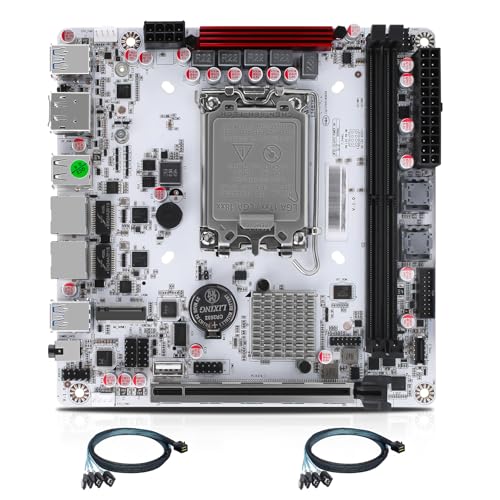
- Supports LGA1700 12th/13th/14th Gen CPUs
- 8 SATA, 3 M.2 NVMe, PCIe 5.0 x16
- DDR5 up to 64GB with dual 2.5GbE
Best For: Upgradeable NAS builds that need desktop CPU support and maximum expansion
Compact 8-Bay NAS Builder – StoneStorm N150 Mini-ITX with 10GbE
If you’re shopping for a motherboard for NAS build and want a compact board with strong storage density, this StoneStorm Mini-ITX option is built around an Intel N150 and supports up to eight SATA drives through the included SFF-8643 cables. It also adds dual 2.5GbE, a 10GbE AQC113C port, and dual M.2 NVMe slots, making it a flexible fit for a small but capable home NAS or firewall box.
Best For: Small NAS builds that need 8-bay support, 10GbE networking, and low-power operation.
Pros:
- Supports up to 8 SATA drives via 2 SFF-8643 cables.
- Includes 1x 10GbE AQC113C port plus 2x 2.5GbE ports.
- Dual M.2 NVMe 2280 slots add fast SSD storage options.
- Compact 6.7-inch Mini-ITX board with included cooling fan.
Cons:
- Uses non-ECC DDR5 only, with a 48GB maximum.
- The 10GbE NIC may need system compatibility confirmation.
- Requires both 24-pin and 4-pin power connections.
Overall, this is a well-rounded choice if you want a dense storage-focused motherboard without moving to a larger server platform. The low-power N150 and bundled cabling make it especially appealing for a compact DIY NAS.
Budget 4×2.5GbE NAS Board – N100/N150 Industrial Mini-ITX
This motherboard for NAS build targets low-power 24/7 systems with an Intel N100/N150 processor, four 2.5GbE ports, and a compact 17 cm x 17 cm industrial layout. If your priority is a practical network appliance or small NAS rather than maximum drive count, its 6 SATA ports and dual M.2 slots give you a solid storage foundation.
Best For: Low-power NAS, router, or firewall builds that need four 2.5GbE ports.
Pros:
- Four Intel i226 2.5GbE ports for fast networking.
- 6 SATA3 ports plus 2 M.2 NVMe slots for flexible storage.
- Designed for low-power, 24/7 operation with N100/N150 CPUs.
- Compact industrial Mini-ITX-style 17 cm x 17 cm board.
Cons:
- Maximum RAM is limited to 32GB non-ECC DDR5.
- Storage expansion is less ambitious than 8-bay NAS boards.
- Requires both 24-pin and 4-pin power to start.
For a lean NAS or network appliance, this board keeps the feature set focused on efficiency and wired connectivity. It makes the most sense when you value dependable 2.5GbE networking and modest storage expansion over server-style expandability.
Server-Grade Storage Platform – C612 Mini-ITX for Xeon E5
If you need a motherboard for NAS build with more of a server mindset, this C612 Mini-ITX board is designed for E5 v3/v4 Xeon processors and adds dual 10GbE, ECC support, and broad expansion options. It is aimed at users building a NAS, virtualization host, router, or private cloud system that benefits from enterprise-style connectivity and storage scaling.
Best For: Homelab and NAS users who want a server platform with ECC memory support.
Pros:
- Supports E5 v3/v4 CPUs on the C612 server chipset.
- Dual X550-T2 10GbE ports deliver high-bandwidth networking.
- Up to 10 SATA drives with compatible breakout cables.
- ECC and Registered ECC DDR4 support improves reliability.
Cons:
- Uses older LGA2011-3 / DDR4 platform hardware.
- Only 2 native SATA ports; others require breakout cabling.
- Mini-ITX layout may feel tight for some expansion needs.
This board stands out when reliability and network speed matter more than chasing the newest consumer platform. It is a strong fit for users who want server-class storage features without moving to a full-size rack board.
High-Expansion Q670 NAS Board – 12th/13th/14th Gen LGA1700 NAS
For buyers comparing a motherboard for NAS build on a newer Intel platform, this Q670 Mini-ITX board brings LGA1700 support for 12th, 13th, and 14th Gen desktop CPUs plus a very storage-heavy layout. With eight-bay NAS support, four Intel 2.5GbE ports, DDR5, and multiple M.2 options, it is built for a modern storage server or firewall appliance that needs plenty of flexibility.
Best For: Modern NAS builds that need Intel 12th/13th/14th Gen CPU support and lots of expansion.
Pros:
- Supports Intel 12th/13th/14th Gen desktop processors on LGA1700.
- Four Intel i226 2.5GbE ports, including one i226-LM with vPro support.
- Up to 8 SATA drives plus 6 M.2 NVMe slots.
- Supports up to 64GB DDR5 on two SO-DIMM slots.
Cons:
- K-series processors are not recommended.
- Requires both 24-pin and 8-pin power connections.
- More complex memory training and BIOS setup on first boot.
This is one of the most feature-rich options here if you want a current-generation Intel NAS platform. It is especially appealing when you want built-in networking and storage expansion without adding many extra cards.
High-Performance Mini-ITX Pick – AMD Ryzen 9 8945HX NAS Board
If you’re building a motherboard for NAS build with extra CPU headroom, the MINISFORUM BD895i SE is a strong fit. It combines a Ryzen 9 8945HX with dual PCIe 4.0 M.2 slots, DDR5 support, and a PCIe 5.0 x16 slot, so it can handle storage-focused work while still leaving room for high-end expansion.
Best For: Power users who want a compact NAS board with a fast onboard CPU and serious expansion potential.
Pros:
- Ryzen 9 8945HX onboard with 16 cores and 32 threads
- Dual PCIe 4.0 M.2 slots and DDR5-5200 support up to 96GB
- PCIe 5.0 x16 slot with reinforced metal fixing
- Triple display outputs plus 2.5G RJ45 and USB 3.2
Cons:
- No preinstalled SSD heatsink or fan header for SSD cooling
- Wi-Fi card is not included
- 12cm fan must be purchased separately
This board makes the most sense when you want workstation-level compute in a compact NAS chassis. It is less of a bare-bones storage board and more of a flexible high-performance platform.
8-Bay Storage Specialist – Intel N150 8-Bay NAS Motherboard
For a motherboard for NAS build centered on drive count and network throughput, this 8-bay mini ITX board is built around expansion. It supports up to 8 SATA drives via two SFF-8643 cables, includes two M.2 NVMe slots, and adds both 10GbE and dual 2.5GbE networking for faster transfers.
Best For: DIY NAS builders who want maximum SATA capacity in a compact board with fast networking.
Pros:
- Supports up to 8 SATA drives via 2 SFF-8643 cables
- Includes 1x 10GbE port and 2x 2.5GbE ports
- Two M.2 NVMe 2280 slots and USB 3.2 10Gbps ports
- Comes with a cooling fan and I/O shield in the box
Cons:
- Uses only one DDR5 slot, with up to 48GB supported
- AQC113C 10GbE compatibility may vary by system
- Requires both 24-pin and 4-pin power connections
This is the most storage-dense option in the group, especially if your priority is many SATA drives and solid networking. It is best suited to builders who value practical NAS features over raw CPU muscle.
Balanced Performance Choice – Ryzen 7 7745HX NAS Board
If you want a motherboard for NAS build that balances performance and compact size, the MINISFORUM BD775i SE is the middle-ground option. It uses a Ryzen 7 7745HX onboard CPU, dual PCIe 4.0 M.2 slots, DDR5 memory, and a PCIe 5.0 x16 slot, giving it plenty of capability without jumping to the higher-core model.
Best For: Builders who want strong NAS performance and expansion in a Mini-ITX board.
Pros:
- Ryzen 7 7745HX onboard with 8 cores and 16 threads
- Dual PCIe 4.0 M.2 slots and DDR5-5200 support up to 96GB
- Pre-installed custom 37mm heatsink for better thermal management
- PCIe 5.0 x16 slot plus HDMI, DisplayPort, and USB-C outputs
Cons:
- No Wi-Fi card is preinstalled
- 12cm cooling fan is not included
- Only one 2.5G RJ45 port is listed
This board is a practical pick if you want strong modern CPU performance but do not need the extra cost or heat of a top-end 16-core chip. It still offers the same storage and expansion style that makes the line attractive for compact NAS systems.
Ultra-Low-Power 8-Bay Pick – N150 NAS ITX with 10G + Triple LAN
If you want a motherboard for NAS build that stays compact while still offering serious connectivity, this Mini-ITX N150 board is built around storage density and network flexibility. It combines 8 SATA ports, 2 M.2 NVMe slots, and three LAN ports, including 10G plus dual Intel i226-V 2.5G, making it a practical fit for a small file server, router appliance, or multimedia box.
Best For: Low-power NAS and network appliance builds that need lots of SATA ports in a tiny footprint.
Pros:
- Intel N150 low-power CPU is suited to always-on use.
- 3 LAN ports include 10G plus dual 2.5G Intel i226-V.
- 8 SATA3.0 ports and 2 M.2 NVMe slots support dense storage layouts.
- Dual 4K@60Hz display support via HDMI 2.1 and DP 1.4b.
Cons:
- DDR5 is limited to a single SO-DIMM slot.
- Requires both 24-pin and 4-pin power connections.
- First boot may take time while memory is detected.
This board makes the most sense when network speed and SATA count matter more than raw CPU horsepower. It is a tight, specialized motherboard for NAS build projects where efficiency and connectivity are the main goals.
Balanced DDR4 Workhorse – Dual 2.5G NAS Mini-ITX
This motherboard for NAS build projects aims for a good balance of storage, networking, and CPU headroom. It pairs a low-power quad-core, 8-thread processor with dual 2.5GbE, 8 SATA ports, 2 M.2 NVMe slots, and a PCIe x4 slot, making it a flexible choice for home server, firewall, or virtualization use.
Best For: Users who want a compact NAS platform with stronger CPU performance and DDR4 memory support.
Pros:
- Quad-core, 8-thread CPU is positioned above N100/N150-class chips.
- Dual 2.5GbE ports suit fast NAS and security appliance setups.
- 8 SATA ports, 2 M.2 NVMe slots, and PCIe x4 add expansion room.
- DDR4 SO-DIMM support keeps memory costs and compatibility straightforward.
Cons:
- Has a noted sleep mode bug.
- Includes only a 6-month warranty.
- Requires both 24-pin and 4-pin power connections.
For builders who want more CPU capability than entry-level Intel N-series boards, this is a well-rounded option. It is especially appealing if you need a motherboard for NAS build flexibility without moving to a larger desktop platform.
High-Expandability Intel Platform – Q670 8-Bay DDR5 NAS Board
If you are shopping for a motherboard for NAS build projects that need desktop-class flexibility, this Q670 Mini-ITX board is the most expandable option here. It supports 12th/13th/14th Gen LGA1700 processors, 8 SATA via SFF-8643, 3 M.2 NVMe slots, DDR5 memory, and a PCIe 5.0 x16 slot for add-in cards.
Best For: Builders who want a more powerful, upgrade-friendly NAS platform with modern desktop CPU support.
Pros:
- Supports Intel LGA1700 desktop CPUs through 12th/13th/14th Gen.
- 8 SATA, 3 M.2 NVMe, and PCIe 5.0 x16 offer strong expansion.
- DDR5 support reaches up to 64GB total.
- Includes HDMI 2.0, DP 1.4, USB-C 20Gbps, and dual 2.5GbE.
Cons:
- Requires both 24-pin and 8-pin power connections.
- Uses desktop processors, so power and cooling needs are higher than low-power boards.
- vPro on the i226-LM port depends on the right CPU and BIOS settings.
This board is best when you want a NAS platform that can also behave like a capable desktop or expansion host. It gives you the most headroom for storage, memory, and PCIe devices in this roundup.
How We Picked the Best Motherboard for NAS Build
For this roundup, we prioritized NAS-friendly features that matter in daily use: drive connectivity, network speed, CPU platform longevity, memory support, and expansion options. We also looked for boards that suit different use cases, from low-power file sharing to higher-end storage servers and media or virtualization builds.
We favored a Motherboard for NAS Build that offers enough SATA or NVMe lanes for growth, plus stable networking such as 2.5GbE or 10GbE when faster transfers are a priority.
Quick Comparison
The strongest budget options are the low-power industrial boards built around Intel N-series chips, while the best performance choices come from newer LGA1700 and AMD HX platforms. If your goal is simple backup storage, prioritize SATA ports and efficient power use. If you plan to serve multiple users, transcode media, or run VMs, step up to faster CPUs, DDR5 support, and 10GbE networking.
Key Buying Factors for a Motherboard for NAS Build
Storage Expansion
Check the number of native SATA ports first, then look at M.2 slots and whether the board includes SFF-8643 headers or adapter support. A good NAS board should match your drive roadmap, not just your starting drive count.
Networking Speed
2.5GbE is a solid baseline for modern home NAS use. If you move large video files, run multiple clients, or want faster backup jobs, 10GbE is worth the upgrade.
CPU Platform and Power Use
Low-power processors help keep noise and electricity costs down, which matters for 24/7 operation. Higher-end desktop and mobile HX platforms deliver more headroom, but they also raise cooling and power requirements.
Memory Support
ECC support is valuable for data integrity in critical storage systems. DDR5 can improve platform longevity and bandwidth, while DDR4 may still be fine for budget builds.
Form Factor and Cooling
Mini-ITX boards are popular for compact NAS enclosures, but make sure your case can handle the drive layout and cooling needs. Active cooling, especially around chipsets and NVMe drives, can improve reliability under sustained load.
Who Should Buy Which Motherboard for NAS Build?
Choose a low-power Intel N100 or N150 board if you want an affordable, quiet file server or backup box. Pick a 6- to 8-bay ITX board with 2.5GbE if you want the best all-around home NAS experience. Go for dual 10GbE, ECC support, or LGA1700/Q670-style platforms if you need heavier multitasking, virtualization, or faster shared storage for a team. If raw performance matters most, the AMD Ryzen HX-based boards are the strongest fit for demanding NAS-plus-server builds.
In short, the right Motherboard for NAS Build depends on whether you value efficiency, storage density, network speed, or long-term expandability. Match the board to your drive count and workload first, and you’ll avoid costly upgrades later.