
When you’re working with Maya, the right workstation GPU can make all the difference in your creative process. From rendering complex 3D models to managing heavy simulations, having a powerful GPU guarantees your workflow remains smooth and efficient. In this guide, you’ll explore the top 10 workstation GPUs that can elevate your projects to new heights. Let’s examine which options stand out and why they might be the perfect fit for your needs.
PNY NVIDIA Quadro P4000

If you’re a professional working with complex visual effects and simulations in Maya, the PNY NVIDIA Quadro P4000 is an exceptional choice. This graphics card, built on the NVIDIA Pascal architecture, offers up to 70% more performance than its predecessor, the Quadro M4000. With 8 GB of GDDR5 memory and 1792 CUDA cores, it delivers a peak performance of 5.3 TFLOPS. You’ll appreciate its ability to handle HDR video and support for quad display outputs, enhancing your workflow. Plus, it’s compatible with various Windows and Linux platforms, ensuring you can integrate it seamlessly into your setup.
Best For: Professionals working with complex visual effects and simulations in software like Maya who need high-performance graphics capabilities.
Pros:
- Exceptional performance with up to 70% more power than the Quadro M4000, perfect for demanding applications.
- 8 GB of GDDR5 memory and 1792 CUDA cores enable efficient handling of large models and complex visual tasks.
- Quad display outputs allow for an expansive visual workspace, enhancing productivity and workflow efficiency.
Cons:
- Power consumption of 105 W may require adequate power supply considerations for some systems.
- Size and form factor of the card may limit compatibility with smaller cases or systems.
- Higher price point compared to consumer-grade graphics cards, which might not be justifiable for casual users.
AMD Radeon Pro W7800 Professional Graphics Card

The AMD Radeon Pro W7800 Professional Graphics Card stands out as a premier choice for creative professionals who demand exceptional performance in applications like Maya. With 32GB of GDDR6 memory and 70 compute units, it delivers an impressive 45 TFLOPS of FP32 performance, making it perfect for demanding workloads. You’ll appreciate its support for multiple displays, including 8K at 60Hz and up to four 4K displays at 120Hz. The card’s compatibility with major APIs and software like After Effects and Unreal Engine guarantees seamless workflow integration, empowering you to release your creativity like never before.
Best For: Creative professionals in AI, 3D rendering, and graphic-intensive applications who require high performance and multiple display support.
Pros:
- High-performance capabilities with 45 TFLOPS FP32, ideal for demanding workloads.
- Supports a wide range of display resolutions including 8K and up to four 4K displays for enhanced visual experience.
- Extensive compatibility with major software applications and APIs, ensuring a seamless workflow for professionals.
Cons:
- The 260W TDP may require a robust power supply and adequate cooling solutions.
- Higher initial investment compared to consumer-grade graphics cards, which may not be justified for casual users.
- Limited availability of extremely high-resolution displays that can fully utilize the card’s capabilities.
ASUS Dual NVIDIA GeForce RTX 3050 Gaming Graphics Card

For artists and designers seeking a reliable graphics card for 3D modeling and animation in Maya, the ASUS Dual NVIDIA GeForce RTX 3050 stands out with its powerful 6GB GDDR6 memory and advanced ray-tracing capabilities. This card features NVIDIA’s Ampere architecture, offering impressive performance with 2X FP32 throughput and improved power efficiency. Its 2nd Generation RT Cores deliver enhanced ray-tracing performance, while the 3rd Generation Tensor Cores utilize AI for remarkable speed. With its effective axial-tech cooling system and 2-slot design, it fits well in smaller cases, ensuring peak performance without overheating. Elevate your creative projects with this capable GPU.
Best For: The ASUS Dual NVIDIA GeForce RTX 3050 is best for artists and designers looking for a reliable graphics card to enhance their 3D modeling and animation capabilities in software like Maya.
Pros:
- Excellent ray-tracing performance with 2nd Generation RT Cores and enhanced AI capabilities.
- Compact 2-slot design allows for compatibility with smaller cases while maximizing cooling efficiency.
- Impressive 6GB GDDR6 memory ensures smooth multitasking and handling of demanding creative applications.
Cons:
- May not be suitable for ultra-high-resolution gaming or intensive workloads compared to higher-end GPUs.
- Limited to 6GB memory, which could be a constraint for very large projects or future-proofing.
- Availability and pricing may fluctuate due to demand in the gaming and creative sectors.
AMD Radeon Pro W7900 Professional Graphics Card

Engineered for professionals in graphics-intensive fields, the AMD Radeon Pro W7900 Professional Graphics Card excels in handling demanding tasks like 3D rendering and AI applications. With 48GB of GDDR6 memory and 96 compute units, it delivers a staggering 61 TFLOPS of FP32 performance. You’ll appreciate its support for 4K, 8K, and even 12K displays, guaranteeing stunning visuals at high refresh rates. The card also boasts compatibility with popular software like Maya, After Effects, and Unity, making it a versatile choice for creative professionals. Its extensive API support guarantees you can tackle any project with speed and responsiveness.
Best For: Professionals in graphics-intensive fields such as 3D rendering, AI applications, and video production who require high-performance computing capabilities.
Pros:
- Exceptional performance with 61 TFLOPS of FP32 and 48GB of GDDR6 memory for demanding workloads.
- Support for high-resolution displays, including 4K, 8K, and 12K, ensuring stunning visuals.
- Extensive compatibility with leading software applications used in creative industries.
Cons:
- High power consumption with a TDP of 295W may require robust power supply solutions.
- The price point could be a barrier for smaller studios or individual professionals.
- Potentially overkill for casual users or less demanding tasks.
MSI Gaming GeForce GT 1030 Graphics Card (4GB DDR4)
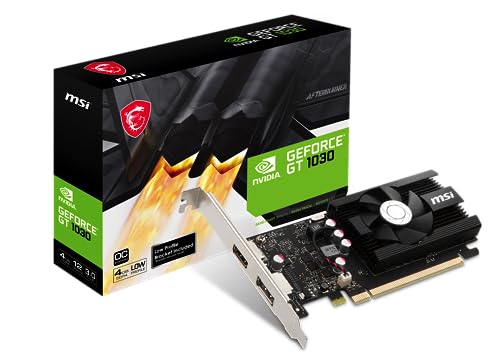
Looking for an affordable option that still delivers solid performance for 3D modeling in Maya? The MSI Gaming GeForce GT 1030 Graphics Card might be your answer. With 4GB of DDR4 memory and a boost clock of 1430 MHz, it handles tasks efficiently. Its low-profile design fits easily into compact workstations, while the 64-bit memory interface supports high-resolution displays up to 3840×2160. Plus, features like Multi-GPU setups and automatic driver updates via GeForce Experience enhance your workflow. Rated 4.5 out of 5 stars, it’s a reliable choice for creators on a budget.
Best For: Budget-conscious creators looking for a reliable graphics card for 3D modeling and HD video editing.
Pros:
- Compact low-profile design allows for easy installation in smaller workstations.
- 4GB DDR4 memory and a 1430 MHz boost clock provide adequate performance for tasks like gaming and picture editing.
- Support for Multi-GPU setups and automatic driver updates through GeForce Experience enhance overall functionality.
Cons:
- Limited memory interface (64-bit) may restrict performance in more demanding applications.
- Not suitable for high-end gaming or intensive 3D rendering tasks due to its entry-level specifications.
- Single fan cooling system may not be sufficient for extended heavy workloads, potentially leading to thermal throttling.
PNY NVIDIA Quadro RTX 4000 – The World’S First Ray Tracing GPU

The PNY NVIDIA Quadro RTX 4000 stands out as an exceptional choice for professionals in the fields of 3D modeling and animation, particularly those using Maya. With its NVIDIA Turing architecture, this GPU features 36 RT cores for accelerated ray tracing and 288 Tensor cores for AI acceleration. You’ll appreciate the 8 GB GDDR6 memory, which efficiently handles large datasets. Capable of 7.1 TFLOPS performance, it supports up to four displays at stunning resolutions. Enjoy real-time rendering and advanced shading features that elevate your creative projects, making the Quadro RTX 4000 a powerful ally in your artistic endeavors.
Best For: Professionals in 3D modeling and animation looking for high-performance graphics and real-time rendering capabilities.
Pros:
- Exceptional performance with 7.1 TFLOPS for efficient processing of complex tasks.
- Supports multiple displays with resolutions up to 7680×4320, enhancing workflow and productivity.
- Advanced features like real-time ray tracing and AI acceleration for immersive creative experiences.
Cons:
- Higher price point compared to standard GPUs, which may not be suitable for all budgets.
- Limited availability of some advanced features depending on the software being used.
- Weight and size may be a concern for users with compact PC builds or limited space.
X-Protector GPU Support Bracket – Large GPU Sag Bracket

For those working with heavy graphics cards in demanding applications like Maya, the X-Protector GPU Support Bracket is a game changer. This adjustable bracket, ranging from 2.9″ to 5″, effectively supports various graphics cards, preventing sagging damage over time. Crafted from solid aluminum and featuring a soft rubber pad, it absorbs vibrations while ensuring a stable and clean look. Installation is a breeze—just adjust the height and place it under your GPU, no tools required. Plus, with a 100% satisfaction guarantee, you can confidently click “Add to Cart” to protect your GPU risk-free today.
Best For: Those using heavy graphics cards in demanding applications who need reliable support to prevent sagging damage.
Pros:
- Adjustable height from 2.9″ to 5″ to accommodate various graphics card sizes.
- Solid aluminum construction with a soft rubber pad for vibration absorption and stable contact.
- Tool-free installation for quick and hassle-free setup.
Cons:
- May not fit in cases with limited space due to its adjustable height requirement.
- Some users may find the aesthetic design not suitable for all builds.
- Limited to supporting GPUs only; does not enhance cooling or performance.
AMD 100-506008 Radeon Pro WX 4100 4GB Workstation Graphics Card

Engineered for professionals in 3D modeling and animation, the AMD 100-506008 Radeon Pro WX 4100 4GB Workstation Graphics Card excels in delivering reliable performance for Maya users. With a core clock speed of 1.13 GHz and a boost clock of 1.20 GHz, this GPU supports a max resolution of 3840×2160, making your visuals stunning. Its 4 GB GDDR5 memory and 128-bit bus width guarantee smooth rendering. Weighing just 7.8 ounces, this low-profile card fits easily into your workstation. Plus, its compatibility with OpenCL 2.0 and Vulkan 1.0 enhances your workflow, making it a solid choice for creative professionals.
Best For: Creative professionals in 3D modeling and animation who require reliable performance and stunning visuals.
Pros:
- High performance with a core clock speed of 1.13 GHz and boost clock of 1.20 GHz for efficient rendering.
- Compact design weighing only 7.8 ounces, making it suitable for low-profile workstations.
- Compatibility with advanced technologies like OpenCL 2.0 and Vulkan 1.0 enhances workflow and productivity.
Cons:
- Limited memory of 4 GB GDDR5 may not be sufficient for very complex projects or large datasets.
- Moderate customer rating of 3.4 out of 5 stars could indicate some reliability issues.
- Only supports 128-bit bus width, which may limit performance compared to higher-end graphics cards.
maxsun AMD Radeon RX 550 4GB GDDR5 Graphics Card

Looking for a budget-friendly option that still packs a punch? The maxsun AMD Radeon RX 550 4GB GDDR5 Graphics Card is your answer. With 4GB of GDDR5 memory and a boost clock of up to 1183 MHz, it delivers impressive performance for your creative projects. Its 9CM cooling fan guarantees low noise while maintaining high airflow, keeping your workspace quiet. Supporting resolutions up to 8K, this card brings your designs to life. Weighing just 14.4 ounces, it’s perfect for compact builds. With a 4.4-star rating and solid customer feedback, you can trust this GPU for your Maya needs!
Best For: Budget-conscious gamers and creators seeking a powerful yet compact graphics card for their ITX builds.
Pros:
- Excellent performance with 4GB GDDR5 memory and a boost clock of up to 1183 MHz.
- Supports high resolutions up to 8K, making it suitable for demanding creative projects.
- Low noise operation thanks to the 9CM cooling fan, ensuring a quieter workspace.
Cons:
- Limited to 4GB of memory, which may not be sufficient for very high-end gaming or intensive applications.
- The form factor may restrict compatibility with larger cases or setups.
- Customer support and warranty information may require additional steps to access.
NVIDIA Quadro 4000 Graphics Card (VCQ4000-PB)

The NVIDIA Quadro 4000 Graphics Card (VCQ4000-PB) stands out as an excellent choice for professionals in 3D modeling and animation, thanks to its powerful CUDA architecture and impressive 2 GB of GDDR5 memory. With 256 CUDA cores and a 384-bit memory interface, it accelerates your workflows efficiently. You’ll appreciate the 89.6 GB/s memory bandwidth, enhancing performance on complex projects. The card supports high resolutions and dual display channels, ideal for multitasking. Plus, its 64X full-scene antialiasing guarantees stunning image quality. Backed by a three-year warranty, this GPU is built to meet the demands of serious creators like you.
Best For: Professionals in 3D modeling and animation seeking a powerful and reliable graphics card.
Pros:
- High performance with 256 CUDA cores and 2 GB of GDDR5 memory for efficient workflow acceleration.
- Impressive image quality with 64X full-scene antialiasing and support for high resolutions.
- Three-year warranty providing peace of mind for long-term use.
Cons:
- Limited memory capacity of 2 GB may not meet the demands of extremely complex projects.
- Older architecture (Fermi) may not fully support the latest features in newer applications.
- Power consumption of 142 W could require a robust power supply for optimal performance.
Factors to Consider When Choosing a Workstation GPU for Maya
When choosing a workstation GPU for Maya, you need to take into account several key factors. Memory size, CUDA core count, and cooling efficiency play vital roles in performance. Additionally, verify the GPU has the right display options and software compatibility to meet your specific needs.
Memory Size Importance
Choosing the right GPU memory size is vital for your work in Maya, especially if you’re tackling complex scenes or large datasets. A minimum of 8 GB of VRAM is often recommended for professional 3D rendering tasks, ensuring smooth operation while managing extensive geometry and assets. If you regularly work with high-resolution textures or multiple applications, aiming for 16 GB or more can greatly enhance performance. Insufficient memory can lead to slowdowns or crashes, making it difficult to open large projects. Additionally, consider the efficiency of memory bandwidth and speed, as these factors, alongside memory size, are important for ideal rendering and simulation tasks. Prioritize your GPU memory to maximize your creative potential in Maya.
CUDA Cores Count
Selecting the right GPU memory size sets the foundation for your performance in Maya, but the count of CUDA cores also plays a notable role in how efficiently your tasks are executed. CUDA cores accelerate computational tasks in 3D applications, making rendering and simulation faster. Generally, a higher count of CUDA cores leads to improved performance, especially for parallel processing tasks, like rendering complex scenes. For effective Maya performance, aim for a GPU with at least 1,500 CUDA cores to handle demanding workloads. Additionally, newer GPU architectures can deliver better performance per core, so consider this factor as well. Optimizing your use of CUDA cores can considerably reduce render times and enhance responsiveness during intricate operations.
Cooling Solutions Efficiency
Efficient cooling solutions are essential for maintaining ideal performance in your workstation GPU while working in Maya, especially during intense rendering tasks. A GPU equipped with advanced cooling technologies, like axial fans or vapor chamber designs, can help minimize thermal throttling, ensuring consistent performance under heavy loads. Additionally, a well-designed cooling system improves airflow within your workstation, preventing overheating during prolonged rendering sessions. When selecting a GPU, consider those with lower TDP (Thermal Design Power) ratings for better cooling efficiency and system stability. Regularly monitoring GPU temperatures and ensuring adequate ventilation is critical, as elevated temperatures can decrease rendering performance and potentially damage your components over time. Prioritize cooling to maximize your creative output.
Display Output Options
When you’re working with Maya, the display output options of your workstation GPU play an essential role in your overall experience. First, consider the maximum screen resolution supported; higher resolutions enhance the clarity of your complex models. Look for GPUs that allow multiple display outputs, letting you connect several monitors for a more expansive workspace—this is great for multitasking. Confirm your GPU supports high refresh rates and HDR capabilities, as these features greatly improve your visual experience during rendering and animation. Also, check for DisplayPort and HDMI outputs, important for modern monitors, and evaluate compatibility with advanced display technologies like 8K and 12K resolutions, which are critical for high-end visual effects projects.
Software Compatibility Support
Choosing the right workstation GPU for Maya hinges on ensuring software compatibility, as this directly impacts your workflow and productivity. First, confirm that the GPU supports OpenGL and DirectX, since Maya relies heavily on these APIs for rendering and visualization. Look for GPUs compatible with the latest versions of OpenCL and Vulkan to enhance performance in rendering and simulation tasks. Driver support optimized for Maya is essential; manufacturers often release tuned drivers for better stability and performance. Make sure the GPU has at least 8GB of memory to handle complex scenes and large datasets without bottlenecks. Finally, consider GPUs that are tested and certified for use with Maya, as they typically offer greater reliability and performance in production environments.
Performance Benchmarking Metrics
To guarantee ideal performance in Maya, it’s important to contemplate various benchmarking metrics when selecting a workstation GPU. Start by examining the floating-point operations per second (FLOPS); higher values indicate better performance for complex simulations and rendering tasks. Also, consider the number of CUDA cores or compute units, as these directly influence parallel processing capabilities, vital for handling large models. Memory bandwidth and size matter too; increased bandwidth means faster data transfer rates, while larger memory capacity helps manage more intricate scenes without lag. Don’t overlook frame rates and responsiveness during viewport interactions, as these facilitate smooth navigation. Finally, check for API support like OpenGL and DirectX, which can greatly enhance compatibility and performance in your Maya workflows.
Power Consumption Considerations
While selecting a workstation GPU for Maya, power consumption plays a significant role that can’t be overlooked. It affects your energy costs and cooling needs. Generally, higher power consumption means a more powerful GPU, which can boost your rendering speeds and performance in demanding tasks. Pay attention to the thermal design power (TDP) rating, as it helps you determine the necessary cooling solutions to keep your system running effectively during intensive workloads. Efficient power usage not only enhances overall system stability but also extends the longevity of your workstation, especially if it runs for long periods. Finally, verify your power supply unit (PSU) has sufficient capacity; insufficient wattage can lead to instabilities during high-load scenarios.
Price-to-Performance Ratio
A solid price-to-performance ratio is important when you’re selecting a workstation GPU for Maya, as it directly impacts the value you get from your investment. To gauge this ratio, consider performance metrics like TFLOPS—higher values reflect better processing capabilities for complex tasks. Additionally, memory capacity plays a significant role; more GBs allow you to handle larger models and textures without lag. Don’t overlook the GPU architecture either; newer designs often deliver superior performance per watt, making them more cost-effective over time. Finally, guarantee compatibility with Maya’s supported APIs, such as OpenGL and DirectX. This compatibility allows your GPU to fully harness its capabilities, further enhancing that important price-to-performance ratio.