
The best portable radios keep essential news, weather alerts, music, and talk programming available when internet access or cellular service is unreliable. This roundup compares simple AM/FM models with emergency radios offering NOAA alerts, hand-crank charging, solar power, and phone charging.
Consider where you will use your radio most—at home, outdoors, while traveling, or during a power outage. Power options, reception, speaker quality, tuning controls, and emergency features can matter more than a long list of extras.
Best 10 Portable Radios Picks for 2026
Top Emergency Pick
Midland ER310PRO Weather Radio
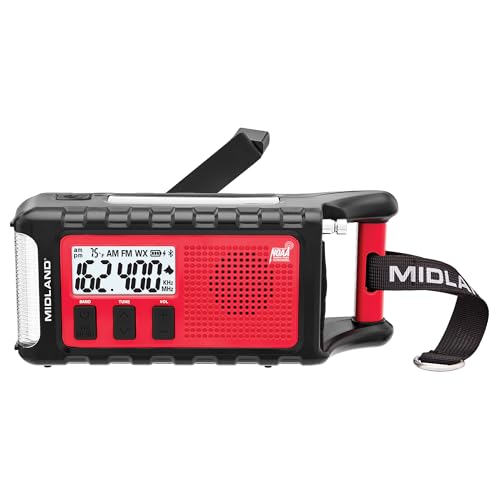
- 10,000 mAh power bank with solar and hand-crank charging
- NOAA Weather Scan plus flashlight, SOS beacon, and rescue siren
- Bluetooth streaming for everyday use
Best For: Emergency kits, camping, and severe-weather preparedness
High-Capacity Choice
Solar Hand-Crank Radio with 12,000mAh Battery

- 12,000 mAh battery for extended backup power
- Large solar panel and upgraded hand-crank generator
- NOAA, FM, and AM reception with two LED light sources
Best For: Extended outages, camping, and off-grid use
Simple Home Favorite

- AC plug or four-AA-battery operation
- Large controls and telescopic antenna for easy use
- Full speaker with 3.5mm headphone output
Best For: Home listening, seniors, and straightforward AM/FM use
Compact Emergency Value

- AM/FM/weather reception with NOAA broadcasts
- Solar, hand-crank, USB, and AAA-battery power options
- 2,000 mAh power bank plus flashlight and reading light
Best For: Compact emergency kits and weather preparedness
Classic Everyday Radio

- AM/FM tuner with powerful mono speaker
- AC or three-AA-battery operation
- Carry handle and headphone socket
Best For: Simple everyday listening at home or while traveling
Emergency Preparedness Pick
Raynic Emergency Weather Radio

- NOAA alerts plus AM/FM/SW/WB reception
- Six charging methods, including solar and hand crank
- Flashlight, USB charging, SOS siren, and IPX3 resistance
Best For: Storm preparedness, power outages, and outdoor adventures
Simple Shortwave Listener

- AM/FM/SW coverage with long-range antenna
- Large speaker and simple analog controls
- Wall power or four-AA-battery operation
Best For: Easy home, yard, camping, and shortwave listening
Best Emergency Power Pick
Leaton Hand Crank Weather Radio

- 10,000mAh backup battery with USB output
- Solar, hand-crank, and USB-C charging
- NOAA, AM/FM, lights, and compass
Best For: Emergency kits, camping, RV travel, and storm preparedness
Best Band Versatility
BAIJIALI AM/FM/SW Portable Radio

- Receives AM, FM, and shortwave
- 5W speaker with telescopic antenna
- Rechargeable battery and USB charging
Best For: Everyday listening, shortwave reception, and indoor emergency use
Best Simple Everyday Radio
Panasonic RF-2400D AM/FM Radio

- AC adapter or four AA battery operation
- Large fluorescent-pointer tuning dial
- Headphone jack and stable AFC tuning
Best For: Home listening, camping, and straightforward outage preparation
Top Emergency Pick – Midland ER310PRO Weather Radio
The Midland ER310PRO is one of the most versatile portable radios for emergency preparedness, camping, and everyday outdoor use. It combines AM/FM and NOAA weather reception with Bluetooth streaming, a substantial power bank, multiple charging methods, and rescue-focused lighting and alerts.
Best For: Emergency kits, severe-weather readiness, camping, and off-grid phone charging.
Pros:
- 10,000 mAh power bank can charge phones and other external devices.
- Solar and hand-crank charging provide alternatives during outages or away from outlets.
- NOAA Weather Scan, a 130-lumen flashlight, Morse-code SOS beacon, and rescue siren add practical emergency features.
- Bluetooth streaming makes it useful for everyday listening as well as emergencies.
Cons:
- Its emergency-focused feature set may be more than casual AM/FM listeners need.
- The listed 8.1-inch length makes it less compact than basic portable radios.
The ER310PRO stands out when emergency capability matters as much as radio reception. Choose it if you want one device for alerts, lighting, power backup, and entertainment.
High-Capacity Choice – Solar Hand-Crank Radio with 12,000mAh Battery
This solar hand-crank model is a strong option among portable radios for buyers who prioritize battery capacity and flexible charging. It receives NOAA, FM, and AM broadcasts and adds a large solar panel, phone-charging capability, flashlight, and reading lamp for outages or outdoor trips.
Best For: Long-duration blackouts, off-grid travel, camping, and survival kits.
Pros:
- 12,000 mAh lithium battery provides substantial reserve power for devices and radio use.
- Large 8,500mm² monocrystalline solar panel and hand crank offer renewable charging options.
- AM, FM, and NOAA reception is paired with a focused flashlight and soft reading lamp.
- Large tuning knob, clear labels, and non-slip grip support easy operation.
Cons:
- It is larger than some compact emergency radios at 6.8 x 2.9 x 4.7 inches.
- The product notes recommend fully charging the unit before first use.
With its unusually large battery and solar panel, this radio is designed for extended independence from wall power. It is especially compelling when backup charging capacity is a priority.
Simple Home Favorite – PRUNUS J03 AM/FM Radio
The PRUNUS J03 is a straightforward choice for shoppers seeking portable radios without emergency electronics or internet connectivity. It runs from an AC outlet or four AA batteries, with large tuning controls, a telescopic antenna, and a full-size speaker suited to news, music, and talk programming.
Best For: Home listening, seniors, kitchens, offices, and occasional outdoor use.
Pros:
- AC operation is convenient indoors, while four AA batteries support portable use.
- Large frequency scale and tuning knobs are easy to read and operate.
- DSP chip and 19.5-inch telescopic antenna are designed for clear AM/FM reception.
- Large speaker delivers full sound, with a 3.5mm headphone connection for private listening.
Cons:
- AA batteries are required for portable use but are not included.
- It supports only AM/FM and has no NOAA weather band or emergency power bank.
- The radio is not water resistant.
The J03 favors simplicity and accessibility over feature-heavy emergency functions. It is a practical pick for dependable household radio listening and users who prefer physical controls.
Compact Emergency Value – FosPower A1 NOAA Radio
The FosPower A1 is a compact emergency option for shoppers comparing portable radios with weather access and backup power. Its AM/FM/weather reception, solar and hand-crank charging, AAA battery support, power bank, flashlight, reading light, and SOS alarm cover the essentials for outages and outdoor emergencies.
Best For: Compact emergency kits, power outages, weather monitoring, and outdoor preparedness.
Pros:
- Receives AM, FM, and NOAA weather broadcasts.
- Uses solar, hand-crank, USB, and AAA-battery power options.
- Built-in 2,000 mAh power bank can provide emergency power to a phone or small tablet.
- Includes a 1W flashlight, four-LED reading light, and SOS alarm.
Cons:
- The 2,000 mAh power bank is smaller than the capacities listed for some competing emergency radios.
- Its speaker output is listed at 2 watts, so it may be less powerful than larger household radios.
- AAA batteries are required for that power option and are not indicated as included.
At 6.2 x 2.1 x 2.9 inches, the A1 balances portability with a useful set of emergency functions. It is a sensible choice when compact size and weather access matter more than maximum battery capacity.
Classic Everyday Radio – Sony ICF-506
The Sony ICF-506 is a straightforward choice among portable radios for listeners who want dependable AM/FM tuning, a strong mono speaker, and simple power options. Its built-in handle makes it practical to move around the home or take along on day trips.
Best For: Everyday AM/FM listening at home, in the kitchen, or on the go.
Pros:
- Powerful mono speaker designed to deliver room-filling sound.
- Runs on three AA batteries or the included AC power option.
- Built-in carry handle and dedicated headphone socket add convenience.
Cons:
- Supports AM and FM only, without shortwave or NOAA bands.
- Not water resistant.
- Analog tuning and display may be less precise than digital controls.
This is a sensible pick if you value simple operation and clear speaker output over emergency features or expanded band coverage. Choose it for uncomplicated daily listening rather than weather preparedness.
Emergency Preparedness Pick – Raynic Emergency Weather Radio
The Raynic Emergency Radio is one of the more versatile portable radios for storm readiness and outdoor use. It combines AM/FM, shortwave, and NOAA alert reception with rechargeable, solar, hand-crank, USB, AC, and AAA-battery charging options.
Best For: Emergency kits, camping, hiking, outages, and weather-alert monitoring.
Pros:
- Automatic NOAA weather alerts and AM/FM/SW/WB reception help keep you informed.
- Six charging methods include rechargeable battery, AC, USB, solar, hand crank, and AAA batteries.
- Built-in flashlight, reading lamp, USB device charging, SOS siren, and headphone jack.
- Compact 1.2-pound design with IPX3 water resistance.
Cons:
- AAA batteries are not included.
- Its emergency-focused feature set may be more than casual listeners need.
- Solar and hand-crank charging are backup methods rather than a substitute for planning ahead.
With multiple backup power sources and alert-focused features, this is the strongest option here for preparedness. It is also useful outdoors, especially when a flashlight, device charger, and weather information are valuable in one compact unit.
Simple Shortwave Listener – DreamSky AM FM Radio
The DreamSky AM FM Radio is a practical choice among portable radios when you want broad AM/FM/shortwave coverage and familiar physical controls. Its large speaker, long antenna, analog tuning dial, and AC-or-battery operation suit both indoor listening and basic outdoor use.
Best For: Listeners who prefer easy knobs, loud sound, and shortwave access.
Pros:
- AM/FM/SW tuning and a long antenna support wider listening options.
- Large speaker delivers loud sound, with high- and low-tone selection.
- Can plug into a wall outlet or run on four AA batteries.
- Backlit LCD shows the station and time, with 12- or 24-hour format options.
Cons:
- Four AA batteries are not included.
- Not water resistant.
- Analog tuning may require more adjustment than a fully digital tuner.
This model balances old-school controls with useful modern touches such as a backlit time and station display. It is a good fit for home listening, seniors, or anyone who wants shortwave capability without a complicated interface.
Best Emergency Power Pick – Leaton Hand Crank Weather Radio
For shoppers seeking portable radios for outages, camping, or emergency kits, the Leaton combines AM/FM and NOAA reception with several backup-power options. Its 10,000mAh internal battery, hand crank, solar panel, and USB-C input make it especially versatile when wall power is unavailable.
Best For: Emergency preparedness, camping, RV travel, and storm kits needing backup charging and lighting.
Pros:
- 10,000mAh battery can provide approximately 1–1.5 iPhone 14 charges through the USB output, depending on conversion and device efficiency.
- Supports solar, hand-crank, and USB-C charging.
- Includes AM/FM and NOAA reception, a three-mode flashlight, reading lamp, and compass.
- IPX6 water resistance helps protect against splashes and water spray.
Cons:
- NOAA reception requires manual tuning and does not provide SAME or automatic alerts.
- IPX6 protection is for splashes and spray, not immersion or heavy rain.
- Hand-crank charging and device runtime vary with cranking speed and usage.
This is the most feature-rich option here for emergency storage and outdoor use. Choose it when charging flexibility, lighting, and weather information matter more than a simple plug-in radio.
Best Band Versatility – BAIJIALI AM/FM/SW Portable Radio
This BAIJIALI model is a practical choice among portable radios when you want AM, FM, and shortwave reception in a straightforward package. Its large tuner, telescopic antenna, and 5W speaker make it suitable for everyday listening and basic emergency use.
Best For: Home, kitchen, office, travel, and listeners who want shortwave alongside AM/FM.
Pros:
- Supports FM, AM, and shortwave bands from 2.8–22 MHz.
- Enhanced 5W speaker is designed for clear music, talk, and sports listening.
- Large channel tuner and dedicated function controls are easy to use, including for seniors.
- Offers a built-in rechargeable battery plus DC 5V USB charging.
Cons:
- Not water resistant, so it is less suitable for wet outdoor conditions.
- Charging requires a DC 5V USB connection or the included rechargeable battery; no solar or hand-crank option is listed.
Choose this radio if broad band coverage and a louder speaker are your priorities. It offers more tuning range than a basic AM/FM model, but lacks the weatherproofing and emergency charging features of a dedicated survival radio.
Best Simple Everyday Radio – Panasonic RF-2400D AM/FM Radio
Panasonic Portable AM/FM Radio, Battery Operated Analog Radio, AC Powered, Silver (RF-2400D)
Check Price On AmazonThe Panasonic RF-2400D keeps portable radios simple with dependable AM/FM reception, an analog-style dial, and two power choices. Its AC adapter is convenient at home, while four AA batteries provide flexibility for camping or power outages.
Best For: Simple home listening, severe-weather preparation, camping, and users who prefer large, uncomplicated controls.
Pros:
- Runs from the included AC adapter or four AA batteries.
- Large dial with a fluorescent pointer improves visibility in low light.
- Digital tuner with AFC supports smooth, stable tuning.
- 3.5mm headphone compatibility enables private listening.
Cons:
- Supports AM/FM only, with no shortwave or NOAA-specific band listed.
- Not water resistant.
- Requires four AA batteries when AC power is unavailable.
This Panasonic is a sensible pick for buyers who value familiar operation over extra features. It is less suited to advanced emergency setups, but its AC-and-battery flexibility and easy-to-see dial make it a dependable everyday option.
How We Picked These Portable Radios
We selected models that cover the main ways people use Portable Radios in 2026: everyday AM/FM listening, emergency preparedness, outdoor activities, travel, and backup communication. We considered power flexibility, including batteries, AC adapters, USB charging, solar panels, and hand cranks; reception features such as AM, FM, shortwave, and NOAA weather bands; and practical details such as speaker volume, tuning ease, headphone support, durability, and portability.
Emergency models were also evaluated for useful backup functions, including phone charging, built-in lights, weather alerts, and battery capacity. A radio does not need every feature to be a good choice, so the right model depends on your priorities and listening environment.
Quick Comparison
| Best For | Features to Prioritize | Typical Choice |
|---|---|---|
| Power outages | NOAA alerts, hand crank, solar charging, flashlight | Emergency radio |
| Home listening | Clear speaker, easy tuning, AC power | AC- or battery-powered AM/FM radio |
| Travel and camping | Compact size, battery life, strong reception | Lightweight portable model |
| Remote areas | Shortwave, flexible charging, long runtime | Multiband emergency radio |
| Private listening | Headphone output and precise tuning | Portable radio with headphone support |
Key Buying Factors for Portable Radios
Power and Charging
Battery-powered radios are convenient for travel, while AC operation makes a model practical for a kitchen, workshop, or bedside table. Emergency radios with solar panels and hand cranks provide additional backup, but these methods are best viewed as ways to extend operation rather than replace normal charging. Check whether the unit uses common AA batteries or a rechargeable internal battery.
Reception and Alert Coverage
AM and FM cover most everyday broadcasts. NOAA weather reception is valuable in the United States for emergency forecasts and alerts, while shortwave can add access to distant broadcasts. Reception also depends on antenna design, location, and local signal strength, so extra bands do not guarantee better performance everywhere.
Controls, Sound, and Size
Large tuning dials and readable markings are useful for quick operation, especially during an outage. A larger speaker may produce fuller sound, but a compact radio is easier to pack. If you expect to use the radio around other people or outdoors, prioritize clear speech and sufficient volume over maximum bass.
Emergency Extras
Phone charging, flashlights, SOS functions, and weather alerts can be helpful, but they may increase weight and cost. Confirm the radio’s battery capacity and charging limits before relying on it as a phone power bank.
Who Should Buy Which Portable Radios?
Choose a straightforward AC- and battery-powered AM/FM radio if you mainly want dependable home listening with simple controls. A compact battery model is better for travel, camping, or keeping in a bag. For storm preparation or extended outages, choose an emergency radio with NOAA reception, a rechargeable battery, and at least one backup charging method. If you spend time beyond standard broadcast coverage, consider a model with shortwave. Finally, shoppers who value privacy should look for a headphone jack, while households preparing for emergencies may prefer a louder speaker, flashlight, and phone-charging capability.