
When it comes to achieving perfect color accuracy, choosing the right monitor calibration tool is essential for your work. With countless options available, it can be overwhelming to find the one that best fits your needs. From user-friendly interfaces to support for multiple display types, the right tool can greatly enhance your visual quality. Let’s explore the top ten tools that could redefine your color calibration process.
Datacolor SpyderExpress

If you’re a photographer, graphic designer, or content creator seeking precise color accuracy, the Datacolor SpyderExpress is an excellent choice for your calibration needs. This color calibrator guarantees lifelike color representation in both digital and print formats. It’s compatible with the latest displays, including Liquid Retina XDR, and supports software upgrades for OLED screens. Achieve edit-ready colors in just 90 seconds, with consistent results for skin tones and shadows. The user-friendly setup lets you save profiles and calibrate three displays easily. Don’t forget to recalibrate before editing for true-to-life accuracy every time!
Best For: Photographers, graphic designers, and content creators who demand precise color accuracy in their digital and print work.
Pros:
- Quick calibration speed of just 90 seconds for efficient workflow.
- Supports multiple displays, allowing users to calibrate up to three at once.
- User-friendly setup with advanced features like ambient light adjustment and device previews.
Cons:
- May require regular recalibration to maintain color accuracy.
- Limited to specific display types, potentially excluding some older models.
- Software upgrades needed for full support of advanced mini-LED displays.
Calibrite Display Pro HL Monitor Calibration Colorimeter

The Calibrite Display Pro HL Monitor Calibration Colorimeter is an ideal choice for photographers and designers who need precise color accuracy in their work. With its high luminance sensor, it accurately calibrates modern displays up to 3000 nits, ensuring perfect tone and color consistency. The included Calibrite PROFILER software offers both Basic and Advanced modes, allowing you to fine-tune settings like white point and gamma. Plus, it supports multiple monitors, making it perfect for creative studios. Quick Check and uniformity tools help validate your results, reducing errors caused by glare, so you can trust your monitor outputs for client projects.
Best For: Photographers and designers seeking high precision in color calibration for modern displays.
Pros:
- High luminance sensor allows calibration of displays up to 3000 nits for accurate results.
- Calibrite PROFILER software offers both Basic and Advanced modes for customizable settings.
- Multi-display support enables consistent color outputs across multiple monitors in creative environments.
Cons:
- Higher price point compared to basic colorimeters may not suit all budgets.
- Learning curve associated with advanced software features for new users.
- Limited compatibility with older display models that do not support high luminance calibration.
Datacolor Spyder Monitor Calibrator for Graphic Designers and Photographers
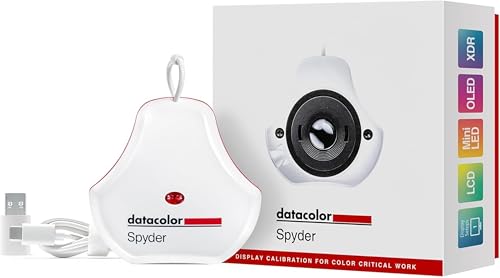
For graphic designers and photographers seeking precise color accuracy, the Datacolor Spyder Monitor Calibrator stands out as an essential tool. It calibrates various displays, including OLED and Apple Liquid Retina XDR, ensuring true color representation. With its intuitive software, you can easily use preset settings if you’re a novice, while professionals can enjoy customizable options. The DevicePreview TM Beta feature lets you see how your photos will look on different devices. Plus, the integrated ambient light sensor adapts your display’s brightness based on your environment, promoting confidence in your color work. Setup takes just 90 seconds, making it a fast solution.
Best For: Graphic designers, photographers, and content creators seeking precise color accuracy for their digital workflows.
Pros:
- Intuitive software with preset calibration options makes it user-friendly for beginners.
- Fast setup process takes only 90 seconds, allowing for quick calibration.
- Integrated ambient light sensor automatically adjusts display settings based on room lighting conditions.
Cons:
- May require periodic recalibration to maintain optimal color accuracy.
- Customizable settings may be overwhelming for some novice users.
- Limited to specific display types, which may not cover all user needs.
Datacolor SpyderPro Monitor Calibration

Datacolor SpyderPro Monitor Calibration stands out as the ideal choice for professionals and enthusiasts who demand precise color accuracy. It supports ultra-bright displays, calibrating brightness up to 12,000 nits. With 3D LUT export, you’ll achieve color consistency across various monitors and color spaces. The Device Preview Plus feature lets you compare original and converted images side-by-side, enhancing your workflow. Plus, it integrates Content Credentials, capturing creator details and edit history for authenticity. Syncing with light meters guarantees your calibration accounts for ambient lighting, making it a thorough tool for achieving perfect color fidelity in your work.
Best For: Professionals and enthusiasts who demand precise color accuracy and work with ultra-bright displays.
Pros:
- Supports calibration for ultra-bright displays, ensuring accurate color representation.
- Features Device Preview Plus for enhanced workflow with side-by-side image comparison.
- Integrates Content Credentials for authenticity, capturing creator details and edit history.
Cons:
- May have a higher price point compared to basic calibration tools.
- Requires compatible light meters for optimal ambient lighting calibration.
- The advanced features may have a learning curve for new users.
Datacolor Spyder X Pro Monitor Calibrator

Endeavoring for exceptional color accuracy in your photographic images? The Datacolor Spyder X Pro Monitor Calibrator is your perfect companion. With its groundbreaking lens-based color engine, you’ll enjoy enhanced precision across multiple monitors. It automatically adapts to changing room lighting, ensuring peak performance. Calibration is a breeze, taking just a minute or two, thanks to its intuitive single-click design. Plus, you can use the SpyderProof feature to visually compare before and after results with your own images. With a solid customer rating of 4.3 stars, this tool is ideal for both beginners and seasoned pros alike.
Best For: Photographers and graphic designers seeking accurate color calibration for their monitors without extensive technical knowledge.
Pros:
- Intuitive Design: Quick single-click calibration makes it user-friendly for beginners.
- Room-Light Adaptability: Automatically adjusts profiles based on changing lighting conditions for optimal accuracy.
- Time-Efficient: Achieves color precision in just a minute or two, enhancing productivity.
Cons:
- Battery Dependency: Requires 4 AA batteries, which may need frequent replacement.
- Limited Advanced Features: May not satisfy professional users looking for extensive customization options.
- Size and Portability: While compact, the weight could be a concern for users needing a highly portable solution.
Calibrite Display Plus HL Monitor Calibration Colorimeter

The Calibrite Display Plus HL Monitor Calibration Colorimeter stands out for professionals working with ultra-bright displays, such as Mini LED and OLED screens. It features an advanced HL high luminance sensor that measures up to 10,000 nits, ensuring accurate HDR calibration. With Calibrite PROFILER software, you can adjust white point, luminance, contrast ratio, and gamma in both Basic and Advanced modes. It supports broadcast standards like Rec.709 and BT.1886, making it perfect for video production. Plus, its validation tools, including Quick Check and Profile Validation, help maintain color consistency across multiple monitors, enhancing your editing setup.
Best For: Professionals and content creators who require precise color calibration for ultra-bright displays like Mini LED and OLED screens.
Pros:
- High luminance sensor measures up to 10,000 nits for accurate HDR calibration.
- Calibrite PROFILER software offers flexibility with Basic and Advanced modes for comprehensive adjustments.
- Validation tools ensure color consistency across multiple monitors, enhancing the editing workflow.
Cons:
- Limited to specific screen technologies, which may not suit all users.
- Requires software installation for full functionality, which may be a barrier for some.
- Price may be higher compared to basic calibration tools, making it less accessible for casual users.
Calibrite Display 123 Monitor Calibration Colorimeter

For photographers and creators seeking reliable color accuracy, the Calibrite Display 123 Monitor Calibration Colorimeter stands out with its user-friendly 1 2 3 software workflow. This compact device, featuring a USB C connection, makes calibration fast and approachable, allowing you to focus on your art. It supports up to two displays, ensuring color consistency in multi-screen setups. With brightness target options like Native or Photo, you can easily select your desired setting. The built-in comparison view highlights calibration improvements, helping maintain consistent results across editing sessions. Enjoy truer tones and reliable contrast, making your images pop on any screen.
Best For: Photographers and creators who need reliable color accuracy and consistency across multi-screen setups for their editing work.
Pros:
- User-friendly 1 2 3 software workflow simplifies the calibration process, making it accessible for all skill levels.
- Dual display support allows for color matching across multiple monitors, essential for professional photo editing.
- Built-in comparison view enables easy visibility of calibration improvements, promoting regular maintenance for consistent results.
Cons:
- Limited to two displays, which may not be sufficient for users with larger multi-screen setups.
- Requires USB C connection, which may not be compatible with older devices without adapters.
- Initial calibration process may take some time, potentially delaying immediate editing tasks.
Calibrite Photo Kit with Display Pro HL Monitor Calibration Colorimeter

Photographers seeking precise color accuracy will find the Calibrite Photo Kit with Display Pro HL Monitor Calibration Colorimeter an invaluable tool. This kit pairs the Display Pro HL with the ColorChecker Passport Photo 2, ensuring accurate monitor calibration for your editing needs. It supports custom camera profiles, enhancing RAW workflows while working seamlessly with modern displays like mini LED, OLED, and Apple XDR. With Calibrite PROFILER software, you can achieve reliable color representation and maintain consistency across different sessions and lighting conditions. The integration of capture accuracy and monitor confidence empowers you to refine your creative colors confidently.
Best For: Photographers and digital artists who require precise color accuracy and reliable monitor calibration for high-quality photo editing.
Pros:
- High luminance calibration: The Display Pro HL ensures accurate monitor calibration for modern display technologies.
- Custom camera profiles: The ColorChecker Passport Photo 2 allows for consistent white balance and exposure across different sessions.
- Integrated workflow: Combines camera profiling and monitor calibration for a streamlined editing process.
Cons:
- Cost: The kit may be considered expensive for amateur photographers or those with limited budgets.
- Learning curve: Users may need time to familiarize themselves with the Calibrite PROFILER software and calibration process.
- Limited to specific workflows: Primarily designed for photographers, which may not be suitable for users focused on other forms of digital art.
Datacolor Spyder X Elite Monitor Calibration

Expert photographers and motion imagemakers will find the Datacolor Spyder X Elite an invaluable tool for achieving precise monitor calibration. This model calibrates your monitors in just one to two minutes, thanks to its groundbreaking lens-based color engine. You’ll appreciate features like room-light monitoring, automatic profile changing, and improved white balance. The intuitive design, complete with a step-by-step assistant, makes calibration straightforward. Plus, the SpyderProof functionality lets you evaluate display quality before and after calibration using full-screen images. With support for the latest screen types and resolutions, it’s future-proof, ensuring your setup remains compatible as technology evolves.
Best For: Expert photographers and motion imagemakers seeking precise and efficient monitor calibration.
Pros:
- Calibrates monitors in just one to two minutes, significantly reducing setup time.
- Features room-light monitoring and automatic profile changing for optimal performance.
- Intuitive design with step-by-step assistant and SpyderProof functionality for easy evaluation.
Cons:
- May be overkill for casual users or non-professionals who do not require high-level calibration.
- Some users may find the initial setup process slightly complex.
- Limited to specific monitor types and may not support very niche or outdated models.
Datacolor Spyder4Pro S4P100 Colorimeter for Display Calibration

The Datacolor Spyder4Pro S4P100 Colorimeter stands out as an ideal choice for those who require precise display calibration, whether you’re a graphic designer or a video editor. Its automated color and brightness calibration makes setup a breeze, while the single sensor can calibrate multiple displays efficiently. With the Fast Re-calibration Assistant (ReCAL), you’ll find it easy to maintain accuracy over time. The full-spectrum color sensor, enhanced to meet CIE color standards, boosts average accuracy by 26% and consistency among Spyder units by 19%. Plus, its improved long-term stability guarantees your colors remain true, project after project.
Best For: Professionals in graphic design and video editing who need precise display calibration.
Pros:
- Automated color and brightness calibration simplifies the setup process.
- Single sensor calibration efficiently calibrates multiple displays.
- Enhanced accuracy and long-term stability ensure colors remain true over time.
Cons:
- May require periodic recalibration for optimal performance.
- Initial setup may be complex for beginners.
- Limited compatibility with certain display types or operating systems.
Factors to Consider When Choosing a Monitor Calibration Tool
When choosing a monitor calibration tool, you should consider calibration speed and efficiency to save time. Display compatibility is also essential, as not all tools work with every screen type. Finally, look at software features and user experience to guarantee the tool meets your needs without unnecessary complexity.
Calibration Speed Efficiency
Choosing a monitor calibration tool that maximizes speed efficiency can greatly impact your workflow, especially if you often face tight deadlines. Some tools can achieve edit-ready results in as little as 90 seconds, allowing you to quickly adapt to changing lighting conditions. Fast calibration means your color representation remains accurate without significant downtime, which is essential in busy studios or during client presentations. Tools that offer one to two-minute calibration enhance your workflow by minimizing interruptions. Plus, being able to recalibrate quickly over time helps maintain color accuracy and consistency, reducing the need for lengthy processes. Look for efficient tools with automated features that streamline the calibration process, letting you focus more on your creative work.
Display Compatibility Range
Maximizing your workflow with fast calibration tools sets the stage for considering display compatibility range. You’ll want a calibration tool that supports a variety of display types, including LCD, OLED, and mini-LED. Advanced technologies like Apple Liquid Retina XDR should also be on your radar for versatility. Make certain the tool can handle varying brightness levels, especially for HDR content, ideally up to 12,000 nits. Consistency is key, so choose a tool that accommodates multiple displays for uniform color profiling across your workstation. Additionally, look for tools that offer software updates to keep pace with new display technologies. Finally, verify the calibration process includes ambient light adjustments for accurate color representation in different lighting conditions.
Software Features Available
While evaluating monitor calibration tools, you’ll want to prioritize software features that enhance your calibration experience. Look for options that offer both Basic and Advanced modes, letting you customize settings based on your expertise. Features like ambient light adjustment can greatly improve accuracy by adapting to your workspace’s lighting conditions. If you work with multiple monitors, make sure the software supports multi-display profiling for consistent color representation across all screens. Additionally, validation and uniformity tools are essential for maintaining accuracy over time, especially in professional settings. Finally, the ability to save custom profiles and presets streamlines the process, making it easier to switch setups while guaranteeing color consistency. These features will elevate your calibration experience.
User Experience Ease
When it comes to selecting a monitor calibration tool, user experience ease plays an essential role in guaranteeing you achieve accurate results without frustration. Look for tools with intuitive software interfaces that guide you through simple calibration workflows, minimizing complexity. Many tools offer quick setup processes, allowing you to achieve accurate color representation in just one to two minutes—perfect for beginners. Integrated features like ambient light sensors automatically adjust settings based on your surroundings, enhancing usability. Additionally, tools with before-and-after evaluation functionalities let you visually assess improvements, boosting your confidence in the results. If you work with multiple displays, choose a tool that supports saving calibration profiles to guarantee consistent color accuracy across all your screens.
Advanced Calibration Options
Choosing the right monitor calibration tool involves considering advanced calibration options that can greatly enhance your display’s performance. Look for tools that offer custom white point adjustments, allowing you to tailor your settings to your specific needs. Validation and uniformity checks are essential for ensuring consistent color performance across different displays, reducing errors from screen glare. If you work in a collaborative environment, consider devices that support multi-display profiling, so you can calibrate multiple monitors simultaneously. The ability to export 3D LUTs enhances your color management capabilities, ensuring consistency across various media formats. Additionally, advanced software modes let you make detailed adjustments to luminance, contrast ratios, and gamma settings, giving you greater control over the entire calibration process.