
Choosing the right 3D scanner for reverse engineering parts comes down to accuracy, surface handling, workflow speed, and how much post-processing you can tolerate. The best option for you depends on whether you’re scanning small mechanical pieces, larger assemblies, or glossy, detail-rich surfaces.
Below, we focus on scanners and accessories that help produce clean, usable meshes for CAD, 3D printing, inspection, and part replication without wasting time on poor tracking or messy data.
Best 10 3d Scanner for Reverse Engineering Parts Picks for 2026
Precision Laser Pick
Creality CR-Scan Raptor for fine-detail reverse engineering

- 0.02 mm claimed accuracy for detailed parts
- Blue laser and NIR scanning modes
- Handles objects from 5 mm to 2000 mm
Best For: High-precision reverse engineering and mixed-size part scanning
Surface Prep Essential
AESUB White permanent scanning spray

- Improves contrast on difficult surfaces
- Thin approx. 7 µm coating
- Designed for easy post-scan cleaning
Best For: Glossy or reflective parts that need better scan contrast
All-Round Scanner
Creality CR-Scan Otter for flexible part capture

- Dual-lens scanning from 10 mm to 2000 mm
- Handles black and metal parts without spray
- Up to 20 fps with anti-shake tracking
Best For: Mixed-size part scanning and workshop reverse engineering
Scan Assist Pick
Revopoint Auto Turntable with marked top cover

- Keeps small parts moving instead of the scanner
- Supports up to 2.5 kg load
- Marked topper helps featureless objects
Best For: Small to medium part scans in a Revopoint workflow
Industrial Reverse Engineering Scanner

- 0.01 mm single-frame precision
- Five scan modes for varied part shapes
- No-spray scanning for dark or shiny surfaces
Best For: Industrial reverse engineering, inspection, and 3D printing
Marker Prep Kit
Revopoint 6-Piece Magnetic Dome Markers

- Improves marker tracking accuracy
- Reusable magnetic bases for fast setup
- Compatible with many Revopoint scanners
Best For: Featureless or complex parts that need better scan tracking
Photogrammetry 3D Scanner

- Photogrammetric kit for complex measurements
- Near and far modes handle tiny to large objects
- Portable all-in-one design with Wi-Fi 6
Best For: Portable metrology and reverse engineering workflows
Wireless Laser Scanner
EINSTAR Rockit for Fast, Flexible Scans
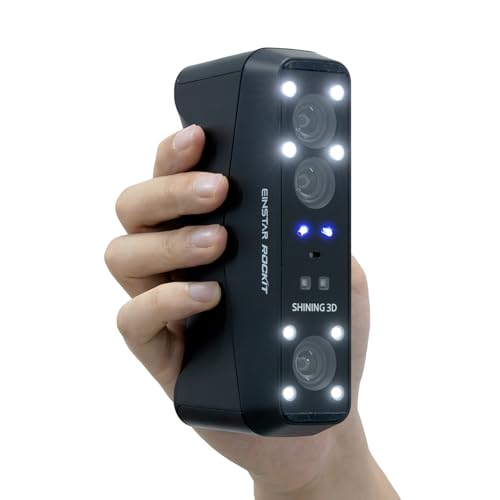
- 38 blue laser lines plus 7 parallel lines for speed and detail.
- Marker-free scanning with strong support for black and reflective surfaces.
- True wireless design with Wi‑Fi, swappable battery, and outdoor-ready use.
Best For: Automotive components, industrial parts, and outdoor scanning
Portable Accuracy Pick
Creality CR-Ferret SE for Simple, Clean Scans

- 0.1mm precision with anti-shake capture for steadier results.
- Scans dark and metallic objects without spray or markers.
- 105g design with one-click scanning and 24-bit color capture.
Best For: Beginners and small workshops scanning tricky dark or metallic parts
Reverse Engineering All-Rounder
Fox AI SLAM Scanner for Mixed-Sized Parts

- Up to 0.07mm accuracy with 0.10mm resolution.
- Scans objects from 40mm to 1200mm with marker-free AI SLAM tracking.
- One-click processing and broad export options for CAD and 3D printing.
Best For: Reverse engineering, 3D printing prep, and mixed-size object scanning
Precision Laser Pick – Creality CR-Scan Raptor for fine-detail reverse engineering
If you need a 3D scanner for reverse engineering parts, the CR-Scan Raptor is built for detail-first work where edge clarity and small features matter. Its 7 parallel blue laser lines, 0.02 mm claimed accuracy, and 60 fps blue-light mode make it a strong fit for capturing precise geometry on parts from tiny components up to larger objects.
Best For: Users who want high-precision scanning for part reconstruction, small mechanical components, and mixed-size projects.
Pros:
- 0.02 mm accuracy and 0.1 mm laser lines support sharp detail capture.
- Blue laser mode plus NIR gives flexibility for marker-based and marker-free scans.
- Scans objects from 5 mm to 2000 mm, covering many reverse-engineering use cases.
- Class 1 blue light and anti-shake tracking are helpful for controlled scanning sessions.
Cons:
- Requires a fairly strong PC or Mac setup to run properly.
- Infrared mode is better suited to some scenarios than others, so setup may vary by subject.
For reverse engineering where fine detail and scan speed both matter, this model is aimed at demanding users rather than casual hobby work. It is especially appealing if you regularly work with parts that need clean geometry and consistent tracking.
Surface Prep Essential – AESUB White permanent scanning spray
For a 3D scanner for reverse engineering parts, surface prep can make or break the scan, especially on glossy or low-contrast materials. AESUB White is a permanent scanning spray designed to create a homogeneous coating with strong contrast, helping scanners read difficult surfaces more reliably.
Best For: Scanning glossy, reflective, or low-contrast parts that need a consistent matte layer.
Pros:
- Creates a very homogeneous coating for better scan contrast.
- Approximate 7 µm layer thickness helps keep the coating thin.
- Designed for easy cleaning with water, a towel, and a soft brush.
- Optimized material compatibility for broader part handling.
Cons:
- It is a permanent spray, so coated parts need to be cleaned or disposed after scanning.
- Not a scanner itself, so it is only useful as an accessory.
This is a practical add-on for anyone who scans parts with challenging surfaces. If your reverse-engineering workflow includes shiny plastics, metal, or other hard-to-read finishes, this spray can improve data quality before the scan even begins.
All-Round Scanner – Creality CR-Scan Otter for flexible part capture
The CR-Scan Otter is a versatile 3D scanner for reverse engineering parts when you need one tool for both small features and large assemblies. Its dual-lens system, 10 mm to 2000 mm size range, and support for black or metal objects without spray make it a practical choice for mixed workshop scanning.
Best For: Users who need a flexible handheld scanner for parts, prototypes, and larger objects with mixed surface types.
Pros:
- Dual lenses and stereo depth cameras support detailed scans across a wide size range.
- Can scan black and metal objects without scanning spray, including car parts and tires.
- Up to 20 fps scanning with One-Shot imaging helps stabilize tracking.
- Works with Windows, macOS, iOS, and Android workflows with the right accessories.
Cons:
- Some mobile use cases require accessories for proper wireless scanning.
- Performance requirements are fairly demanding for reliable operation.
If you reverse engineer a variety of parts rather than a single type of object, the Otter offers broad coverage and solid material flexibility. It is especially useful when you want to avoid spray on dark or metallic surfaces and keep your workflow moving.
Scan Assist Pick – Revopoint Auto Turntable with marked top cover
When using a 3D scanner for reverse engineering parts, a stable turntable can simplify small-object capture by keeping the subject moving instead of the scanner. Revopoint’s Auto Turntable is designed for small to medium objects, and its marked top cover helps make featureless parts easier to scan.
Best For: Scanning small to medium parts with less manual repositioning and easier marker-based alignment.
Pros:
- Lets you scan without moving the scanner around the object.
- Lightweight 315 g design is easy to carry and set up.
- Supports up to 2.5 kg, which suits many small to medium parts.
- Marked topper with pre-placed points helps with featureless objects.
Cons:
- It is an accessory, not a standalone scanner.
- Compatibility is limited to Revopoint 3D scanners.
This is a useful workflow upgrade if you scan compact parts often and want smoother, more repeatable results. It is most compelling for users already in the Revopoint ecosystem who want easier handling of featureless objects.
Industrial Reverse Engineering Scanner – Revopoint MetroY Ultra
If you need a 3d scanner for reverse engineering parts with tight tolerances, the MetroY Ultra is built for detailed capture and fast turnaround. Its blue laser modes, marker-free structured light, and no-spray support make it practical for small to medium industrial components, including dark or shiny surfaces.
Best For: Industrial users scanning precise parts for reverse engineering, inspection, and 3D printing workflows.
Pros:
- Up to 0.01 mm single-frame precision and 0.015 + 0.04 mm x L(m) volumetric accuracy
- Five scanning modes cover rapid scans, fine details, deep holes, and automatic turntable use
- Handles black, glossy, and metallic parts without scanning spray
- Wi-Fi 6, battery grip, and outdoor-capable laser scanning add field flexibility
Cons:
- Minimum system requirements are fairly demanding, especially on Windows
- Best suited to small and medium objects rather than very large parts
The MetroY Ultra stands out when accuracy and workflow speed matter more than a casual plug-and-play setup. For reverse engineering parts in industrial settings, it offers a strong mix of precision, surface handling, and software export options.
Marker Prep Kit – Revopoint 6-Piece Magnetic Dome Markers
Good scan prep matters when using a 3d scanner for reverse engineering parts, especially on featureless or complex shapes. This 6-piece magnetic dome marker kit is designed to improve tracking accuracy and reduce tracking loss by giving the scanner reliable reference points during capture.
Best For: Preparing smooth or complex parts for more stable scanning and better marker tracking.
Pros:
- Helps improve marker tracking accuracy on featureless objects
- Reduces tracking loss for small or complex parts
- Reusable magnetic bases make setup quick on flat surfaces
- Compatible with a wide range of Revopoint scanners
Cons:
- It is an accessory, not a scanner
- Works best on flat attachment surfaces such as tabletops or panels
If your reverse engineering work involves difficult surfaces, these markers can make the scanning process more stable and repeatable. They are a practical add-on for users who want cleaner tracking before processing the model.
Photogrammetry 3D Scanner – Revopoint MIRACO Plus
The MIRACO Plus is a strong option if you want a 3d scanner for reverse engineering parts that can handle both small details and larger assemblies. Its photogrammetric metrology kit, quad depth cameras, and high-accuracy calibration board are aimed at more demanding measurement and scan-to-CAD workflows.
Best For: Users who need portable, high-accuracy scanning with photogrammetry support for product design and reverse engineering.
Pros:
- Photogrammetric metrology kit includes scale bars and coded targets for complex measurements
- Claims 0.02 mm + 0.05 mm x L(m) photogrammetric length accuracy
- Quad depth cameras and near/far modes cover tiny screws to large machinery
- Built-in hardware includes 32GB RAM, Wi-Fi 6, USB-C, and a 2K AMOLED flip screen
Cons:
- Revo Design is sold separately for scan-to-CAD conversion
- Battery life is up to 2 hours of continuous scanning
- Some software features are limited to x86-compatible systems
For users who want a mobile scanner with measurement-focused tooling, the MIRACO Plus offers a versatile balance of accuracy and convenience. It is especially appealing when reverse engineering work needs both detailed capture and organized photogrammetric workflow support.
Wireless Laser Scanner – EINSTAR Rockit for Fast, Flexible Scans
If you want a 3d scanner for reverse engineering parts that can move quickly across larger objects, the EINSTAR Rockit is built around speed, mobility, and material flexibility. Its blue laser modes support marker-free scanning, while the wireless design and swappable battery make it easier to scan parts in the shop or on-site without cable clutter.
Best For: Automotive components, industrial parts, and outdoor scanning when you need marker-free workflow and true wireless use.
Pros:
- 38 blue laser lines plus 7 parallel lines for fast capture and finer detail.
- Marker-free laser scanning reduces prep time on feature-rich parts.
- True wireless operation with built-in Wi-Fi and up to 3 hours of battery life.
- Handles black and reflective surfaces without spray, and supports deep-hole scanning.
Cons:
- Recommended system memory is 64 GB or more.
- Wireless use can fall back to cable connection if Wi-Fi interference occurs.
Overall, the Rockit is the most mobility-focused option here, especially if you need a scanner that can keep up with larger parts, bright environments, and workflow speed without relying on markers.
Portable Accuracy Pick – Creality CR-Ferret SE for Simple, Clean Scans
The Creality CR-Ferret SE is a practical 3d scanner for reverse engineering parts if you want a simple, lightweight setup with dependable precision. It combines anti-shake capture, dark-and-metallic object support, and full-color scanning in a compact body that is easy to carry from desk to workshop.
Best For: Beginners, small workshops, and users scanning dark or metallic parts without spray or markers.
Pros:
- 0.1mm precision with anti-shake technology for steadier scans.
- Scans black, dark, and metallic objects without spray or markers.
- 24-bit full-color capture with a built-in 2MP color camera.
- Very portable at 105g and designed for one-click scanning.
Cons:
- Positioned more as a desktop-friendly scanner than a high-mobility field unit.
- Less emphasis on advanced reverse-engineering workflows than the more industrial models.
In practice, the CR-Ferret SE is a straightforward choice when you want accurate scans without a complicated learning curve, especially for mixed-material objects that are often troublesome for basic scanners.
Reverse Engineering All-Rounder – Fox AI SLAM Scanner for Mixed-Sized Parts
The Fox is a strong fit if you need a 3d scanner for reverse engineering parts across a wide size range, from small mechanical pieces to larger objects. Its 0.07mm accuracy, marker-free AI SLAM tracking, and one-click processing make it appealing for users who want detailed scans without spending extra time on setup or cleanup.
Best For: Reverse engineering, 3D printing prep, and scanning everything from small parts to full-size objects.
Pros:
- Up to 0.07mm accuracy and 0.10mm resolution for detailed geometry.
- Scans objects from 40mm to 1200mm, covering both small and large parts.
- AI SLAM tracking reduces marker use and can re-lock after tracking interruptions.
- One-click processing helps turn raw scans into printable models faster.
Cons:
- Requires a compatible Windows or macOS computer for operation.
- Only claims improved performance on many matte dark and low-reflective surfaces, not universal surface compatibility.
For buyers comparing compact scanners for engineering work, the Fox stands out for balancing precision, scan range, and automated software tools in a package that still stays beginner friendly.
How We Picked the Best 3d Scanner for Reverse Engineering Parts
We prioritized scanners and supporting accessories that matter most in reverse engineering: measurement accuracy, stable tracking, capture speed, usable scan range, and surface adaptability. We also considered whether a device is practical for real workshop use, including portability, ease of setup, and whether it can handle parts that are small, reflective, dark, or textured.
Quick Comparison
If you want the shortest path to a decision, think in terms of workflow. Handheld scanners are better for larger or complex shapes. Desktop or turntable-based setups are useful for smaller parts with repeatable positioning. Scanning sprays and marker kits can improve capture quality when surfaces are glossy or feature-poor. If you need a 3d Scanner for Reverse Engineering Parts, the right accessories can matter almost as much as the scanner itself.
Key Buying Factors for a 3d Scanner for Reverse Engineering Parts
Accuracy and Repeatability
Look for stated accuracy that matches your part tolerance needs, but also pay attention to repeatability and tracking stability. A scanner that is theoretically precise but struggles to maintain alignment will create more cleanup work.
Part Size and Working Distance
Choose a scanner with a range that fits the parts you actually reverse engineer. Small components benefit from close-range detail capture, while larger parts need wider coverage and fewer tracking dropouts.
Surface Type
Shiny metals, black plastics, clear parts, and low-texture surfaces can all be difficult to scan. In those cases, scanning spray, markers, or a laser-based system may improve results significantly.
Software and Export Workflow
Good hardware is only half the story. Check whether the scanner’s software offers clean alignment, easy mesh cleanup, and exports that fit your CAD or inspection workflow. Faster post-processing usually matters more than flashy feature lists.
Mobility Vs. Control
Portable handheld scanners are flexible and efficient for larger jobs, while turntables and desktop setups offer more control for small parts. If you often scan both, consider a system that can support mixed workflows.
Who Should Buy Which 3d Scanner for Reverse Engineering Parts?
Buy a high-accuracy handheld scanner if you need flexible capture across different part sizes and shapes. Choose a desktop or turntable setup if your work centers on smaller mechanical components and you want repeatable scans. Pick scanning spray or markers if your current problem is surface reflection or poor tracking rather than raw scanner performance. For buyers building a complete reverse-engineering kit, combining a capable scanner with the right accessories is often the most cost-effective approach.