
Choosing the right printer for architectural models is about more than speed. You need clean detail, accurate dimensions, dependable first layers, and a build volume that matches the scale of your projects.
This roundup of the best 3D printers for architectural models in 2026 focuses on machines that balance precision, ease of use, and the flexibility to handle everything from small concept studies to larger presentation pieces.
Best 10 3d Printers for Architectural Models Picks for 2026
Large-Format Farm Workhorse
Creality Ender 5 Max for Oversized Architectural Models

- 400×400×400 mm build volume suits large architectural parts
- Up to 700 mm/s speed supports faster production runs
- Auto leveling and dual-gear extrusion help maintain consistency
Best For: Oversized models, batch parts, and print-farm workflows
Beginner-Friendly Precision
Bambu Lab A1 for Clean Architectural Models

- Full-auto calibration reduces setup effort
- High acceleration supports fast, detailed prints
- Quiet operation works well in shared spaces
Best For: New users and small architectural presentation models
Large-Scale Speed Runner
Sovol SV08 Max for Big Architectural Prototypes
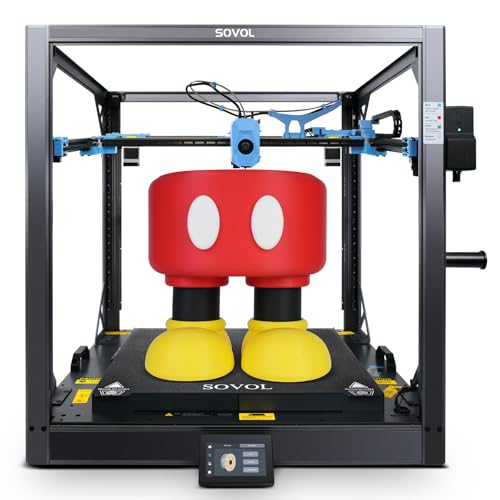
- 500×500×500 mm build volume for oversized models
- 700 mm/s speed with high acceleration for faster turnaround
- Eddy current leveling helps with consistent first layers
Best For: Very large prototypes and high-volume architectural builds
Multi-Material Detail Builder
Flashforge Creator 5 Pro for Presentation Models

- Four toolheads reduce purge waste for color changes
- 65°C chamber helps limit warping on advanced filaments
- CoreXY motion supports up to 600 mm/s printing
Best For: Multi-color presentation models and controlled material printing
Continuous-Print Pick
IdeaFormer IR3 V2 for Continuous Printing

- Infinite Z-axis conveyor belt for nonstop output
- 250×250×∞mm format for long model sections
- Auto leveling plus Klipper up to 400mm/s
Best For: Long architectural parts, batches, and production-style model runs
Fast Enclosed Pick
Bambu Lab P1S Ready-to-Use Printer

- Up to 500mm/s speed with 20000 mm/s² acceleration
- Enclosed design and auto bed leveling
- AMS support for up to 16 colors
Best For: Fast, easy-to-use model printing with optional multicolor output
Multicolor Smart Pick
Creality K2 Combo for Detailed Models

- Up to 16 colors with CFS support
- 600mm/s speed with smart auto leveling
- 95% pre-assembled for quick setup
Best For: Multicolor architectural models and fast, automated model workflows
Large-Format Prototyping Pick
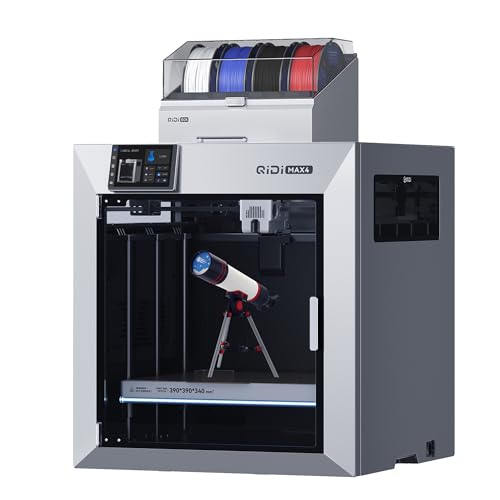
- 390×390×340mm build volume for oversized models
- 65℃ heated chamber helps cut warping
- AI camera and closed-loop motion for stable printing
Best For: Large architectural models and advanced workshop prototyping
Fast Multi-Color Value
FLASHFORGE AD5X Multi-Color 3D Printer

- Up to 4-color printing for presentation models
- 600mm/s CoreXY speed with auto leveling
- 0.25mm to 0.8mm nozzle options for detail or speed
Best For: Fast, colorful architectural concept models
High-Volume Precision Pick

- 300×300×300mm build area for larger models
- 60 °C chamber heating helps reduce warping
- 600mm/s speed with dual AI monitoring
Best For: Medium-to-large architectural models and stable prototyping
Large-Format Farm Workhorse – Creality Ender 5 Max for Oversized Architectural Models
If you need one of the most capable 3d printers for architectural models, the Creality Ender 5 Max is built for large-scale parts, fast turnaround, and repeatable production. Its 400×400×400 mm build volume gives you room for bigger building masses, site models, or multiple components in one job, while the CoreXY system and rigid frame are aimed at keeping those larger prints stable.
Best For: Studios, model makers, and print-farm users who need oversized architectural pieces and reliable batch production.
Pros:
- Extra-large 400×400×400 mm build volume for bigger models or multiple parts per run
- Fast CoreXY motion with up to 700 mm/s printing speed for higher throughput
- 64-point auto leveling and auto Z-offset simplify first-layer setup
- All-metal frame, linear rail, and dual-gear extruder support stable, repeatable printing
Cons:
- Large footprint and 68.9-pound weight make it less portable
- Clearly geared toward production workflows rather than compact desktop use
For architectural work that needs size and speed more than compact convenience, the Ender 5 Max stands out as a high-output option. It looks especially useful when you want to reduce slicing into multiple sections and keep a production line moving.
Beginner-Friendly Precision – Bambu Lab A1 for Clean Architectural Models
The Bambu Lab A1 is a practical pick if you want 3d printers for architectural models with a simple setup and accurate day-to-day output. Its full-auto calibration, active flow rate compensation, and high-speed motion make it appealing for smaller presentation models, concept pieces, and detailed parts where ease of use matters.
Best For: Beginners, students, and hobbyists who want an easy-to-use printer for smaller architectural models.
Pros:
- Full-auto calibration handles bed leveling, Z-offset, and setup automatically
- High acceleration and precision help produce detailed prints quickly
- Quiet operation makes it easier to use in a home, studio, or classroom
- AMS lite support enables multi-color printing for presentation-ready models
Cons:
- Build volume is not as large as dedicated large-format machines
- AMS lite is required for multi-color printing and sold separately unless bundled
If your architectural workflow values simplicity over maximum size, the A1 is easy to recommend. It is especially appealing for users who want to spend less time calibrating and more time iterating on models.
Large-Scale Speed Runner – Sovol SV08 Max for Big Architectural Prototypes
For buyers comparing 3d printers for architectural models, the Sovol SV08 Max is aimed squarely at large-format work that still needs speed. Its 500×500×500 mm build space, 700 mm/s motion, and high-flow nozzle make it a strong fit for oversized prototypes, large massing studies, and multi-part architectural fabrication.
Best For: Architectural teams needing very large build volume, fast output, and advanced material support.
Pros:
- Huge 500×500×500 mm build volume handles oversized architectural models
- Up to 700 mm/s speed and 40,000 mm/s² acceleration reduce wait time
- Eddy current scanning and pressure-sensing points support accurate first layers
- 300°C hotend expands material options, including PLA, PETG, ABS, ASA, PA, and CF blends
Cons:
- Large machine size may be impractical for small desks or tight studios
- Heated chamber support requires a separate future upgrade
The SV08 Max is best viewed as a production-minded tool for bigger architectural jobs. If scale is your top priority and you want speed to match, this model is one of the strongest large-format choices here.
Multi-Material Detail Builder – Flashforge Creator 5 Pro for Presentation Models
The FLASHFORGE Creator 5 Pro is a more specialized option for 3d printers for architectural models when you want multi-material capability, cleaner color changes, and enclosed printing control. Its four independent toolheads and near-zero waste switching system are well suited to presentation pieces, branded displays, and complex parts where finish quality matters.
Best For: Architectural studios that need multi-material or multi-color presentation models with controlled printing.
Pros:
- Four independent toolheads and FlashSwap reduce purge waste during color changes
- 65°C heated chamber helps reduce warping with advanced filaments
- CoreXY structure and linear rails support up to 600 mm/s printing speed
- Built-in camera, remote control, and calibration features improve monitoring and setup
Cons:
- More specialized than a basic single-toolhead printer
- Smaller overall size than large-format machines for big one-piece models
This printer makes the most sense when presentation quality and material flexibility matter as much as speed. For polished architectural mockups, it offers a capable mix of control, efficiency, and enclosure-based stability.
Continuous-Print Pick – IdeaFormer IR3 V2 for Continuous Printing
If you’re comparing 3d printers for architectural models, the IdeaFormer IR3 V2 stands out for continuous, long-part output thanks to its conveyor belt and infinite Z-axis design. It’s built for jobs where you want to keep printing without frequent resets, and the 250×250×∞mm format is well suited to extended structural pieces, model sections, and production-style batches.
Best For: Users who need nonstop printing for long architectural components, prototypes, and repeated model runs.
Pros:
- Infinite Z-axis conveyor belt enables continuous printing for long models and batches.
- Large 250×250×∞mm format supports extended parts and support-free complex overhangs.
- One-click auto calibration and Y-offset strain sensor simplify setup.
- Klipper firmware and up to 400mm/s speed support efficient, stable printing.
Cons:
- Conveyor-belt printing is more specialized than a standard bed-slinger workflow.
- Best suited to users who can take advantage of long, continuous prints.
For architectural model work that involves long sections, repeated runs, or unusual geometry, this printer offers a distinctive production-oriented approach. Its speed, auto-leveling, and broad filament support make it a practical pick when continuous output matters more than traditional desktop simplicity.
Fast Enclosed Pick – Bambu Lab P1S Ready-to-Use Printer
For shoppers looking at 3d printers for architectural models, the Bambu Lab P1S is a strong all-around option if you want fast turnaround and a simple setup. Its enclosed design, automatic bed leveling, and ready-to-use format make it appealing for detailed model parts, display pieces, and multi-material presentation work.
Best For: Model makers who want a fast, enclosed printer with easy setup and optional multi-color printing.
Pros:
- Up to 500mm/s speed and 20000 mm/s² acceleration for fast prints.
- Fully enclosed body helps improve results with advanced filaments.
- Automatic bed leveling reduces setup hassle and supports successful prints.
- AMS support enables up to 16 colors when you add the system.
Cons:
- Multi-color printing requires connecting Bambu Lab AMS.
- Carbon/glass fiber reinforced polymers are not recommended.
The P1S is a practical choice when you want a dependable printer that gets to work quickly and handles a wide range of common filaments. For architectural models, its speed and enclosed build can be especially useful for producing clean parts and presentation-ready pieces without a long setup process.
Multicolor Smart Pick – Creality K2 Combo for Detailed Models
If you want 3d printers for architectural models that can handle presentation pieces as well as functional prototypes, the Creality K2 Combo brings speed, automation, and multicolor capability into one package. With a 260×260×260mm build volume, smart auto leveling, and a pre-assembled design, it fits users who want a more turnkey workflow for detailed output.
Best For: Makers who want multicolor architectural models with fast setup, strong automation, and high-speed printing.
Pros:
- Up to 16-color printing with CFS support for more presentation-ready models.
- 600mm/s printing speed and sturdy step-servo motion system.
- Smart auto leveling targets only the relevant print area for faster calibration.
- 95% pre-assembled for a more plug-and-play setup.
Cons:
- Multicolor printing requires CFS hardware, and the combo includes only one unit.
- At 260×260×260mm, the build volume is solid but not oversized.
The K2 Combo is a strong fit for users who want a fast, automated printer that can also add color to architectural displays. Its AI camera, quiet mode, and wide material support make it a versatile option for model making where efficiency and finish both matter.
Large-Format Prototyping Pick – QIDI Max4 Combo 3D Printer
If you need 3d printers for architectural models that can handle oversized floor plates, massing studies, or complex presentation pieces in one print, the QIDI Max4 Combo stands out for sheer build size. Its 390×390×340mm volume and heated chamber make it a strong fit when you want large parts with fewer splits and reduced warping.
Best For: Architects, model makers, and advanced users printing large-scale architectural concepts, prototypes, and display models.
Pros:
- Very large 390×390×340mm build volume for big model components or full assemblies.
- 65℃ active heated chamber and full-surface heated bed help improve adhesion and reduce warping.
- Closed-loop motors, lead screw Z-axis, and anti-backlash nut are aimed at smoother, more precise output.
- AI camera can detect print issues and pause automatically to save material.
Cons:
- Large footprint and 120 lb weight make it a less convenient desktop option.
- Polar Cooler is not included and must be purchased separately for supported use cases.
- Multi-color printing requires connection to the QIDI BOX, which is not built into the printer itself.
For architectural modeling, this machine is strongest when size and material flexibility matter more than compactness. It is better suited to serious workshop setups than casual desktop use.
Fast Multi-Color Value – FLASHFORGE AD5X Multi-Color 3D Printer
For 3d printers for architectural models where speed, detail control, and multi-color presentation matter, the FLASHFORGE AD5X is a practical option. Its CoreXY design, 600mm/s top speed, and nozzle choices give you flexibility for quick concept models as well as finer-detail display work.
Best For: Users who want fast architectural concept prints, multi-color presentation models, and easy day-to-day operation.
Pros:
- Supports up to 4 colors simultaneously for more presentation-ready architectural models.
- CoreXY motion system reaches up to 600mm/s with 20,000mm/s² acceleration.
- 1-click auto leveling simplifies setup and helps with consistent first layers.
- Four nozzle size options, including a pre-installed 0.4mm nozzle and optional 0.25mm for finer detail.
Cons:
- 220×220×220mm build volume is smaller than large-format printers.
- Best for efficient models and parts, but not ideal for oversized architectural assemblies.
- Multi-color capability may be more than some users need for basic monochrome drafting models.
This is a good fit when you want fast turnaround and visual impact without stepping up to a massive machine. It balances speed and usability well for smaller architectural pieces and presentation models.
High-Volume Precision Pick – Creality K2 Pro 3D Printer
If you’re comparing 3d printers for architectural models and want a blend of build space, speed, and material support, the Creality K2 Pro is a well-rounded choice. Its 300×300×300mm volume, active chamber heating, and dual AI cameras make it a strong option for consistent prints in more demanding materials.
Best For: Users printing medium-to-large architectural models, multi-part assemblies, and material-rich prototypes.
Pros:
- 300×300×300mm build volume gives you room for substantial architectural models or multiple parts.
- 600mm/s speed with 20,000mm/s² acceleration supports fast turnaround.
- Active chamber heating up to 60 °C helps reduce warping and cracking with advanced filaments.
- Dual AI cameras, auto leveling, and filament handling features support monitored, reliable printing.
Cons:
- Smaller than ultra-large-format printers if you need very big one-piece models.
- Multi-color printing depends on compatibility with the CFS Smart Filament System.
- Advanced feature set may be more than basic PLA-only workflows require.
Overall, the K2 Pro is a strong middle-ground machine for architectural workflows that need speed and stability. It fits teams that want reliable production without jumping to a massive industrial footprint.
How We Picked the Best 3d Printers for Architectural Models
We focused on 3d Printers for Architectural Models that can produce sharp edges, consistent wall thickness, and stable dimensional accuracy. Priority also went to printers with practical build volumes, strong bed leveling systems, enclosed or temperature-controlled options for better part consistency, and speeds that do not sacrifice quality.
Quick Comparison
For most studios, the best choice depends on the type of model you produce. Smaller desktop printers are ideal for detailed massing studies and facade samples, while larger-format machines are better for site models, campus layouts, and multi-part assemblies. Multi-color systems can also help when you want to distinguish materials, levels, or phases without post-processing.
Key Buying Factors for 3d Printers for Architectural Models
Build Volume
Choose a build area that matches your common model scale. A larger bed reduces slicing and assembly work, but compact printers can still be excellent for fine-detail components and repeated parts.
Dimensional Accuracy
Architectural work depends on clean geometry. Look for strong auto-leveling, rigid frames, and stable motion systems so openings, grids, and joints print consistently.
Material and Chamber Control
PLA is often the easiest material for presentation models, but enclosed printers with heated chambers are helpful when you need stronger parts, better surface quality, or more demanding filaments for functional mockups.
Speed Vs. Surface Finish
Fast printing is useful for iterative design, but only if the machine can preserve fine details. For exhibit-quality models, prioritize reliable extrusion and layer consistency over headline speed alone.
Who Should Buy Which 3d Printers for Architectural Models?
If you want the simplest path for everyday model work, pick a beginner-friendly printer with strong calibration and dependable output. If your projects are large or repeated often, go with a bigger build volume and a sturdy frame. If your workflow includes presentation-ready color coding or material separation, a multi-material system may be worth the extra cost. For studios that need 3d Printers for Architectural Models with both speed and precision, the best option is usually the one that matches your most common scale, not the biggest or fastest machine on paper.