
Choosing among video distribution amplifiers for home studios can be confusing because similarly named products may serve very different signal types. RCA, BNC, coax, antenna, and home-theater amplifiers are not automatically interchangeable.
This roundup compares ten distribution-focused options and related signal equipment, emphasizing output count, compatibility, signal handling, installation needs, and realistic home-studio use cases.
Best 10 Video Distribution Amplifiers for Home Studios Picks for 2026
Broadcast-Ready Pick
ClearStream JUICE4 Distribution Amplifier

- Four outputs for antenna or CATV signals
- Supports ATSC 3.0, 4K, and 8K UHD
- Compact 75-ohm RF design with included RG6 cable
Best For: Antenna and CATV signal distribution
Audio Routing Alternative

- Distributes one or two RCA stereo inputs
- Four outputs with up to +15 dB gain
- Independent volume controls and metal housing
Best For: Analog audio routing beside a video setup
Long-Run CCTV Booster

- Supports AHD, CVI, TVI, and analog CCTV
- Rated for coaxial runs up to 2,600 feet
- Plug-and-play design for compatible BNC systems
Best For: Long-distance CCTV video transmission
Compact 5-Channel Pick
Pyle PFA540BT.6 Audio Amplifier

- Bluetooth streaming from common devices
- HDMI, AUX, and subwoofer connectivity
- Compact 5-channel surround receiver
Best For: Small home studios adding amplified surround audio to a consumer AV setup
Cable-TV Distribution Pick
Reliable Cable Products VRA900B/AC
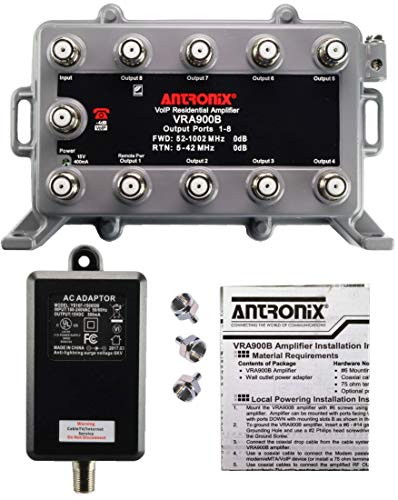
- Eight amplified coaxial outputs
- Active return supports cable services
- Surge-protected corrosion-resistant housing
Best For: Studios distributing standard cable TV over multiple coaxial runs
Surround Audio Alternative
Pyle PFA560BT Home Theater Receiver
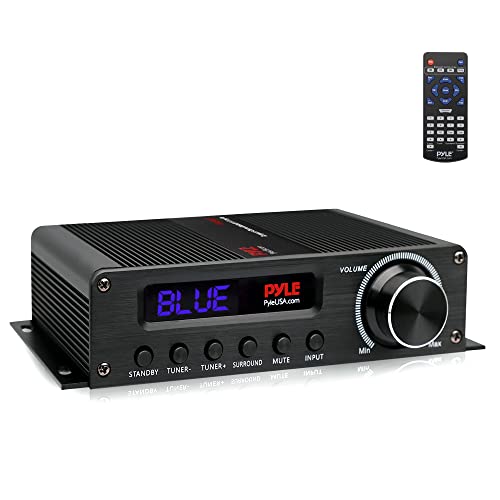
- 5.1-channel audio amplification
- Bluetooth, HDMI, RCA, and subwoofer output
- Remote and front-panel controls
Best For: Home studios needing compact surround audio for video playback
Eight-Port OTA Distribution Pick
8-Port TV Antenna Signal Splitter

- Feeds up to eight devices from one line
- Provides +4 dB per-port boost
- Compact design with included power supply
Best For: Large multi-screen OTA or cable setups
High-Gain Four-Port Pick
Antronix MRA4-8 Signal Amplifier

- Distributes one feed to four outputs
- Provides +7.5 dB per-port gain
- Includes passive return and surge protection
Best For: Smaller cable or OTA setups needing higher per-port gain
Compact RCA Choice – 1-to-4 Video Amplifier
For home studios using composite video, this compact unit is one of the more straightforward video distribution amplifiers for home studios. It accepts one RCA video source and replicates it across four outputs, with a 12V power adapter and adjustable output level.
Best For: Mirroring one RCA video source to up to four compatible displays.
Pros:
- Distributes one RCA input to four outputs simultaneously.
- Adjustable level helps accommodate different output requirements.
- Compact metal design with LED power indicator.
- Designed to preserve the source’s high-definition color television signal during distribution.
Cons:
- Limited to RCA composite video connections.
- Requires a 12V DC power adapter and separate RCA cables.
- Not intended for modern HDMI-based studio workflows.
This is a practical fit when your setup relies on legacy composite video and needs several identical feeds. Its small footprint is convenient, but connection compatibility should be checked before buying.
Broadcast-Ready Pick – ClearStream JUICE4 Distribution Amplifier
The ClearStream JUICE4 is aimed at RF and antenna systems rather than camera or HDMI setups. Among video distribution amplifiers for home studios, it makes sense when you need to distribute an over-the-air or CATV signal to four televisions or compatible devices while supporting newer broadcast standards.
Best For: Splitting antenna, CATV, or cable broadband signals to four TV outputs.
Pros:
- Four-output design supports up to four TVs or digital converter boxes.
- Supports ATSC 3.0, 4K, and 8K UHD applications.
- Compact housing can be used indoors or outdoors with the stated weather-protection accessories.
- Provides gain across its operating frequency range with a low noise figure below 3 dB.
Cons:
- Designed for 75-ohm RF, antenna, and CATV connections rather than studio baseband video.
- Reception still depends on tower distance, obstructions, and building materials.
- Includes a 90-day parts warranty.
Choose this model when your studio or media room distributes broadcast RF, not when you need to duplicate an RCA or HDMI source. Its included RG6 cable and power adapter make the package relatively easy to deploy.
Audio Routing Alternative – 2-In/4-Out RCA Distributor
Although it is an audio product, this RCA distributor can complement video distribution amplifiers for home studios by handling the associated stereo signal path. It accepts one or two RCA L/R inputs, routes them to four outputs, and adds independent level controls for flexible monitoring or speaker setups.
Best For: Distributing and mixing analog RCA stereo audio alongside a separate video system.
Pros:
- Routes one or two RCA L/R inputs to four outputs.
- Built-in amplification provides up to +15 dB of gain.
- Independent volume controls support separate level adjustment.
- Metal housing and shielded RCA ports are designed to reduce hum and interference.
Cons:
- It distributes audio, not video.
- RCA L/R connectivity is unsuitable for HDMI, SDI, or digital audio workflows.
- Adding gain requires careful level setting to avoid an unsuitable signal level.
This is best viewed as a companion component for a home studio, not as a video splitter. Its two-input mixing function is useful for simple analog monitoring, podcasting, or speaker-routing arrangements.
Long-Run CCTV Booster – BNC Video Amplifier
This BNC amplifier targets surveillance installations with long coaxial runs. It is a specialized option within video distribution amplifiers for home studios when the studio includes AHD, CVI, TVI, or analog CCTV cameras and needs to address signal loss over distances of up to 2,600 feet.
Best For: Boosting compatible CCTV video over extended coaxial cable runs.
Pros:
- Supports AHD, CVI, TVI, and analog CCTV camera formats.
- Rated for transmission distances up to 2,600 feet.
- Designed to support 1080P signals with minimal loss.
- Plug-and-play coaxial installation with a compact, durable build.
Cons:
- Built for BNC/coax CCTV systems rather than general-purpose RCA or HDMI distribution.
- Does not provide multiple video outputs according to the supplied details.
- Its usefulness depends on compatible camera formats and cabling.
For a surveillance-focused studio, this can help recover clarity on long coaxial links. It is not a general home-theater splitter, so verify the camera standard and BNC installation requirements first.
Compact 5-Channel Pick – Pyle PFA540BT.6 Audio Amplifier
For home studios that also handle movie playback, the Pyle PFA540BT.6 is a compact audio receiver with Bluetooth, HDMI inputs, AUX connectivity, and five speaker-terminal sets. It is better suited to distributing and amplifying audio to a surround setup than to professional video signal routing, so confirm that your studio workflow only needs audio amplification.
Best For: Home studios needing a small, Bluetooth-equipped amplifier for surround audio and multiple consumer sources.
Pros:
- Bluetooth supports wireless streaming from phones, tablets, laptops, and computers.
- Offers two HDMI inputs, an HDMI output, AUX RCA inputs, and a subwoofer output.
- Includes a remote, 12V adapter, LCD display, and front-panel controls.
Cons:
- Its listed 100-watt rating is peak power, not a stated continuous studio-output specification.
- It is an audio amplifier, not a dedicated multi-output video distribution amplifier.
- Spring-loaded speaker terminals may be less convenient than pro-style connectors.
The PFA540BT.6 makes sense when your “video distribution amplifiers for home studios” setup primarily needs flexible source connection and amplified surround audio in a compact enclosure. Choose a dedicated video distribution unit separately if you need replicated video outputs.
Cable-TV Distribution Pick – Reliable Cable Products VRA900B/AC
The Reliable Cable Products VRA900B/AC is the closest match here to an RF distribution amplifier for a studio with cable-based video feeds. It provides eight amplified outputs with active return, but its coaxial design is intended for standard cable TV services rather than HDMI studio routing, OTA antennas, or satellite systems.
Best For: Home studios distributing cable TV and related RF services across multiple coaxial destinations.
Pros:
- Provides eight amplified output ports with lossless forward and reverse paths.
- Supports standard and digital cable services, including triple-play phone service.
- Includes surge protection, a corrosion-resistant housing, and auto-seizing F-ports.
- A modem port can preserve VoIP service connectivity during a power failure.
Cons:
- Not recommended for OTA antennas and not compatible with satellite systems.
- Not MoCA capable and may not work with cable systems requiring MoCA.
- Connection cables are not included.
For coaxial cable distribution, this unit offers useful port capacity and protection features. It should not be treated as a general-purpose video distribution amplifier: verify your source type, cable provider requirements, and MoCA needs before choosing it.
Surround Audio Alternative – Pyle PFA560BT Home Theater Receiver
The Pyle PFA560BT is a compact 5.1-channel receiver for home studios that need to amplify audio accompanying video work. With Bluetooth, HDMI input and output, RCA connectivity, a subwoofer output, and five speaker-terminal sets, it can centralize several consumer sources, though it does not replace a dedicated video distribution amplifier.
Best For: Home studios building an affordable 5.1-channel monitoring or home-theater-style audio system.
Pros:
- Supports Bluetooth streaming from computers, phones, and tablets.
- Includes HDMI connectivity, AUX RCA inputs, an RCA subwoofer output, and an FM antenna input.
- Provides front-panel input, surround, mute, tuner, and volume controls.
- Comes with a remote and 12V adapter.
Cons:
- The stated 100-watt output is a peak rating.
- It amplifies and switches audio rather than distributing duplicated video signals.
- Its one-year warranty is shorter than the two-year amplifier warranty listed for the cable-TV distribution option.
The PFA560BT is a practical audio-side companion for a video studio, especially when 5.1 playback and wireless streaming matter. Pair it with a purpose-built video distribution device if your workflow requires sending one video source to multiple displays or capture destinations.
Eight-Port OTA Distribution Pick – 8-Port TV Antenna Signal Splitter
For home studios distributing an antenna or cable feed to several screens, this eight-port unit is a practical option among video distribution amplifiers for home studios. It provides a stated +4 dB boost per output and includes a power supply plus F59 terminators.
Best For: Home studios or media spaces sending one standard antenna or cable line to up to eight TVs or other compatible devices.
Pros:
- Supports up to eight connected devices from one antenna or cable line.
- Provides a stated +4 dB boost on each port to help offset distribution loss.
- Compact form factor suits confined installation spaces.
- Includes a power supply and F59 terminators.
Cons:
- Not compatible with amplified antennas or systems using a pre-amplifier.
- Not intended for satellite TV.
- Power supply is for indoor use, and connection cables are sold separately.
This is a straightforward choice when eight outputs matter more than advanced routing features. Confirm that your source is a standard cable or passive OTA setup before buying.
Multi-Room Audio Control Pick – 4-Zone 8-Channel Bluetooth Amplifier
Although designed for audio rather than video, this receiver can complement video distribution amplifiers for home studios by supplying independently controlled sound across multiple listening areas. Its four zones, eight speaker outputs, Bluetooth 5.4, optical, USB, AUX, LINE IN, and microphone inputs make it a flexible whole-room audio hub.
Best For: Home studios, media rooms, and multi-room setups that need separate audio-zone control alongside distributed video.
Pros:
- Provides four independently controlled zones and up to eight speaker outputs.
- Supports Bluetooth 5.4 with a stated barrier-free range of up to 33 feet.
- Offers optical, USB, AUX, LINE IN, TF Card, and microphone connectivity.
- Includes independent bass, treble, microphone volume, and echo controls.
Cons:
- This is an audio amplifier, not a video signal distributor.
- Speaker outputs are specified for 4–8 ohm speakers, so system matching is required.
- The supplied notes do not specify video inputs or video outputs.
Choose this model when your studio project requires coordinated, independently adjustable audio zones rather than direct video routing. It is best paired with a separate video distribution solution.
High-Gain Four-Port Pick – Antronix MRA4-8 Signal Amplifier
For smaller home studio installations, this four-port amplifier combines signal boosting with distribution from a cable drop or OTA antenna feed. It delivers a stated +7.5 dB per port, includes passive return for compatible systems, and comes with a power supply, coax cable, and terminators.
Best For: Studios or media rooms distributing a standard cable or OTA signal to up to four TVs while seeking more per-port gain.
Pros:
- Provides four outputs with a stated +7.5 dB increase per port.
- Passive return path may support cable modem performance and two-way systems.
- Includes 6 kV surge protection on all ports and a corrosion-resistant nickel-plated housing.
- Package includes the amplifier, power supply, 36-inch coax cable, and two 75-ohm terminators.
Cons:
- Not compatible with systems that already use an amplifier or pre-amplifier.
- Four outputs provide less expansion than an eight-port model.
- Designed for 75-ohm cable and antenna systems, not satellite TV distribution.
This is the stronger-gain option for a compact four-display setup, particularly where passive return and surge protection are useful. Verify that no upstream amplifier is already installed.
How We Picked These Video Distribution Amplifiers for Home Studios
We evaluated the selected products by looking at the signal formats they support, how many displays or downstream devices they can feed, whether they amplify or merely split a signal, and how clearly their connection requirements are specified. We also considered practical installation details such as power supplies, connector types, return-path support, cable length, and whether a product is intended for automotive, CCTV, OTA antenna, cable-TV, or home-audio use.
Because this list includes several product categories, compatibility matters more than a generic wattage or port-count claim. A CCTV BNC booster may be useful for surveillance distribution but unsuitable for an HDMI studio monitor, while an audio receiver is not a video distribution amplifier at all.
Quick Comparison
| Best For | Look For | Watch Out For |
|---|---|---|
| Multiple RCA displays | RCA video inputs and powered outputs | Short cable runs and standard-definition limitations |
| OTA antenna distribution | Coax connectors, gain control, and adequate output count | Over-amplification and products marked cable-only |
| CCTV camera feeds | BNC compatibility and support for the camera format | AHD, TVI, and CVI are not universally interchangeable |
| Multi-zone audio | Independent outputs and the required source inputs | Audio amplification does not distribute video |
Key Buying Factors for Video Distribution Amplifiers for Home Studios
Match the Signal and Connectors
Start with the source and display connections. RCA composite video, BNC surveillance video, coaxial antenna signals, and HDMI use different electrical standards and cannot be substituted simply because they carry video. Confirm the product’s input and output connector type, supported resolution or video format, and whether adapters would introduce an unnecessary weak point.
Choose Splitting Versus Amplification
A passive splitter divides signal power and can reduce quality as more outputs or longer cables are added. A powered distribution amplifier compensates for some loss, but extra gain is not always better. Excessive amplification can overload tuners or create distortion, especially with antenna systems. Look for adjustable gain or clear input-level guidance when available.
Count Outputs and Plan for Expansion
Buy for the number of displays, recorders, monitors, or zones you actually need, then allow modest room for expansion. Verify whether every output is simultaneously active and whether outputs are buffered independently. For antenna and cable systems, check whether the unit supports passive or active return paths and whether it is explicitly approved for your signal source.
Consider Installation and Noise
For a studio, a stable power supply, compact enclosure, secure connectors, and low electromagnetic noise can matter as much as headline specifications. Use properly shielded cables, avoid unnecessary adapters, and keep signal cables separated from power supplies where possible.
Who Should Buy Which Video Distribution Amplifiers for Home Studios?
Choose a compact RCA video splitter for a simple legacy monitor or vehicle-style composite setup. An OTA-rated antenna amplifier is the better fit when one antenna must feed several televisions or tuners. For security systems, select a BNC amplifier that explicitly supports your camera standard and cable distance. Cable-TV amplifiers should only be used when their frequency range and return-path design match your provider’s system.
If your real requirement is several powered speakers, microphones, or listening zones, choose a multi-channel audio receiver instead—but do not treat it as a video distribution solution. For mixed studio workflows, identify each signal path separately and purchase dedicated equipment rather than relying on a vaguely labeled all-in-one device.