
The right patch bay can make a studio easier to wire, troubleshoot, and expand without repeatedly reaching behind racks or audio equipment. This roundup compares 10 practical options priced under $500, from compact XLR feed-through panels to versatile 48-point balanced TRS designs.
We focus on connection format, routing flexibility, rack integration, build quality, and the needs of home studios, project rooms, and live-sound setups.
Best 10 Patch Bays Under 500 Picks for 2026
Best Flexible Rack Patch Bay

- 48-point, fully balanced 1/4-inch patch bay
- Normalled, half-normalled, and thru modes
- 1U rack-mountable design with front switches
Best For: Flexible studio routing and rack-mounted audio systems
Best Gold-Plated Connector Patch Bay

- 48-point layout with 96 gold-plated TRS connectors
- Three-way mode switch
- Maximum sample rate listed at 192 kHz
Best For: TRS-centered studio setups seeking high connector count
Best Multi-Mode Patch Bay
Behringer ULTRAPATCH PRO PX3000

- 48-point balanced patch bay
- Four selectable routing functions
- Rugged construction with high-quality jack connectors
Best For: Studios needing versatile signal-path configuration
Best Pedalboard Connection Hub

- Four 1/4-inch thru connections
- USB, MIDI, and AC IEC thru connections
- Lightweight 0.52 kg design
Best For: Organizing pedalboard audio, MIDI, USB, and power connections
Best XLR Rack Solution

- 32 XLR connectors with front female and rear male connections
- Shielded steel 1U rack-mount enclosure
- Reversible rack ears and 3-year warranty
Best For: Balanced XLR rack setups
Best High-Count 1/4-Inch Bay

- 48 front and 48 rear 1/4-inch jacks
- Designed for quick, precise studio rerouting
- Rugged metal 1U rack-mount construction
Best For: High-capacity 1/4-inch studio routing
Best Compact XLR Access
Hosa PDR-369 12-Point XLR Patchbay

- 12-channel XLR patchbay in a one-unit rack chassis
- Reversible design for flexible installation
- Suitable for mixers, interfaces, and preamps
Best For: Compact front-access XLR routing
Color-Coded XLR Choice

- Eight color-coded XLR feed-through ports
- 1U rack-mount design
- Includes mounting hardware and manual
Best For: Organized XLR routing in studios and live-sound racks
High-Capacity Rack Pick

- 48-point balanced patch bay
- 19-inch rack installation
- Fully shielded steel construction
Best For: Large studio, PA, AV, and live-sound installations
Flexible TRS Routing Pick
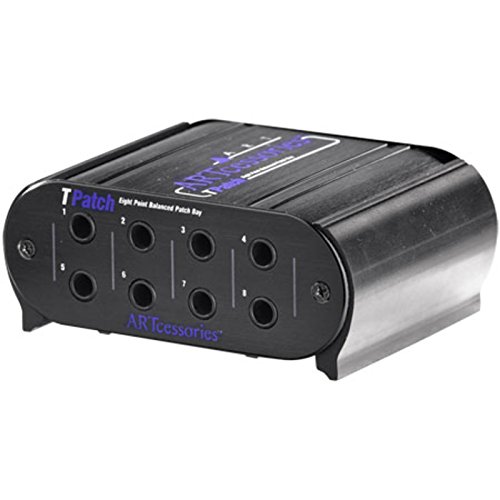
- Eight balanced signal points
- Switchable half-normal and normal modes
- Rugged aluminum case with 1/4-inch TRS jacks
Best For: Flexible balanced routing in project and home studios
Best Flexible Rack Patch Bay – Samson S-Patch Plus
For studios comparing patch bays under 500, the Samson S-Patch Plus stands out as a flexible 48-point, fully balanced option. Its front-panel switches make it easier to change routing without reaching behind your rack.
Best For: Home and project studios that need flexible routing for rack-mounted audio equipment.
Pros:
- Provides 48 front and 48 rear 1/4-inch phone connections in a 1U rack-mountable design.
- Supports normalled, half-normalled, and thru operation through miniature front-panel toggle switches.
- Fully balanced construction helps maintain a clean signal path.
- Centralizes connections for faster, tidier studio workflows.
Cons:
- Its 1/4-inch TRS format may not suit setups built around other connector types.
- The extensive routing flexibility may be more than a very simple rig requires.
The S-Patch Plus is a practical choice when convenient front-panel control and multiple balanced connections matter. Its combination of rack-friendly construction and selectable routing makes it one of the more adaptable options in this group.
Best Gold-Plated Connector Patch Bay – Black Lion Audio PBR TRS3
Among patch bays under 500, the Black Lion Audio PBR TRS3 is a straightforward 48-point choice with 96 gold-plated TRS connectors. Its three-way mode switch gives you useful routing control for studio connections.
Best For: Users who want a TRS patch bay with gold-plated connectors and three-way switching.
Pros:
- Offers 48 patch-bay points and 96 gold-plated TRS connectors.
- Includes a three-way mode switch for flexible signal routing.
- Supports a wide range of connections involving guitars, microphones, computers, speakers, and XLR equipment.
- Lists a maximum sample rate of 192 kHz.
Cons:
- The supplied notes do not specify the individual routing modes included with the three-way switch.
- Its TRS-focused design may be less suitable for systems needing a different primary connector format.
The PBR TRS3 focuses on a high connector count and simple mode selection. It is worth considering when gold-plated TRS connectivity is a priority and you want a modern patch-bay solution without unnecessary feature complexity.
Best Multi-Mode Patch Bay – Behringer ULTRAPATCH PRO PX3000
Behringer ULTRAPATCH PRO PX3000 Multi-Functional 48-Point 3-Mode Balanced Patchbay
Check Price On AmazonThe Behringer ULTRAPATCH PRO PX3000 is a strong contender among patch bays under 500 for users who want multiple routing choices. Each of its 48 points can be configured for parallel, half-normalled, normalled, or open operation.
Best For: Studios that need broad routing flexibility across TRS, TS, XLR, or MIDI-related connections.
Pros:
- Provides 48 points with 96 high-quality jack connections.
- Offers parallel, half-normalled, normalled, and open functions.
- Rugged construction and high-quality components are designed for long service.
- Helps reduce cable clutter and organize studio connections.
Cons:
- The supplied item weight of 3.9 pounds makes it less lightweight than some alternatives.
- Its many routing modes may require more setup attention than a basic thru patch bay.
The PX3000 is the most feature-oriented option here for configuring signal paths in different ways. Choose it if your studio benefits from selectable modes and broad connectivity rather than a minimal patching setup.
Best Pedalboard Connection Hub – ROCKBOARD RBO B MOD 2 V2
For shoppers seeking patch bays under 500 for an effects setup, the ROCKBOARD RBO B MOD 2 V2 takes a different approach. It centralizes pedalboard connections with 1/4-inch thru ports plus USB, MIDI, and AC IEC thru connections.
Best For: Pedalboard users who want to manage audio, USB, MIDI, and power connections in one place.
Pros:
- Designed to manage an effector setup and its connections centrally.
- Includes four 1/4-inch mono TRS thru connections.
- Adds one USB thru, two MIDI thru, and one AC IEC thru connection.
- Compact 0.52 kg design is suited to portable pedalboard systems.
Cons:
- Its two-channel listing and compact connection layout are not intended to replace a large 48-point studio patch bay.
- The product is specialized for pedalboard connectivity rather than broad rack-studio routing.
The RBO B MOD 2 V2 is best viewed as a pedalboard connection module rather than a conventional studio patch bay. Its mix of audio, USB, MIDI, and AC IEC thru connections makes it useful when one organized access point is the main goal.
Best XLR Rack Solution – ART P16 XLR Balanced Patchbay
For setups seeking patch bays under 500 with balanced XLR connectivity, the ART P16 provides a straightforward 1U rack-mounted solution. It offers 16 front-panel female XLR connectors and 16 rear-panel male XLR connectors in a fully shielded steel enclosure.
Best For: Studios and live-sound racks that need organized access to 16 XLR connections.
Pros:
- Provides 32 XLR connectors across the front and rear panels.
- Uses reliable PCB wiring for all connections.
- Rugged, fully shielded all-steel 1U rack enclosure.
- Reversible rack ears and a 3-year warranty add installation flexibility and support.
Cons:
- Uses XLR connections rather than 1/4-inch patch points.
- Offers 16 channels, which may be limiting for larger installations.
The ART P16 is a focused choice when balanced XLR routing and rack organization matter more than having a high point count or mixed connector formats.
Best High-Count 1/4-Inch Bay – dbx PB-48 48-Point Patch Bay
Among patch bays under 500, the dbx PB-48 is designed for studios that need many accessible 1/4-inch connections. It places 48 jacks on the front and 48 on the back, making it useful for quick rerouting while reducing wear on equipment jacks.
Best For: Studio users who need a high-capacity 1/4-inch patch point system in a 1U rack space.
Pros:
- Offers 48 front-panel and 48 rear-panel 1/4-inch jacks.
- Provides quick access for rerouting mixers and other audio gear.
- Helps reduce wear and tear on connected equipment jacks.
- Rugged metal construction with 1U rack-mount compatibility.
Cons:
- Uses 1/4-inch jacks rather than XLR connections.
- The large number of connections may be more than smaller setups require.
The PB-48 stands out for connection density and practical studio routing, especially when your equipment already uses 1/4-inch cabling and you want a compact rack-mounted access point.
Best Compact XLR Access – Hosa PDR-369 12-Point XLR Patchbay
For patch bays under 500 in a compact XLR format, the Hosa PDR-369 brings 12 mixer inputs or other XLR connections to the front of a rack. Its reversible design and steel one-unit rack chassis suit installations where accessible balanced connections are the priority.
Best For: Smaller racks needing front-panel access to XLR mixer inputs, interfaces, or microphone preamps.
Pros:
- Provides 12 XLR patch points in a one-unit rack chassis.
- Reversible design supports flexible installation.
- Compatible with audio mixers, audio interfaces, and microphone preamps.
- Steel construction and a limited lifetime warranty provide practical durability support.
Cons:
- Has fewer patch points than higher-capacity models.
- Designed for XLR connections rather than 1/4-inch routing.
The PDR-369 is a sensible space-conscious pick for bringing hard-to-reach XLR connections forward without dedicating a larger patchbay to the job.
Color-Coded XLR Choice – 8-Channel Rack Patch Bay
If you need patch bays under 500 for straightforward XLR routing, the AMIMA 8-Channel XLR Patch Bay offers a practical feed-through layout for studio or live-sound setups. Its eight color-coded female-to-female ports can make signal tracing and installation easier.
Best For: XLR-based studio racks, live-sound systems, and users who want quick visual cable identification.
Pros:
- Eight distinct colored XLR ports simplify signal tracing.
- 1U rack-mount format suits standard rack installations.
- Gold-plated contacts are designed for reliable connections.
- Includes mounting screws and a user manual.
Cons:
- Designed for XLR connections rather than 1/4-inch TRS patching.
- Indoor usage is specified.
This is a focused option for buyers who want an organized XLR feed-through panel rather than a multi-format patch bay. The color coding is especially useful when several balanced lines need to be identified quickly.
High-Capacity Rack Pick – Art Pro Audio P48
Among patch bays under 500, the Art Pro Audio P48-48 Point Balanced Patch Bay is suited to larger installations that need extensive cable organization. Its rack-mount, fully shielded design supports professional and home recording, PA, AV, home theater, and live-sound applications.
Best For: High-connection-count studio racks, installed audio systems, PA setups, and live sound.
Pros:
- Provides 48 points for extensive signal organization.
- Fits a 19-inch rack.
- Fully shielded construction helps keep the installation organized.
- Steel outer material and a two-year warranty add practical reassurance.
Cons:
- Its large point count may be more than a small home setup needs.
- The supplied details do not specify switching or normalization modes.
The P48 makes the most sense when rack space and connection density matter more than portability. It can also help reduce wear on the connectors of connected audio equipment by providing a centralized patching point.
Flexible TRS Routing Pick – Art Pro Audio TPatch
For shoppers comparing patch bays under 500 with 1/4-inch connections, the Art Pro Audio TPatch provides eight balanced points and flexible routing controls. Its linked input/output pairs and switchable half-normal and normal modes support adaptable signal-flow setups.
Best For: Home or project studios using balanced 1/4-inch TRS connections and adjustable patching configurations.
Pros:
- Offers eight points of balanced direct signals.
- Includes four channels of linked input/output pairs.
- Switchable half-normal and normal modes expand routing flexibility.
- Uses 1/4-inch TRS phone jack connectors in a rugged aluminum case.
Cons:
- It has eight channels, so larger installations may need more capacity.
- The supplied compatibility details focus on computer-based Windows DAW setups.
The TPatch is a strong fit when switching behavior matters as much as basic signal access. Its compact eight-point layout keeps the feature set focused while offering more routing control than a simple feed-through panel.
How We Picked the Best Patch Bays Under 500
We evaluated these patch bays by looking at the factors that matter most during daily setup and operation: connector type, number of points, balanced-signal support, normalization options, rack compatibility, switching flexibility, and likely use case. We also considered whether each unit is better suited to front-panel access, permanent studio wiring, live-sound connections, or compact signal management.
Because patch bays serve different purposes, a higher point count is not automatically better. A 48-point TRS bay may be ideal for a recording studio, while an eight-point XLR or compact balanced unit may be more practical for a smaller rig.
Quick Comparison
| Best For | What to Prioritize | Typical Choice |
|---|---|---|
| Large studio routing | 48 points, balanced TRS, flexible normalization | Multi-mode 48-point patch bay |
| Compact rack systems | Small footprint and straightforward wiring | Eight- or 12-point balanced bay |
| XLR equipment | Matching XLR input and output formats | XLR feed-through patch bay |
| Live sound | Durable construction and clear labeling | Rack-mount XLR or balanced model |
| Modular or pedalboard rigs | Format compatibility and easy access | Specialized compact patch bay |
Key Buying Factors for Patch Bays Under 500
Connector Format and Signal Type
Choose TRS, XLR, or another format based on the equipment you will connect most often. Balanced TRS and XLR connections help reject interference over longer cable runs, but adapters can add clutter and potential failure points.
Point Count and Rack Space
Count your current connections, then allow room for expansion. A 48-point unit uses more cabling but can centralize many synthesizers, processors, interfaces, and console connections. Smaller bays save rack space and simplify installation.
Normalization and Routing Modes
Normalled connections pass a signal through until you insert a patch cable, while half-normalled and isolated configurations offer different tap and routing behaviors. If you frequently change signal paths, look for a model with accessible switching or multiple routing modes.
Labeling, Build Quality, and Maintenance
Clear labels and sturdy jacks make troubleshooting faster. Check that the bay fits your rack, leaves room for cable plugs, and uses a layout that will remain understandable after installation. Keep a wiring diagram so future changes do not become guesswork.
Who Should Buy Which Patch Bays Under 500?
Choose a full-size 48-point balanced patch bay if you are wiring a recording studio, expanding a rack, or routing several pieces of outboard gear. A multi-mode design is especially useful when different devices require different normalization arrangements.
Choose a compact balanced or XLR model for a smaller home studio, interface-centered setup, or live rack where only a handful of connections need front-panel access. XLR feed-through bays are the natural fit when your microphones, stage boxes, or processors already use XLR connections.
For pedalboards, modular systems, or specialized routing, prioritize physical compatibility and connector placement over maximum point count. The best option among these patch bays under $500 is the one that matches your existing cables and makes the connections you change most often easy to reach.