
In today’s fast-paced work environment, having the right tools is vital for maximizing productivity. DisplayLink docks are becoming essential for professionals like you who need to connect multiple monitors and peripherals seamlessly. With options that support triple displays and offer extensive connectivity, choosing the right dock can transform your workspace. But how do you know which one fits your needs best? Let’s explore the top contenders to help you make an informed decision.
Plugable USB-C Triple Monitor Docking Station (UD-ULTCDL)
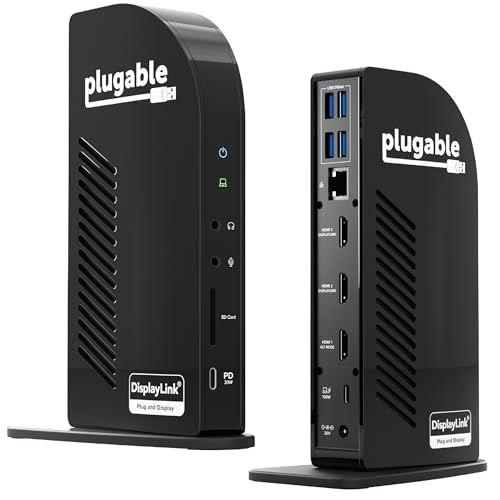
If you’re looking for a versatile solution to enhance your laptop’s connectivity, the Plugable USB-C Triple Monitor Docking Station (UD-ULTCDL) is the best choice for you. With 13 ports, it effortlessly connects up to three monitors, offering stunning visuals up to 4K at 30Hz. You’ll enjoy fast 100W power delivery, ensuring your devices stay charged while you work. Its lightweight design makes it portable, and compatibility with Windows, macOS, and Chrome means you won’t be left behind. Plus, with a 4.4 out of 5-star rating from over 1,500 reviews, it’s a reliable addition to any workspace.
Best For: Professionals and creatives who need to connect multiple monitors and peripherals for enhanced productivity.
Pros:
- Versatile Connectivity: Offers 13 ports for various devices, including support for triple monitor setups.
- High-Quality Display: Supports up to 4K resolution on the main display and 1920×1200 on secondary displays.
- Fast Charging: Provides 100W power delivery to keep your devices charged while in use.
Cons:
- Driver Requirement for macOS: Requires DisplayLink drivers for full functionality on Mac systems.
- Weight and Size: Although portable, it may be bulkier compared to other docking stations.
- Limited to USB-C Compatibility: Not suitable for older laptops without USB-C ports.
Anker Prime Docking Station (DL7400) – 14-Port Triple Display

The Anker Prime Docking Station (DL7400) stands out as an ideal choice for professionals and multitaskers who require multiple displays and robust connectivity options. With 14 ports, including dual HDMI and a DisplayPort, you can easily set up a triple display, even supporting one monitor at a stunning 8K resolution. It delivers up to 140W power, ensuring your devices stay charged while you work seamlessly. The smart display keeps you updated on charging and performance, while ActiveShield 3.0 technology keeps everything cool. Compatible with both macOS and Windows, this dock enhances your productivity and workspace efficiency effortlessly.
Best For: Professionals and multitaskers who need multiple displays and extensive connectivity options for enhanced productivity.
Pros:
- Supports triple display setup, including one 8K monitor, perfect for multitasking.
- 14 ports provide a wide range of connectivity options, accommodating various devices.
- Smart display and ActiveShield 3.0 technology ensure optimal performance and cooling.
Cons:
- Requires installation of the latest DisplayLink driver for full functionality.
- The charging capability may be limited for some devices when using multiple ports simultaneously.
- The physical size of the docking station may take up more desk space compared to simpler docks.
Minisopuru Displaylink Triple Display Docking Station for MacBook and Windows
For professionals and creatives who need to maximize their workspace, the Minisopuru Displaylink Triple Display Docking Station stands out as an ideal choice. Compatible with MacBook M1/M2/M3/M4 and Windows, it requires the DisplayLink driver for peak performance. With 12 ports, including dual 4K HDMI and DisplayPort outputs, you can easily connect multiple displays at 4K@60Hz. Fast data transfer is achievable through USB 3.2 ports, while the 100W USB-C PD port ensures your laptop stays charged. Just remember to connect the docking station to its 36W power adapter for seamless operation.
Best For: Professionals and creatives seeking to enhance their workspace with multiple 4K displays and fast data transfer capabilities.
Pros:
- Supports up to three 4K displays simultaneously for enhanced productivity.
- Fast data transfer with USB 3.2 ports, capable of transferring large files in seconds.
- 100W USB-C Power Delivery port allows for charging laptops while using the docking station.
Cons:
- Requires installation of DisplayLink driver for full functionality.
- HDMI and DisplayPort for display 3 cannot be used simultaneously.
- Not compatible with Linux/Unix operating systems.
Plugable USB 3.0 and USB-C Universal Laptop Docking Station

Plugable’s USB 3.0 and USB-C Universal Laptop Docking Station stands out with its dual HDMI outputs, making it perfect for professionals who need to connect two monitors for enhanced productivity. You’ll appreciate the versatility of its multiple ports, including Gigabit Ethernet, audio jack, and several USB ports. Weighing just 11.7 ounces, it’s portable yet powerful. Compatible with Windows, macOS, and ChromeOS, it offers easy installation, though macOS users need to install a driver manually. While ideal for office tasks, it’s not suited for gaming or encrypted content playback. With a 2-year warranty and stellar customer support, it’s a solid investment.
Best For: Professionals seeking to enhance productivity with dual monitor setups in home or office environments.
Pros:
- Versatile connectivity: Features multiple ports including dual HDMI, Gigabit Ethernet, and several USB ports for various device connections.
- Lightweight and portable: Weighs only 11.7 ounces, making it easy to transport between locations.
- Strong customer support: Includes a 2-year warranty and lifetime support from a North American-based team.
Cons:
- Not suitable for gaming: Performance limitations make it unsuitable for gaming or playback of encrypted content.
- Manual driver installation for macOS: Requires additional steps for macOS users to install the necessary DisplayLink driver.
- Limited resolution support: Maximum resolution of 1920×1200, which may not meet the needs of users requiring higher display resolutions.
TobenONE DisplayLink Docking Station Triple Monitor with 120W Power Adapter
Looking to maximize your productivity with a powerful docking solution? The TobenONE DisplayLink Docking Station is perfect for you, enabling a triple monitor setup with stunning 4K displays. With its 120W power adapter, it charges your laptop efficiently while connecting multiple peripherals through 18 ports. You’ll enjoy seamless connectivity via HDMI, DisplayPort, USB-C, and USB 3.2 ports. Plus, it’s compatible with various systems, including macOS and Windows. Whether you’re multitasking or transferring files, the TobenONE guarantees smooth performance with up to 10Gbps data transfer speeds. Elevate your workspace and enhance your workflow effortlessly with this impressive dock!
Best For: Professionals and creatives who require a powerful docking solution for a multi-monitor setup with high-resolution displays.
Pros:
- Supports triple 4K displays, enhancing productivity through expanded screen real estate.
- Includes 18 ports, allowing for versatile connectivity of peripherals and devices.
- High data transfer speeds up to 10Gbps, ensuring efficient file transfers.
Cons:
- Requires installation of the latest DisplayLink drivers, which may be an added step for users.
- Limited compatibility with Linux/Unix systems, excluding a segment of potential users.
- Only supports 3 monitors for macOS users, which may be a limitation for some setups.
WAVLINK USB C Docking Station Dual Monitor (13-in-1)

The WAVLINK USB C Docking Station Dual Monitor (13-in-1) stands out as an ideal choice for creative professionals and multitaskers who need robust connectivity and stunning visuals. With support for dual 5K@60Hz or 4K@60Hz displays, you can enhance your workspace with vibrant graphics. The dock features 13 ports, including USB 3.0, USB-C, Gigabit Ethernet, and audio connections, ensuring fast data transfers and stable networks. Plus, its 100W Power Delivery keeps your laptop charged during demanding tasks. Compatible with various operating systems, this docking station simplifies your setup while offering lifetime technical support and a one-year warranty.
Best For: Creative professionals and multitaskers seeking robust connectivity and stunning visuals for their dual monitor setup.
Pros:
- Supports dual 5K@60Hz or 4K@60Hz displays, providing vibrant graphics for enhanced productivity.
- Includes 13 versatile ports for fast data transfers and stable network connections, consolidating multiple devices in one dock.
- 100W Power Delivery ensures laptops remain charged during intensive tasks, preventing battery drain.
Cons:
- Requires installation of the DisplayLink driver for proper media display functionality, which may be an extra step for some users.
- Incompatible with Unix systems, Linux, iOS, and iPad OS, limiting usability for users of those operating systems.
- May be overkill for casual users who do not need dual monitor support or extensive connectivity options.
Plugable Dual DisplayPort & HDMI Docking Station (UD-6950Z)

For professionals who rely on dual monitor setups to enhance productivity, the Plugable Dual DisplayPort & HDMI Docking Station (UD-6950Z) stands out as an excellent choice. It supports dual 4K monitors at 60Hz, thanks to DisplayLink technology, making multitasking seamless. With dual HDMI and DisplayPort outputs, Gigabit Ethernet, an audio jack, and six USB 3.0 ports, you’ll have all the connectivity you need. It’s compatible with Windows, macOS, and ChromeOS, though installation is required for Mac. The sleek design keeps your workspace organized, ensuring you focus on your tasks without cable clutter.
Best For: Professionals seeking a reliable docking station for dual monitor setups to enhance productivity and connectivity.
Pros:
- Supports dual 4K monitors at 60Hz for improved multitasking capabilities.
- Offers multiple connectivity options, including dual HDMI, DisplayPort, Gigabit Ethernet, and six USB 3.0 ports.
- Sleek vertical design promotes clean cable management and an organized workspace.
Cons:
- Requires manual driver installation for macOS users, which may be inconvenient.
- Not compatible with Linux operating systems.
- Does not provide charging for the host computer.
TobenONE DisplayLink Docking Station for 4 Monitors

Designed for professionals who demand high performance, the TobenONE DisplayLink Docking Station excels with its ability to support up to four external monitors, making multitasking seamless and efficient. With 20 ports, including HDMI, DisplayPort, and USB options, you can connect all your essential devices easily. Enjoy stunning 4K@60Hz resolution on your screens, though note that M1 MacBooks can extend to only three monitors. The 150W power adapter delivers 100W charging to your laptop, keeping your workspace tidy. Compatible with various systems, you’ll appreciate the two-year defect coverage and dedicated support for a worry-free experience.
Best For: Professionals who require efficient multitasking with multiple high-resolution monitors.
Pros:
- Supports up to 4 external monitors with 4K@60Hz resolution for enhanced productivity.
- Includes a wide range of ports (20 total), allowing for easy connection of various devices.
- Comes with a 2-year defect coverage and dedicated technical support for peace of mind.
Cons:
- M1 MacBooks are limited to extending to only 3 monitors, reducing versatility for Apple users.
- Requires installation of the DisplayLink driver, which may be an extra step for some users.
- HDCP is not supported, which could limit the ability to play protected content on external displays.
WAVLINK DisplayLink Docking Station Triple Monitor 4K@60Hz

If you’re looking to maximize your productivity with multiple displays, the WAVLINK DisplayLink Docking Station is an excellent choice. It supports triple monitors at stunning 4K@60Hz, providing vibrant visuals for all your tasks. With three HDMI ports, two DisplayPorts, and six USB Gen2 ports, you’ll enjoy seamless connectivity. The 160W power adapter guarantees your laptop gets up to 100W charging, keeping everything powered up. Plus, the 1Gbps Ethernet connection boosts your data transfer speeds. Compatible with various operating systems, this dock is perfect for enhancing your workspace. Just install the latest DisplayLink drivers for peak performance and enjoy!
Best For: Professionals and multitaskers who need to operate multiple displays for enhanced productivity and visual experience.
Pros:
- Supports triple monitors at 4K@60Hz for vibrant visuals and improved multitasking.
- Multiple connectivity options with 3 HDMI ports, 2 DisplayPorts, and 6 USB Gen2 ports for seamless integration of devices.
- Powerful 160W power adapter provides up to 100W charging for laptops, ensuring continuous operation.
Cons:
- Requires latest DisplayLink drivers for optimal performance, which may need regular updates.
- Not compatible with Unix systems, Linux, or iPad OS, limiting usage for some users.
- Heavier than some competitors, weighing 1.12 pounds, which may affect portability.
Kensington 11-in-1 USB-C Docking Station

The Kensington 11-in-1 USB-C Docking Station is a top choice for professionals needing to connect multiple displays effortlessly. With support for up to three external monitors, you can enjoy one 4K display at 30Hz and two 1080p displays at 60Hz using DisplayLink technology. It’s universally compatible with various laptops, including MacBook M1 to M4 models. Plus, it delivers up to 100W of power to your laptop while connecting multiple accessories. The dock features ample connectivity options, including HDMI and USB-A ports, ensuring you have everything you need to enhance your workspace efficiently.
Best For: Professionals and creatives who need to connect multiple displays and devices seamlessly for enhanced productivity.
Pros:
- Supports up to three external monitors with high-resolution display options.
- Universally compatible with a wide range of laptops, including the latest MacBook models.
- Provides 100W power delivery for laptop charging while connecting accessories.
Cons:
- Requires DisplayLink technology, which may necessitate additional software installation.
- Mounting bracket sold separately for zero-footprint mounting option.
- Limited features for non-Windows users, as some software functionalities are exclusive to Windows.
Factors to Consider When Choosing a Displaylink Dock for Laptops
When you’re choosing a DisplayLink dock for your laptop, think about compatibility with your operating system first. You’ll also want to take into account the number of display outputs and the variety of ports to suit your needs. Don’t forget to check power delivery capacity and data transfer speeds to guarantee peak performance.
Compatibility With Operating Systems
Choosing a DisplayLink dock that works seamlessly with your laptop hinges on compatibility with your operating system. Make sure the dock supports your OS, as many require specific drivers for Windows, macOS, or Chrome OS. Some docks cater to multiple systems, like Windows 10/11 and macOS 11 or later, while others may exclude Linux and Unix. It’s essential to check if the dock needs the latest DisplayLink drivers for peak performance on your system. Compatibility with USB-C Alt Mode is also important for laptops like the MacBook M1, M2, M3, and M4. Finally, verify the dock’s support for multi-monitor setups, including the maximum number of displays and resolutions compatible with your operating system before making a decision.
Number of Display Outputs
Selecting a DisplayLink dock with the right number of display outputs is essential for maximizing your workstation’s potential. Some docks support dual or triple monitors, while others may only handle a single display. For greater flexibility, choose a dock with multiple output options like HDMI and DisplayPort. It’s vital to check the specifications for maximum resolution and refresh rate, as these can vary widely. Some docks can support 4K displays on multiple outputs, while others may restrict certain ports to lower resolutions, like 1080p. Finally, confirm whether the dock requires specific drivers, as this can impact compatibility with your laptop and how many displays it can effectively support.
Power Delivery Capacity
Understanding power delivery capacity is essential for ensuring your laptop stays charged during demanding tasks. This capacity refers to the maximum wattage a docking station can provide, typically ranging from 100W to 140W. A higher capacity, like 140W, lets you charge multiple devices simultaneously, including your laptop and smartphone, through various USB-C ports. It’s vital to check if the dock’s power delivery is certified for your specific laptop model, as some laptops need particular wattages for peak performance. Insufficient power delivery can cause slower charging rates or even lead to your laptop discharging while connected, especially during resource-heavy activities like gaming or video editing. Choose wisely to keep your workflow uninterrupted and efficient.
Port Variety and Types
When exploring options for a DisplayLink dock, it’s crucial to evaluate the variety and types of ports available, as they can greatly affect your setup. Look for docks that offer between 12 to 20 ports, giving you flexibility for multiple devices and peripherals. Verify there are various video output options like HDMI, DisplayPort, and USB-C to support different monitor configurations. Also, check for USB-A and USB-C ports that enable high-speed data transfer rates, ideally up to 10Gbps. Don’t overlook dedicated charging ports; many docks offer Power Delivery ranging from 100W to 140W. Additionally, having Gigabit Ethernet ports guarantees stable internet connections, while audio jacks enhance your multimedia experience.
Data Transfer Speeds
As you explore DisplayLink docks, pay close attention to data transfer speeds, since they can greatly impact your workflow. USB 3.0 ports typically offer speeds up to 5 Gbps, while USB 3.1 and USB-C ports can double that to 10 Gbps. If you want the fastest rates, look for docks with USB 3.2 Gen 2 ports, which can reach up to 20 Gbps with compatible devices. Keep in mind that when multiple devices are connected, the total speed may be shared, potentially slowing down individual ports. For peak performance, verify your laptop and peripherals are compatible with the dock’s capabilities and use high-quality cables to achieve maximum throughput.
Installation and Setup Process
Installing and setting up your DisplayLink dock can be straightforward, but there are a few key factors to keep in mind to assure a smooth process. First, make sure you install the DisplayLink drivers, which you can get from the manufacturer’s website or included media. If you’re a macOS user, you’ll need to do this manually, while Windows users might enjoy plug-and-play convenience. Don’t forget to connect the dock to a power source using the provided adapter, as many require it to function properly. Check compatibility with your laptop’s operating system and USB-C specifications to avoid connectivity issues. Finally, review the setup guide, as some docks may limit simultaneous use of display ports for peak performance.
Cooling and Performance Features
Cooling and performance features are essential considerations when selecting a DisplayLink dock for your laptop, especially if you plan to engage in demanding tasks like gaming or video editing. Look for docking stations with effective cooling mechanisms, such as built-in fans and ActiveShield technology, to maintain peak performance during high-demand situations. Smart cooling solutions that automatically adjust fan speeds based on temperature can guarantee efficient operation and prevent overheating. Additionally, real-time monitoring displays can keep you updated on charging power and display performance, giving you better control over your devices. A well-designed cooling system not only enhances performance but also extends the longevity and reliability of your connected devices by preventing thermal stress during extended use.
Warranty and Support Options
When choosing a DisplayLink dock for your laptop, it’s essential to take into account warranty and support options. Start by checking the warranty period, which can vary from one year to several, giving you peace of mind against defects. Look for docks that offer customer support services, such as lifetime technical assistance, to help with any issues you encounter. Review the return policy carefully—some products may allow full refunds if defective or damaged upon arrival. It’s also vital to understand restocking fees for returns due to misuse. Finally, consider any additional warranty options or coverage plans for extended protection beyond the standard warranty period, ensuring you’re well-covered for your investment.