
If you’re looking to elevate your workspace and boost productivity, choosing the right DisplayLink dock is vital. These docking stations not only offer extensive connectivity options but also blend seamlessly into your office setup. With various models available, each catering to different needs, it’s important to find one that suits your specific requirements. Let’s explore the top options that can transform your work experience and help you achieve more in less time.
Minisopuru DisplayLink Triple Display Docking Station for MacBook and Windows
If you’re looking to enhance your workspace with versatile connectivity, the Minisopuru DisplayLink Triple Display Docking Station is an excellent choice for both MacBook and Windows users. This docking station supports MacBook M1/M2/M3/M4 and Windows, requiring the DisplayLink driver for seamless functionality. With 12 ports, including dual 4K HDMI and DisplayPort outputs, you can easily connect multiple displays. It offers fast data transfer via USB-A and USB-C ports, plus charging capabilities with a 100W USB-C PD port. Just remember to connect it to the 36W power adapter for peak performance and enjoy a streamlined, efficient workspace!
Best For: Users seeking an efficient docking station to connect multiple displays and enhance productivity on MacBook and Windows devices.
Pros:
- Supports dual and triple display setups with 4K resolution for improved multitasking.
- Fast data transfer capabilities with USB 3.2 Gen1 ports, enabling quick file transfers.
- High charging power with a 100W USB-C PD port, perfect for powering laptops and devices.
Cons:
- Requires installation of the DisplayLink driver for functionality, which may be an extra step for some users.
- Only operates with a 36W power adapter, which may limit flexibility in power sources.
- HDMI and DP ports for display 3 cannot be used simultaneously, restricting display options.
Plugable Universal Laptop Docking Station (UD-3900)

The Plugable Universal Laptop Docking Station (UD-3900) is an excellent choice for professionals who need to enhance their workspace with dual HDMI monitors. With support for both Windows and Mac, it connects via USB 3.0 or USB-C. You’ll appreciate the hybrid 2-in-1 USB cable and multiple ports, including 2x HDMI outputs, wired Gigabit Ethernet, and several USB connections. It handles dual displays up to 1920×1200 at 60Hz, making it perfect for productivity tasks. Just remember, it’s not suitable for gaming or HDCP content. Plus, you’ll benefit from a 2-year warranty and lifetime support.
Best For: Professionals seeking an efficient dual monitor setup for enhanced productivity in web and office applications.
Pros:
- Supports dual HDMI displays up to 1920×1200 @ 60Hz, ideal for multitasking.
- Compatible with various operating systems including Windows, Mac, and ChromeOS.
- Comes with a 2-year warranty and lifetime support from a North American-based team.
Cons:
- Not suitable for gaming or HDCP protected content.
- Requires driver installation, which may not be user-friendly for all.
- Does not support 4K resolution, limiting high-definition display options.
Plugable 13-in-1 USB C Docking Station
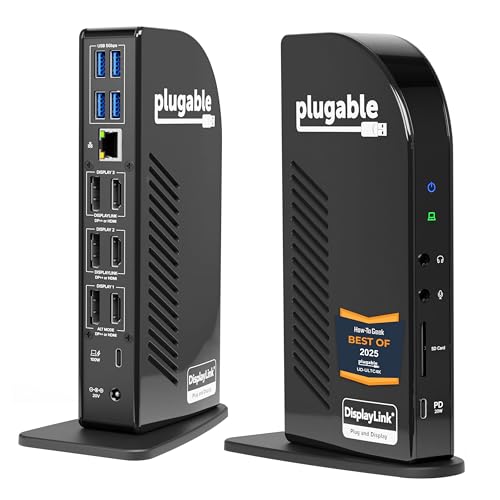
For professionals seeking enhanced productivity, the Plugable 13-in-1 USB C Docking Station stands out with its ability to support triple 4K monitors through a combination of HDMI and DisplayPort outputs. This versatile dock features 13 ports, including USB-C for 100W charging, four USB-A ports, Ethernet, an SD card reader, and audio in/out. With a 10Gbps USB-C connection, you’ll enjoy fast data transfer and seamless multitasking. Weighing just 1.07 pounds and compact at 4.72 x 2.64 x 6.89 inches, it’s perfect for any workspace. Don’t forget to install DisplayLink drivers for peak performance!
Best For: Professionals and creatives who require multiple monitor setups and extensive connectivity options for enhanced productivity.
Pros:
- Supports triple 4K monitors, allowing for an expansive workspace.
- Includes 13 versatile ports, catering to a variety of devices and needs.
- 100W Power Delivery enables direct laptop charging through the dock.
Cons:
- Requires installation of DisplayLink drivers for optimal functionality.
- Some users may find the size slightly larger compared to simpler docking stations.
- A few reports of compatibility issues with certain operating systems or configurations.
Plugable Dual DisplayPort & HDMI Docking Station (UD-6950Z)

Designed for professionals who rely on multitasking, the Plugable Dual DisplayPort & HDMI Docking Station (UD-6950Z) offers seamless support for dual 4K monitors at 60Hz, making it an ideal choice for enhancing productivity. With dual HDMI and DisplayPort outputs, plus six USB 3.0 ports, it connects all your essential devices effortlessly. The sleek vertical design improves workspace aesthetics, while Gigabit Ethernet and audio jack guarantee reliable connectivity. Compatible with Windows, macOS, and ChromeOS, setup is plug-and-play for most systems. Just note, it doesn’t charge your laptop, but its performance for web browsing and office tasks makes it a standout choice.
Best For: Professionals seeking reliable connectivity and enhanced productivity through dual monitor setups.
Pros:
- Supports dual 4K monitors at 60Hz, ideal for multitasking and productivity.
- Sleek vertical design enhances workspace aesthetics and promotes clean cable management.
- Compatible with multiple operating systems (Windows, macOS, ChromeOS) with easy setup.
Cons:
- Not compatible with Linux operating systems.
- Does not charge the host laptop, which may limit convenience.
- Not optimized for gaming or playback of protected content (HDCP).
TobenONE DisplayLink Docking Station Triple Monitor
If you’re a professional needing to enhance your workspace with multiple displays, the TobenONE DisplayLink Docking Station is an excellent choice. This dock supports triple 4K monitors, perfect for maximizing productivity. You can connect through a single USB-C cable, utilizing 18 ports, including HDMI and DisplayPort options. Its compatibility with various devices guarantees you won’t face issues, whether you’re using macOS or Windows. Plus, the 120W power adapter charges your laptop efficiently while providing fast data transfer speeds. With the TobenONE, you’ll streamline your workspace and elevate your multitasking capabilities effortlessly.
Best For: Professionals and creatives seeking to enhance their productivity with a triple monitor setup for their laptops.
Pros:
- Supports triple 4K displays for an expansive workspace.
- Easy connectivity with 18 ports, allowing multiple peripherals to be connected through a single USB-C cable.
- Includes a powerful 120W adapter that efficiently charges laptops while enabling fast data transfer speeds.
Cons:
- Requires installation of the latest DisplayLink drivers for optimal performance.
- Limited compatibility with Linux/Unix systems.
- Some restrictions on monitor usage depending on the operating system and device capabilities.
Plugable USB-C Triple Monitor Docking Station (UD-ULTCDL)
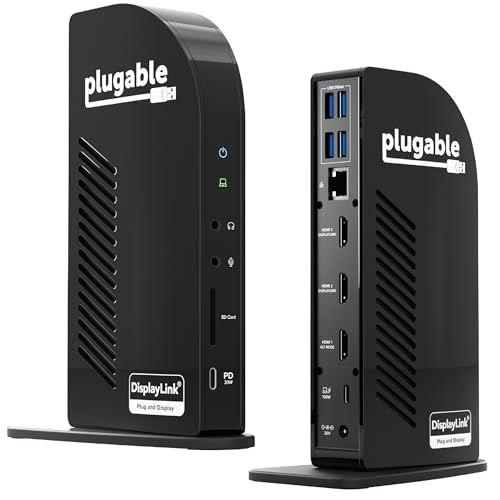
The Plugable USB-C Triple Monitor Docking Station (UD-ULTCDL) stands out as an ideal solution for professionals seeking powerful expansion and enhanced productivity. With 13 ports, you can easily connect up to three monitors, supporting resolutions up to 4K at 30Hz. This sleek space grey dock weighs just 14.1 ounces and provides fast 100W power delivery, ensuring your devices stay charged. It’s compatible with Windows, macOS, and Chrome, though macOS users will need DisplayLink drivers. Plus, with a gigabit Ethernet port and multiple USB 3.0 ports, you’ll enjoy seamless connectivity for all your peripherals.
Best For: Professionals who need to connect multiple monitors and peripherals for enhanced productivity and seamless connectivity.
Pros:
- Powerful Expansion: Offers 13 ports for extensive connectivity options, including support for three monitors.
- High Resolution Support: Capable of displaying up to 4K @ 30Hz on the main monitor and 1920×1200 @ 60Hz on secondary displays, enhancing visual clarity.
- Fast Charging: Provides 100W power delivery with additional charging options, ensuring devices stay powered throughout the workday.
Cons:
- MacOS Driver Requirement: Users on macOS must install DisplayLink drivers to utilize the full functionality, which may be inconvenient.
- Limited 4K Support: The 4K resolution is only available at 30Hz, which may not meet the needs of users requiring higher refresh rates.
- Weight and Size: At 14.1 ounces and with its dimensions, it may not be the most portable option for mobile professionals.
Kensington 11-in-1 USB-C Docking Station

For professionals who need seamless multitasking, the Kensington 11-in-1 USB-C Docking Station is an ideal solution. It supports up to three external monitors, including one 4K display and two 1080p displays, using DisplayLink technology. You’ll appreciate its universal compatibility with various laptops and the ability to charge your device with up to 100W power delivery. With 11 ports, including HDMI, USB-A, and Gigabit Ethernet, connectivity is a breeze. Plus, the free Kensington DockWorks software enhances your experience, ensuring excellent connection and security. Packaged sustainably and backed by a 3-year warranty, this dock is a smart investment for any professional.
Best For: Professionals seeking a versatile docking station for seamless multitasking with multiple monitors and extensive connectivity options.
Pros:
- Supports up to three external monitors, including one 4K and two 1080p displays for enhanced productivity.
- Provides 100W power delivery, allowing you to charge your laptop while using connected devices.
- Universally compatible with a range of laptops, including MacBook M1, M2, M3, and M4 models.
Cons:
- Requires installation of Kensington DockWorks software for optimal functionality, which is only available for Windows users.
- The zero-footprint mounting option requires a separate purchase of a mounting bracket.
- Actual data speeds on the Gigabit Ethernet port may vary based on external factors.
Plugable 7-in-1 USB-C DisplayLink Dock
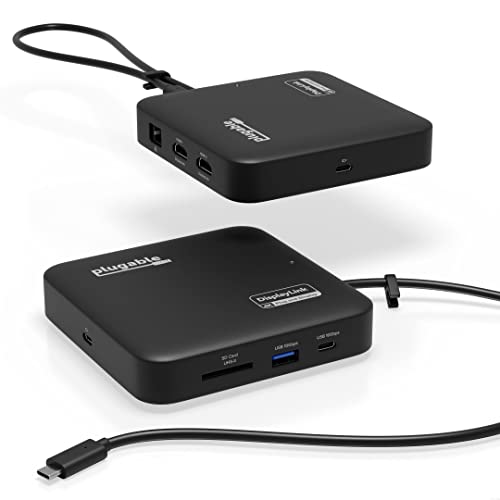
Designed for professionals seeking enhanced workspace connectivity, the Plugable 7-in-1 USB-C DisplayLink Dock is a powerful solution for multitaskers. It enables dual 4K 60Hz HDMI output, along with USB-C, USB-A (10Gbps), an SD card slot, Gigabit Ethernet, and 100W power delivery charging. This compact dock supports both Windows and macOS, making it versatile. With DisplayLink technology, you can easily connect two extended displays, though you’ll need to install a driver on macOS. Plus, the dock’s compatibility with various USB-C power adapters guarantees your laptop stays charged and ready for action. Enjoy a seamless productivity boost!
Best For: Professionals seeking enhanced workspace connectivity and multitasking capabilities.
Pros:
- Dual 4K 60Hz HDMI support allows for extended display setups, enhancing productivity.
- Versatile compatibility with Windows, macOS, and various USB-C power adapters ensures broad usability.
- Lifetime support and a 2-year warranty provide peace of mind for users.
Cons:
- Requires DisplayLink driver installation on macOS, which may be a hassle for some users.
- Not compatible with HDCP protected content, gaming, or 3D rendering, limiting its use for certain applications.
- USB-C-only portable displays are not supported, which could restrict options for some users.
TobenONE DisplayLink Docking Station for 4 Monitors

Professionals juggling multiple tasks will appreciate the TobenONE DisplayLink Docking Station, which seamlessly supports up to four external monitors. With 20 ports, including 4 HDMI and 4 DisplayPort connections, you can easily connect your devices and enhance your workflow. Enjoy stunning visuals at 4K@60Hz, although M1 chip MacBooks can extend to only three monitors. The 150W power adapter delivers 100W charging for laptops and 18W for phones, keeping your workspace tidy. Compatible with various systems, including Windows and macOS, this docking station guarantees you can multitask efficiently. Plus, you get 2-year defect coverage and dedicated support for peace of mind.
Best For: Professionals who require efficient multitasking capabilities with multiple external monitors.
Pros:
- Supports up to 4 external monitors with 4K@60Hz resolution for enhanced visual experience.
- Includes 20 ports for versatile connectivity, accommodating various devices.
- Provides substantial charging power with a 150W adapter, ensuring devices remain charged and workspace remains tidy.
Cons:
- M1 chip MacBooks can only extend to 3 monitors, limiting compatibility.
- Requires installation of DisplayLink driver for functionality, which may be cumbersome for some users.
- HDCP is not supported, potentially limiting content playback options.
iVANKY 20-in-1 DisplayLink Docking Station for MacBook and Windows

The iVANKY 20-in-1 DisplayLink Docking Station stands out with its impressive triple 4K@60Hz display capability, making it an ideal choice for users seeking enhanced multitasking on both MacBook and Windows systems. With a robust 180W power adapter and a 2.5GbE Ethernet port, it guarantees stable connections. You’ll appreciate the variety of ports, including 10Gbps USB-C and multiple USB-A options, allowing seamless data transmission. Just install the DisplayLink driver for peak performance, and you’re set. Plus, enjoy peace of mind with a 24-month warranty and responsive customer support. Experience productivity like never before with this versatile dock!
Best For: Users looking for a versatile docking solution that supports triple 4K displays and a wide range of connectivity options for both MacBook and Windows systems.
Pros:
- Triple 4K@60Hz display capability enhances multitasking and productivity.
- Variety of ports including 10Gbps USB-C and USB-A options for fast data transfer.
- 24-month warranty and responsive customer support provide peace of mind.
Cons:
- Requires installation of the DisplayLink driver for optimal functionality.
- HDMI/DP ports are limited to proper driver usage, which may complicate setup for some users.
- Product weight of 4.24 pounds may be less portable for on-the-go users.
Factors to Consider When Choosing a Displaylink Dock for Windows
When choosing a DisplayLink dock for Windows, it’s crucial to take into account several key factors. Think about compatibility with your devices, the number of displays supported, and the variety of ports available. Don’t forget to check power delivery capabilities and installation requirements to guarantee a smooth setup.
Compatibility With Devices
Choosing a DisplayLink dock for your Windows setup requires careful consideration of compatibility factors to guarantee seamless performance. First, make certain the dock supports your specific version of Windows—most models work with Windows 11, 10, 8.x, and 7. Next, check if it requires driver installation; many need the DisplayLink driver for peak functionality. Confirm the dock supports USB-C or USB 3.0 connections to match your laptop’s ports. Also, assess whether the dock can handle multiple external monitors, as some models may only support dual displays. Finally, confirm that the docking station isn’t compatible with Linux or Unix systems, especially if you plan on using multiple operating systems. This guarantees you maximize your productivity without compatibility issues.
Number of Displays Supported
Understanding the number of displays supported by a DisplayLink dock is essential for enhancing your workspace. When you choose a dock, check how many external monitors it can handle—some support dual displays, while others can manage triple or even quadruple setups. Pay attention to the resolutions offered; for example, certain docks can accommodate dual 4K monitors at 60Hz, while others may be limited to lower resolutions. Make sure the dock is compatible with your laptop‘s USB-C or USB-A ports, as this impacts display support. Additionally, some docks may need specific drivers for peak performance. Finally, consider whether the dock allows simultaneous connections of different display types, like HDMI and DisplayPort, to boost your setup flexibility.
Port Selection and Variety
Selecting the right DisplayLink dock for your Windows setup goes beyond just the number of displays it can support; port selection and variety play a significant role in your overall experience. First, check the number of HDMI and DisplayPort outputs to guarantee you can connect multiple monitors at high resolutions. Look for USB ports that support high data transfer speeds—USB 3.2 Gen1 or Gen2—to facilitate efficient file transfers and connectivity. A Gigabit Ethernet port is essential for stable internet access, especially for work or streaming. Additionally, USB-C ports with Power Delivery (PD) are beneficial, allowing you to charge your laptop while using the dock. Finally, extra ports like SD card readers and audio jacks enhance your workspace’s versatility.
Power Delivery Capabilities
When evaluating DisplayLink docks for your Windows setup, power delivery capabilities are vital, as they determine how effectively your devices can be charged while in use. Look for docks that offer USB-C Power Delivery (PD), allowing you to charge and transfer data through a single cable. Consider the wattage rating of the included power adapter; higher wattages, such as 100W, support more power-hungry devices like laptops. Some docks also provide additional charging ports with varying outputs, so you can charge multiple devices at once. Ensuring compatibility with USB-C power adapters ranging from 45W to 100W is essential, as this influences the charging performance based on both the dock and your connected devices.
Installation and Driver Requirements
To guarantee your DisplayLink dock works seamlessly with your Windows setup, installing the correct drivers is essential. Most docks require specific DisplayLink drivers for peak functionality. Fortunately, driver installation is usually a plug-and-play process for Windows users, making it straightforward. However, to avoid compatibility issues, verify you’ve got the latest version of the driver installed. Regular updates may also be necessary to keep up with operating system updates and improve performance features. Keep in mind that some DisplayLink docks may not support HDCP protected content playback, which could limit your media applications. So, before purchasing, check the dock’s compatibility with your needs for a smooth experience.
Design and Form Factor
Design and form factor play an essential role in ensuring your DisplayLink dock meets your specific needs and fits seamlessly into your workspace. Consider the dimensions and weight; a lighter, compact design enhances portability if you frequently move your setup. Look for effective cable management options to keep your workspace tidy and clutter-free. Evaluate the orientation: vertical designs save desk space, while horizontal ones provide easier port access. Check for mounting options, especially if you need a zero-footprint setup in limited spaces. Finally, assess the build quality; sturdier materials contribute to durability and longevity, ensuring your dock stands the test of time. Choosing the right design can greatly enhance your productivity.