
In 2026, upgrading your workspace with the right DisplayLink docking station can greatly improve your productivity. With various options available, from multi-monitor setups to portable solutions, you’ll find a device that suits your unique needs. Each docking station brings its own set of features and benefits, making it essential to choose wisely. Let’s explore the top contenders that can transform how you work and enhance your overall efficiency.
Plugable USB-C Triple Monitor Docking Station (UD-ULTCDL)
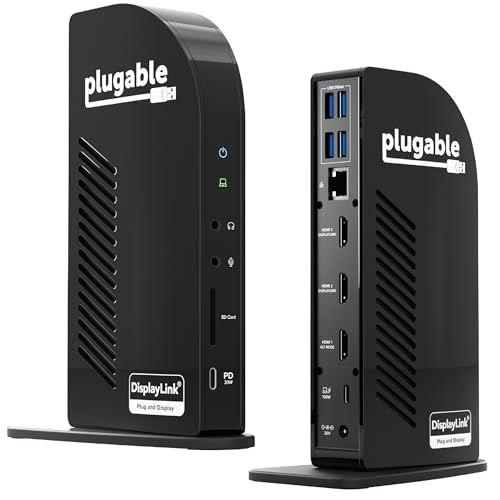
If you’re a professional or power user needing to connect multiple displays without sacrificing performance, the Plugable USB-C Triple Monitor Docking Station (UD-ULTCDL) is the perfect choice. This 13-in-1 laptop dock supports three monitors, delivering stunning visuals up to 4K @ 30Hz on your main display. With 100W power delivery, it charges your devices while offering four USB 3.0 ports for fast data transfer. Its Gigabit Ethernet guarantees a stable internet connection, and the SD card reader makes file management a breeze. Compatible with Windows, macOS, and Chrome, this dock enhances your workspace effortlessly.
Best For: Professionals and power users who require multiple display connections and high performance in their workspace.
Pros:
- Versatile Connectivity: Supports three monitors with resolutions up to 4K @ 30Hz for enhanced productivity.
- Fast Charging: Delivers 100W power through USB-C, ensuring your devices stay charged while you work.
- Stable Internet Connection: Gigabit Ethernet port provides reliable network connectivity.
Cons:
- Driver Requirement for macOS: Requires DisplayLink drivers for optimal functionality on Mac systems.
- Limited 4K Support: Only supports 4K resolution on the main display, with lower resolutions on secondary displays.
- Weight and Size: At 14.1 ounces and compact dimensions, it may not be as portable as smaller docking stations.
Plugable USB 3.0 and USB-C Universal Laptop Docking Station

The Plugable USB 3.0 and USB-C Universal Laptop Docking Station is an excellent choice for professionals and home users seeking seamless connectivity for multiple devices. With dual HDMI ports, you can easily connect two monitors, supporting resolutions up to 1920×1200. The dock features a Gigabit Ethernet port, an audio jack, and multiple USB ports, ensuring versatile connections. It’s compatible with Windows, macOS, and ChromeOS, making it a flexible option for various setups. While perfect for web and productivity tasks, it’s not suitable for gaming or playback of encrypted content. Plus, it comes with a 2-year warranty for peace of mind.
Best For: Professionals and home users looking for a versatile docking station to enhance productivity with multiple device connections.
Pros:
- Dual HDMI ports allow for easy connection of two monitors, enhancing multitasking capabilities.
- Compatible with a variety of operating systems including Windows, macOS, and ChromeOS, providing flexibility for different users.
- Compact design and lightweight build make it easy to transport and set up in various locations.
Cons:
- Not suitable for gaming or playback of encrypted content, limiting its use for high-performance tasks.
- Requires driver installation for macOS users, which may be an extra step for some.
- DisplayPort connections are not supported, potentially restricting certain setups.
Anker Prime Docking Station (DL7400) with Triple Display

For professionals seeking a seamless multitasking experience, the Anker Prime Docking Station (DL7400) stands out with its robust support for triple display setups. With 14 ports, including powerful USB-C and HDMI connections, you can easily connect multiple devices. Enjoy stunning visuals with one monitor capable of 8K resolution, perfect for high-demand tasks. This dock delivers up to 140W power, ensuring your devices stay charged while you work. Its smart display keeps you updated on performance and charging status, while ActiveShield 3.0 cooling technology prevents overheating. Enhance your workspace effortlessly with the Anker Prime Docking Station.
Best For: Professionals and power users who require a versatile docking station for multitasking with multiple high-resolution displays.
Pros:
- Supports triple display setups, including one 8K monitor for exceptional visual clarity.
- Offers a robust 14-port configuration for versatile connectivity options.
- Smart display and ActiveShield 3.0 cooling technology enhance performance and prevent overheating.
Cons:
- Requires installation of the latest DisplayLink driver for optimal display performance.
- Limited charging support on front USB-C ports (100W) when not used for media display.
- May be overkill for casual users who don’t need extensive connectivity or high-resolution displays.
Minisopuru Displaylink Triple Display Docking Station for MacBook and Windows
Designed for professionals and tech enthusiasts, the Minisopuru Displaylink Triple Display Docking Station offers seamless compatibility with MacBook M1/M2/M3/M4 models and Windows systems. With 12 ports, including dual 4K HDMI and DisplayPort options, you can easily connect multiple monitors for an enhanced workspace. Enjoy fast data transfer with USB-A and USB-C ports, and charge your devices with the 100W USB-C PD. Just remember to install the DisplayLink driver for peak performance. This docking station requires a 36W power adapter for proper operation, ensuring you stay powered and productive throughout your workday.
Best For: Professionals and tech enthusiasts seeking a versatile docking station for enhanced productivity with multiple displays.
Pros:
- Supports dual 4K displays for an expanded workspace and improved multitasking.
- Fast data transfer capabilities with USB-A and USB-C ports, enabling quick file sharing.
- 100W USB-C Power Delivery for charging laptops and other devices efficiently.
Cons:
- Requires installation of the DisplayLink driver for full functionality.
- Limited to one display output at a time between HDMI and DisplayPort for the third display.
- Not compatible with Linux/Unix operating systems.
ACASIS USB C to Dual HDMI DisplayLink Adapter

If you’re looking to boost your productivity with dual monitors, the ACASIS USB C to Dual HDMI DisplayLink Adapter stands out as an excellent choice. This adapter lets you connect two 4K monitors at 60Hz through a single USB-C or USB-A port, transforming your laptop into a multitasking powerhouse. It’s compatible with Mac M1/M2/M3 and Windows PCs, making it versatile for various users. Plus, with 100W PD fast charging, you won’t worry about battery drain. Its sleek aluminum design guarantees portability, while three USB-A ports offer convenient peripheral connections. Get ready to enhance your workspace effortlessly!
Best For: Professionals and students looking to enhance their productivity with dual 4K monitors using a single USB-C or USB-A connection.
Pros:
- Supports dual 4K monitors at 60Hz for superior multitasking capabilities.
- 100W PD fast charging ensures your laptop stays powered during extended use.
- Sleek and portable aluminum design makes it ideal for on-the-go professionals.
Cons:
- Not suitable for gaming or HDCP content.
- Requires driver installation for DisplayLink technology to function.
- USB-A ports may not be ideal for large file transfers due to speed limitations.
WAVLINK Displaylink Docking Station for 3 Monitors

The WAVLINK DisplayLink Docking Station for 3 Monitors is perfect for professionals who require extensive multi-display setups, as it seamlessly supports triple displays with high-resolution outputs. You’ll appreciate its 130W power delivery, compatible with MacBook M1/M2/M3 and Windows systems. With 3 HDMI and 2 DisplayPort outputs, you can connect up to three extended displays easily. The docking station utilizes advanced DisplayLink technology, offering 4K@60Hz on one display and 2K@60Hz on the others. Plus, it features multiple USB ports, Gigabit Ethernet, and audio output, making it an ideal hub for productivity tasks. Just remember, driver installation is necessary.
Best For: Professionals who need a robust multi-display setup for enhanced productivity and connectivity.
Pros:
- Supports triple displays with high-resolution outputs, including 4K@60Hz and 2K@60Hz.
- Multiple connectivity options with various USB ports, Ethernet, and audio output for versatile use.
- 130W power delivery allows for charging laptops while using the docking station.
Cons:
- Driver installation required, making it less convenient than plug-and-play options.
- Not suitable for gaming, limiting its use for entertainment purposes.
- Does not support HDCP, restricting playback of encrypted content.
WAVLINK DisplayLink Docking Station for Triple Monitors

Looking to elevate your multitasking game? The WAVLINK DisplayLink Docking Station for triple monitors is your ideal solution. With support for 4K@60Hz resolution across three HDMI ports and two DisplayPorts, you’ll enjoy an enhanced visual experience. You’ll also appreciate the six USB Gen2 ports for quick connections. The 160W power adapter delivers up to 100W charging, keeping your laptop powered and peripherals running smoothly. Plus, with 1Gbps Ethernet and an audio port, your connectivity needs are covered. Compatible with various operating systems, this docking station is a top choice for seamless productivity.
Best For: Professionals and multitaskers who require multiple monitor setups for enhanced productivity and seamless connectivity.
Pros:
- Supports triple monitors with 4K@60Hz resolution for an immersive visual experience.
- Provides up to 100W charging for laptops, ensuring uninterrupted use.
- Includes multiple connectivity options including 1Gbps Ethernet and six USB Gen2 ports for quick connections.
Cons:
- Requires the latest DisplayLink drivers for optimal performance, which may involve additional setup.
- Not compatible with Unix systems, Linux, or iPad OS, limiting its use for some users.
- Some users may find the weight of 1.12 pounds less portable for on-the-go use.
TobenONE DisplayLink Docking Station for Triple Monitor Setup
For professionals needing a robust multi-monitor setup, the TobenONE DisplayLink Docking Station stands out with its ability to support triple 4K displays. With 18 ports available through a single USB-C cable, you can connect multiple peripherals seamlessly. It includes 3 HDMI, 3 DisplayPort, and several USB ports for efficient data transfer. The 120W power adapter charges your devices, delivering up to 100W to laptops and 18W to phones. Compatible with various operating systems, this docking station guarantees you’ll maximize productivity without hassle. Just install the latest DisplayLink drivers, and you’re ready to elevate your workspace.
Best For: Professionals and power users who require a robust multi-monitor setup for enhanced productivity.
Pros:
- Supports triple 4K displays, ideal for multitasking and detailed work.
- Offers extensive connectivity options with 18 ports, allowing multiple peripherals to be connected simultaneously.
- Includes a powerful 120W adapter capable of charging laptops and phones efficiently.
Cons:
- Requires installation of the latest DisplayLink drivers for optimal functionality.
- Not compatible with Linux/Unix systems, limiting its use for some users.
- macOS users cannot use HDMI 3 and DP 3 simultaneously, restricting monitor setups.
TobenONE DisplayLink Docking Station for Quad 4K Monitors

Professionals seeking to enhance their multitasking capabilities will find the TobenONE DisplayLink Docking Station an ideal choice, thanks to its support for up to four 4K monitors at 60Hz. With 20 ports, including 4 HDMI and 4 DisplayPort outputs, you can easily connect all your devices. The 150W power adapter delivers 100W charging for laptops, keeping your workspace organized. Compatible with various operating systems, including Windows and macOS, this dock guarantees seamless integration. Plus, with a 2-year defect coverage and dedicated support, you can purchase confidently, knowing help is just a call away. Elevate your productivity with TobenONE.
Best For: Professionals who require extensive multitasking capabilities with multiple high-resolution monitors.
Pros:
- Supports up to four 4K monitors at 60Hz, enhancing productivity for multitasking professionals.
- Includes 20 ports for versatile connectivity, accommodating various devices and peripherals.
- Comes with a 2-year defect coverage and dedicated technical support for peace of mind.
Cons:
- M1 chip MacBooks can only extend to 3 monitors, limiting potential for some users.
- Requires installation of DisplayLink driver, which may be an extra step for some users.
- HDCP is not supported, potentially limiting playback of protected content on connected displays.
Plugable USB 3.0 Universal Docking Station for Windows, macOS, ChromeOS

The Plugable USB 3.0 Universal Docking Station stands out as the perfect solution for users juggling multiple devices across various operating systems. With 12 ports, it expands your connectivity options, featuring dual HDMI outputs that support displays up to 1920×1200 at 60Hz. You can easily connect to your Windows, macOS, or ChromeOS devices, thanks to its universal compatibility. While it’s great for productivity tasks, keep in mind it’s not designed for gaming or streaming HD content. Plus, with lifetime support from North American experts, you’ll have peace of mind as you enhance your workspace effortlessly.
Best For: Users seeking a versatile docking solution to enhance connectivity and productivity across multiple operating systems.
Pros:
- Universal compatibility with Windows, macOS, and ChromeOS for seamless integration across devices.
- Dual HDMI outputs allow for dual display setups, enhancing multitasking capabilities.
- Lifetime support from North American experts ensures assistance when needed.
Cons:
- Not suitable for gaming or high-performance graphics tasks.
- Does not support HDCP, limiting access to streaming services like Netflix and Hulu.
- Manual installation required for macOS, which may be inconvenient for some users.
Factors to Consider When Choosing a Displaylink Docking Station
When choosing a DisplayLink docking station, you’ll want to take into account a few key factors. Compatibility with your devices, the number of ports, and display resolution support can greatly impact your setup. Don’t forget to check the power delivery capacity and any driver installation requirements to guarantee a smooth experience.
Compatibility With Devices
Choosing the right DisplayLink docking station hinges on guaranteeing compatibility with your devices. First, check that it works with your operating system; many require specific drivers for Windows, macOS, or Chrome OS. Next, verify that it supports the type of USB port available on your device, like USB-C, USB 3.0, or Thunderbolt, for seamless connectivity. If you’re planning to connect multiple displays, confirm the dock accommodates your laptop’s capabilities, especially if you own an M1 or M2 Mac, which have external display limitations. Additionally, review the maximum resolution support, as some models may not handle higher resolutions. Finally, ensure the docking station can adequately power your device, particularly for high-demand laptops like the MacBook Pro.
Number of Ports
A DisplayLink docking station with a sufficient number of ports can substantially enhance your workspace by allowing you to connect multiple devices and peripherals simultaneously. When choosing one, consider the types and quantity of ports available. Aim for at least 12 ports to guarantee expanded connectivity options, including USB-A, USB-C, HDMI, DisplayPort, Ethernet, and audio jacks. Look for models supporting multiple video outputs, like dual or triple HDMI and DisplayPort connections, for versatile monitor setups. It’s also essential to have enough USB ports for peripherals; a mix of USB 3.0 and USB-C can boost data transfer speeds and charging. Additionally, check for specialized ports like SD card readers or gigabit Ethernet for added functionality.
Display Resolution Support
Having the right number of ports is just one part of enhancing your workspace with a DisplayLink docking station. You’ll need to take into account the maximum display resolution supported. Many models can deliver stunning 4K@60Hz visuals across multiple monitors. If you’re looking to set up triple displays, be aware that the resolution on each monitor might be limited based on total output capability. It’s essential to verify if the docking station can handle specific resolutions for all connected displays, as some setups may only support dual displays at higher resolutions. Also, check the outputs—HDMI or DisplayPort—as this affects resolution and refresh rates. Finally, confirm compatibility with your laptop’s capabilities to avoid performance issues.
Power Delivery Capacity
When selecting a DisplayLink docking station, understanding its power delivery capacity is essential to guarantee your devices stay charged during use. Typically ranging from 60W to 140W, this capacity dictates how effectively your laptop and other devices will charge. If you have a laptop with high-performance components or a larger screen, you’ll need a docking station with a higher wattage to keep it powered while in use. Some models offer multiple USB-C ports, but only specific ones might support the higher power delivery rates necessary for charging. Always verify that the docking station’s power delivery capacity meets your laptop’s requirements to avoid slow charging or battery drain. Look for docking stations that include appropriate power adapters for consistent power supply.
Driver Installation Requirements
Understanding driver installation requirements is essential for getting the most out of your DisplayLink docking station. Many of these devices require specific drivers, particularly on macOS, where manual installation is necessary for peak performance. Installing the right DisplayLink drivers enables multiple display outputs and guarantees that your connected monitors work at their intended resolutions and refresh rates. On Windows, you’ll often benefit from plug-and-play functionality, with automatic driver installation through Windows Update, making setup easier. Always check that you have the latest version of DisplayLink drivers to maintain compatibility with system updates and to enhance performance. Neglecting this can lead to limited functionality, such as lower resolutions or the inability to use multiple monitors simultaneously.