
When you’re gearing up for machine learning projects, the right GPU can make all the difference. High VRAM options are essential for managing large datasets and complex models efficiently. With so many choices available, it’s important to know which GPUs stand out in performance and reliability. Let’s explore some of the top contenders that can elevate your AI endeavors and guarantee you’re prepared for future advancements.
ASUS Dual Radeon RX 9060 XT Graphics Card
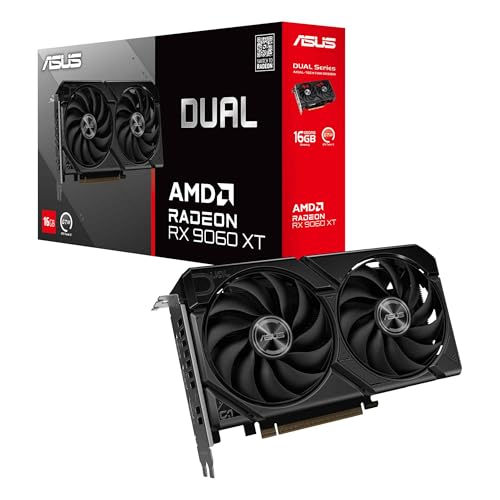
The ASUS Dual Radeon RX 9060 XT Graphics Card stands out as an excellent choice for AI enthusiasts and professionals seeking high VRAM performance. With 16GB of GDDR6 memory, it handles complex tasks effortlessly. Its efficient cooling features, like axial-tech fans and dual ball bearings, guarantee peak performance without excessive noise. You’ll appreciate the flexibility of the dual BIOS switch, allowing you to toggle between Quiet and Performance modes. Plus, the compact 2.5-slot design fits most builds seamlessly. Rated 4.8 out of 5 stars by users, it’s a top contender for powering your machine learning projects effectively.
Best For: AI enthusiasts and professionals seeking high VRAM performance for complex tasks.
Pros:
- Excellent 16GB GDDR6 memory for handling demanding applications.
- Efficient cooling system with axial-tech fans ensures peak performance without excessive noise.
- Dual BIOS switch for easy toggling between Quiet and Performance modes.
Cons:
- The 2.5-slot design may limit compatibility in smaller builds.
- Higher price point compared to lower VRAM graphics cards.
- Limited return period of 30 days may be restrictive for some customers.
ASUS TUF Gaming GeForce RTX 5070 Graphics Card

For AI enthusiasts seeking a powerful graphics card, the ASUS TUF Gaming GeForce RTX 5070 stands out with its impressive 12GB GDDR7 VRAM. Built on NVIDIA’s Blackwell architecture, it supports DLSS 4, ensuring exceptional performance. The card features a robust PCIe 5.0 interface and a 3.125-slot design for enhanced airflow. With three Axial-tech fans and a massive fin array, cooling efficiency is optimized, even under heavy loads. Plus, military-grade components and a protective PCB coating enhance durability. Utilize the GPU Tweak III software for fine-tuning performance and thermal controls, making this card an excellent choice for your AI projects.
Best For: AI enthusiasts and gamers looking for a powerful and reliable graphics card with advanced cooling and performance features.
Pros:
- Exceptional 12GB GDDR7 VRAM for high-performance tasks.
- Optimized cooling with three Axial-tech fans and a massive fin array for efficient airflow.
- Durable design with military-grade components and protective PCB coating.
Cons:
- Larger 3.125-slot design may not fit in all cases.
- Higher price point compared to entry-level graphics cards.
- Limited availability may affect purchasing options.
ASUS Dual GeForce RTX 5060 8GB GDDR7 Graphics Card

Designed for AI enthusiasts and gamers alike, the ASUS Dual GeForce RTX 5060 8GB GDDR7 Graphics Card stands out with its impressive AI performance of 623 AI TOPS. Powered by NVIDIA’s Blackwell architecture, it supports clock speeds of up to 2565 MHz in OC mode. You’ll appreciate its compact 2.5-slot design, making it fit easily into your system. The advanced cooling technology features dual Axial-tech fans, ensuring silent operation under low loads. With 8GB GDDR7 memory and multiple output options, including HDMI 2.1b and DisplayPort 2.1b, this card delivers exceptional performance for your machine learning projects.
Best For: AI enthusiasts and gamers seeking high-performance graphics with advanced cooling technology.
Pros:
- High AI Performance: Delivers 623 AI TOPS for enhanced machine learning capabilities.
- Compact Design: The 2.5-slot form factor fits easily into various system builds.
- Silent Operation: Advanced cooling with dual Axial-tech fans and 0dB technology ensures quiet performance under low loads.
Cons:
- Limited Memory Size: 8GB may not be sufficient for extremely demanding applications or high-resolution gaming.
- Weight: At 1.4 pounds, it might be heavier compared to some other graphics cards in the market.
- Price Point: It may be considered pricey for budget-conscious consumers.
ASUS ROG Astral LC GeForce RTX 5090 32GB Graphics Card

With its impressive 32GB GDDR7 memory, the ASUS ROG Astral LC GeForce RTX 5090 is perfect for AI developers and enthusiasts who require robust performance for demanding tasks. Featuring NVIDIA Blackwell architecture and DLSS 4, it boasts a remarkable boost clock of 2610 MHz in OC Mode. The 360mm AIO cooler guarantees ideal heat management, while the magnetic fans simplify installation. Plus, with a 4.5-star rating from users, it’s clear that this card delivers satisfaction. Weighing 7.8 pounds and measuring 14.16 x 0.7 x 9.15 inches, it’s a powerhouse that can elevate your machine learning projects to new heights.
Best For: AI developers and enthusiasts who require high-performance graphics for demanding tasks.
Pros:
- Exceptional 32GB GDDR7 memory for intensive applications.
- NVIDIA Blackwell architecture and DLSS 4 provide superior performance and graphics quality.
- Effective 360mm AIO cooler ensures optimal heat management and reliability.
Cons:
- Weighs 7.8 pounds, which may be cumbersome for some builds.
- High price point may not be suitable for casual users or gamers.
- Requires sufficient space in the case due to its dimensions of 14.16 x 0.7 x 9.15 inches.
GIGABYTE Radeon RX 9060 XT Gaming OC Graphics Card

The GIGABYTE Radeon RX 9060 XT Gaming OC Graphics Card stands out for its impressive 16 GB of GDDR6 memory, making it an ideal choice for gamers and creative professionals seeking high-performance AI acceleration. With its AMD RDNA™ 4 architecture and a stunning max resolution of 7680×4320 pixels, you’ll experience exceptional visuals. The WINDFORCE Cooling System, featuring a Hawk Fan, guarantees peak performance during intense tasks. Plus, its RGB lighting adds a stylish touch to your setup. With a high rating of 4.6 out of 5 stars from nearly 1,000 reviews, this GPU is a solid investment for your machine learning projects.
Best For: Gamers and creative professionals seeking high-performance graphics and AI acceleration capabilities.
Pros:
- Exceptional 16 GB GDDR6 memory for demanding applications and games.
- Impressive max resolution of 7680×4320 pixels for stunning visuals.
- Effective WINDFORCE Cooling System with RGB lighting for enhanced aesthetics and performance.
Cons:
- Slightly heavier at 2.57 pounds compared to some competitors.
- May be overkill for casual gamers or those with less demanding needs.
- Higher price point may not fit all budgets.
ASUS Dual NVIDIA GeForce RTX 3050 Gaming Graphics Card

For gamers and AI enthusiasts looking to balance performance and budget, the ASUS Dual NVIDIA GeForce RTX 3050 Gaming Graphics Card stands out with its 6GB of GDDR6 memory. This card features NVIDIA’s Ampere architecture, delivering double the FP32 throughput and enhanced power efficiency. With 2nd Generation RT Cores, you’ll enjoy superior ray-tracing performance. The 3rd Generation Tensor Cores enable significant AI advancements, boosting gaming performance dramatically. Its axial-tech fan design maximizes cooling while fitting perfectly in smaller chassis. Overall, this GPU is an excellent choice for those wanting to elevate their gaming and AI projects without breaking the bank.
Best For: Gamers and AI enthusiasts seeking a budget-friendly graphics card that offers solid performance and advanced features.
Pros:
- High-performance capabilities: The Ampere architecture provides double FP32 throughput and improved power efficiency.
- Enhanced ray-tracing performance: With 2nd Generation RT Cores, enjoy better graphics quality in supported games.
- Efficient cooling design: The axial-tech fan design ensures optimal cooling in smaller chassis, maintaining performance stability.
Cons:
- Limited memory capacity: 6GB of GDDR6 may be insufficient for very high-resolution gaming or demanding applications.
- Requires adequate power supply: Users may need to ensure their system has a compatible and sufficient power supply for optimal performance.
- Availability issues: As with many graphics cards, stock may be limited due to high demand, making it hard to purchase at times.
ASUS Prime GeForce RTX 5060 Graphics Card

Designed for AI enthusiasts and developers, the ASUS Prime GeForce RTX 5060 offers a powerful 8GB GDDR7 memory and impressive AI performance of 630 AI TOPS. With its PCIe® 5.0 interface and overclocking capabilities reaching 2595 MHz, it guarantees smooth operation for demanding tasks. The innovative cooling features, like axial-tech fans and 0dB technology, keep your system quiet during light gaming. Plus, the dual BIOS switch allows you to toggle between Quiet and Performance profiles effortlessly. With the GPU Tweak III software, fine-tuning performance and monitoring temperatures is a breeze, making it an excellent choice for your machine learning projects.
Best For: AI enthusiasts and developers seeking a high-performance graphics card for machine learning and demanding tasks.
Pros:
- Powerful AI Performance: Delivers 630 AI TOPS for efficient processing of AI workloads.
- Innovative Cooling Technology: Features axial-tech fans and 0dB technology for quiet operation during light gaming.
- Versatile BIOS Options: Dual BIOS switch allows easy toggling between Quiet and Performance profiles for tailored usage.
Cons:
- Size Compatibility: The 2.5-slot design may limit compatibility with smaller build cases.
- Overclocking Dependency: Maximum performance may require overclocking, which could lead to increased heat output.
- Price Point: As a high-end graphics card, it may not fit within the budget of all consumers.
PNY NVIDIA GeForce RTX 5060 Ti OC Graphics Card

Packed with 8GB of GDDR7 memory, the PNY NVIDIA GeForce RTX 5060 Ti OC Graphics Card is an excellent choice for gamers and creators looking to elevate their AI-driven experiences. With a boost speed of 2692 MHz and PCIe® 5.0 interface, it delivers impressive performance. The inclusion of fifth-gen Tensor Cores and fourth-gen Ray Tracing Cores enhances your AI capabilities, providing better FPS and image quality through DLSS technology. Additionally, its dual-fan design guarantees efficient cooling. Perfect for both gaming and creative applications, this card accelerates workflows while offering the stability of NVIDIA Studio drivers for exceptional performance.
Best For: Gamers and creators seeking high-performance graphics with advanced AI capabilities for an enhanced visual experience.
Pros:
- Impressive Performance: Equipped with 8GB GDDR7 memory and a boost speed of 2692 MHz for seamless gaming and creative workflows.
- Advanced AI Technology: Features fifth-gen Tensor Cores and DLSS for improved frame rates and image quality.
- Efficient Cooling: Dual-fan design ensures optimal thermal management during extended use.
Cons:
- Limited Bit Width: The 128-bit interface may not be sufficient for extremely high-resolution gaming.
- Size Constraints: Being SFF-Ready and 2-Slot may limit compatibility with some compact PC builds.
- Potential Pricing: Advanced features may come at a higher price point compared to entry-level graphics cards.
GIGABYTE Radeon RX 9070 XT Gaming OC Graphics Card

The GIGABYTE Radeon RX 9070 XT Gaming OC Graphics Card stands out for those who demand high VRAM for AI workloads and gaming alike. With 16 GB of GDDR6 memory and a robust AMD Radeon RX 9070 XT chipset, it delivers exceptional performance. You’ll appreciate the stunning max resolution of 7680×4320 pixels, perfect for immersive gaming and complex machine learning tasks. The efficient WINDFORCE Cooling System and server-grade thermal management guarantee peak performance under heavy loads. Plus, the dual BIOS options let you choose between performance and silent modes. With a 4.6-star rating, it’s a solid choice for serious users.
Best For: The GIGABYTE Radeon RX 9070 XT Gaming OC Graphics Card is best for gamers and professionals seeking high-performance graphics with substantial VRAM for demanding applications.
Pros:
- High VRAM: Equipped with 16 GB GDDR6 memory, ideal for gaming and AI workloads.
- Exceptional Resolution: Supports a maximum screen resolution of 7680×4320 pixels for immersive visuals.
- Cooling Efficiency: Features a WINDFORCE Cooling System and server-grade thermal management for optimal performance.
Cons:
- Weight: At 3.91 pounds, it may be heavier than some users prefer for their builds.
- Size: The dimensions (11.34 x 5.2 x 2.2 inches) might not fit in smaller cases.
- Price Point: Being a high-end card, it may be more expensive than budget-friendly alternatives.
Kelinx AISURIX RX 580 Graphics Card, 8GB GDDR5
If you’re diving into AI projects or gaming that demands robust graphical performance, the Kelinx AISURIX RX 580 Graphics Card stands out with its impressive 8GB GDDR5 memory. Built on the Polaris 20 architecture, this card features 2048 Stream Processors and supports DirectX 12, ensuring smooth, high-frame-rate gameplay. With a 1750 MHz memory clock and dual monitor support via 2x DisplayPort and 1x HDMI, you’ll experience stunning visuals at 4K resolution. Plus, its semi-automatic fan system keeps things quiet while maximizing power efficiency, drawing only 185 W. The RX 580 is your solid choice for tackling demanding AI tasks.
Best For: Gamers and AI developers seeking a powerful graphics card that delivers high performance and efficiency for demanding applications.
Pros:
- Supports high-resolution 4K gaming with stunning visuals.
- Efficient cooling system and low noise operation for a comfortable experience.
- Robust performance with 2048 Stream Processors and 8GB GDDR5 memory.
Cons:
- Maximum power draw of 185 W may require a compatible power supply.
- Limited to dual monitor support, which may not suffice for multi-monitor setups.
- Older architecture compared to newer GPU models, potentially limiting future-proofing.
Factors to Consider When Choosing a High VRAM GPU for AI
When choosing a high VRAM GPU for AI, you need to evaluate several key factors. Memory capacity, cooling efficiency, and overall architecture play essential roles in performance. Additionally, don’t overlook compatibility with your system and the GPU’s power consumption metrics.
Memory Capacity Requirements
Choosing a high VRAM GPU for AI isn’t just about the specs; it’s essential to contemplate how your specific applications will leverage memory capacity. For deep learning tasks, you’ll want a minimum of 8GB of VRAM, but 16GB or more is ideal to efficiently handle larger models and datasets. Insufficient VRAM can slow down performance and extend training times, as your GPU may need to rely on slower system memory for data. Applications like image recognition, natural language processing, and generative models greatly benefit from higher VRAM capacities to manage complex calculations. As AI technologies evolve, the demand for GPUs with larger memory capacities will only grow, making high VRAM a critical consideration for future-proofing your AI projects.
Cooling Solutions Efficiency
While selecting a high VRAM GPU for AI, you can’t overlook the importance of efficient cooling solutions. Effective cooling methods, like dual ball fan bearings and axial-tech fan designs, enhance airflow, reducing thermal buildup during intensive tasks. Advanced technologies, such as phase-change thermal pads and full-coverage copper plates, improve heat transfer, allowing your GPU to maintain high performance without overheating. A dual BIOS switch lets you toggle between Quiet and Performance modes, optimizing cooling based on your workload. Larger heatsinks and multiple fans can greatly lower temperatures, ensuring stability during prolonged computations. Plus, an efficient cooling solution operates silently under low load while effectively dissipating heat during peak performance, enhancing your overall AI experience.
Architecture and Performance
To maximize your AI capabilities, understanding the architecture and performance of high VRAM GPUs is vital. Modern architectures, like NVIDIA Blackwell, enhance AI tasks through increased throughput and efficiency. High VRAM enables you to handle large datasets and complex models, guaranteeing smoother performance and faster processing. Look for dedicated AI cores, such as Tensor Cores in NVIDIA GPUs, which accelerate machine learning tasks and boost performance in AI applications. Memory speed, typically GDDR6 or GDDR7, is critical for quick data access and processing, directly impacting your AI training times. Finally, confirm effective cooling solutions and thermal management to prevent thermal throttling, which can hinder your GPU’s computational efficiency during intensive workloads.
Compatibility With Systems
When selecting a high VRAM GPU for AI, it’s vital to guarantee compatibility with your system’s components. First, verify the GPU fits your motherboard’s PCIe interface; newer models typically utilize PCIe 5.0 for peak performance. Next, check the physical dimensions of the GPU, especially if it’s a larger model that may require a 2.5-slot or 3.125-slot design to fit in your case. Also, verify that your power supply unit (PSU) has enough wattage and the necessary power connectors. It’s imperative to confirm that your CPU and other components can keep pace with the GPU to avoid bottlenecking. Finally, consider the maximum screen resolution the GPU supports to align with your display’s capabilities for AI applications.
Power Consumption Metrics
After confirming your high VRAM GPU is compatible with your system, it’s important to evaluate its power consumption metrics. High VRAM GPUs typically draw between 150W to over 300W, depending on their architecture and usage. Newer models often boast better power efficiency, enhancing performance per watt, which is vital for AI tasks. The thermal design power (TDP) rating will help you determine the cooling solutions and power supply requirements. Look for a power supply with at least 80 Plus Gold certification to handle demanding workloads effectively. Additionally, monitor power consumption during AI tasks, as usage can fluctuate based on workload intensity, affecting both energy costs and system stability. Choose wisely to guarantee peak performance and efficiency.
Connectivity Options Available
Connectivity options play an important role in your choice of a high VRAM GPU for AI tasks. High VRAM GPUs typically offer multiple connectivity options, like HDMI and DisplayPort, which guarantee compatibility with high-resolution monitors. Modern GPUs often support PCIe 5.0 interfaces, providing increased bandwidth for faster data transfers between the GPU and motherboard. With HDMI 2.1 and DisplayPort 2.1, you can achieve higher refresh rates and resolutions, significant for demanding AI applications. Enhanced connectivity options also support multiple monitor setups, which is beneficial when visualizing complex data. Additionally, some GPUs feature dual BIOS switches, allowing you to toggle between performance profiles for optimized connectivity and efficiency during your AI projects.
Price-to-Performance Ratio
Understanding the price-to-performance ratio is vital for choosing a high VRAM GPU for AI applications, as it helps you determine if the GPU’s capabilities justify its cost. A higher VRAM capacity can greatly enhance performance, especially when managing large datasets or complex models. However, it’s important to analyze how these VRAM increases impact pricing. By looking at benchmarks and performance metrics, you can find the most cost-effective options tailored to your AI workloads. Market trends suggest that GPUs with 8GB to 32GB of memory often strike the right balance between performance and budget. Finally, consider the long-term value of a GPU to guarantee it meets future AI demands, enhancing its overall price-to-performance effectiveness.