
When it comes to video editing in 2026, choosing the right GPU can greatly impact your workflow. With advancements in technology, you’ll find options that enhance performance and memory capacity, ensuring smoother playback and quicker rendering times. Whether you’re tackling high-resolution projects or working with complex effects, the right graphics card can make all the difference. Let’s explore the top contenders that could elevate your editing process and help you create stunning visual content.
ASUS Dual NVIDIA GeForce RTX 3050 Gaming Graphics Card

If you’re a video editor seeking a balance between performance and affordability, the ASUS Dual NVIDIA GeForce RTX 3050 Gaming Graphics Card is an excellent choice. With 6GB of GDDR6 memory and PCIe 4.0 support, it provides impressive performance for your editing tasks. The advanced NVIDIA Ampere architecture doubles the FP32 throughput, enhancing power efficiency. Its 2nd Generation RT Cores and 3rd Generation Tensor Cores greatly improve ray-tracing and AI capabilities, respectively. The axial-tech fan design guarantees ideal cooling in a compact 2-slot form, making it perfect for small chassis while maximizing performance during intense editing sessions.
Best For: Video editors seeking a balance between performance and affordability while working with demanding applications.
Pros:
- High-performance GDDR6 memory and PCIe 4.0 support for efficient editing tasks.
- Advanced ray-tracing and AI capabilities through 2nd and 3rd Generation Cores.
- Compact 2-slot design with effective cooling for optimal performance in small chassis.
Cons:
- Limited to 6GB of memory, which may not suffice for very high-resolution projects.
- May not perform as well in gaming compared to higher-end models.
- Potentially overkill for casual users or basic editing tasks.
ASUS TUF Gaming GeForce RTX 5070 Graphics Card

The ASUS TUF Gaming GeForce RTX 5070 Graphics Card stands out as an exceptional choice for video editors seeking powerful performance and reliability. With 12GB of GDDR7 memory and NVIDIA’s Blackwell architecture, it handles demanding workloads effortlessly. The advanced cooling system, featuring three Axial-tech fans and a massive fin array, guarantees peak airflow, even under heavy loads. Its military-grade components and protective PCB coating add durability, making it a robust option for long-term use. Plus, the GPU Tweak III software lets you fine-tune performance and monitor temperatures, ensuring your creative workflow remains smooth and efficient.
Best For: Video editors and gamers seeking high-performance graphics for demanding workloads and extended durability.
Pros:
- Powerful Performance: Equipped with 12GB of GDDR7 memory and NVIDIA Blackwell architecture for seamless handling of intensive tasks.
- Advanced Cooling System: Features three Axial-tech fans and a massive fin array to maintain optimal airflow and thermal performance.
- Durable Construction: Built with military-grade components and a protective PCB coating for long-lasting reliability.
Cons:
- Size: The 3.125-slot design may not fit in all cases, requiring careful consideration of PC dimensions.
- Price Point: As a high-end graphics card, it may be on the pricier side compared to lower-end options.
- Power Requirements: May demand a robust power supply to fully utilize its capabilities, which could be an additional investment.
ASUS Dual GeForce RTX™ 5060 Graphics Card

For video editors seeking high-quality performance, the ASUS Dual GeForce RTX™ 5060 Graphics Card delivers exceptional power with its 623 AI TOPS capability. This 8GB GDDR7 OC Edition card, built on NVIDIA’s Blackwell architecture, features impressive clock speeds of up to 2565 MHz in OC mode. Its compact 2.5-slot design and advanced cooling with dual Axial-tech fans guarantee peak performance without noise. With outputs like HDMI 2.1b and DisplayPort 2.1b, you can enjoy stunning resolutions up to 7680×4320 pixels. Rated 4.7 out of 5 stars, it’s a reliable choice that enhances your creative workflow effortlessly.
Best For: Video editors and gamers seeking high-performance graphics with advanced cooling technology and compact design.
Pros:
- Exceptional AI performance with 623 AI TOPS for enhanced creative workflows.
- Compact 2.5-slot design allows for easy installation in various setups.
- Advanced cooling system with dual Axial-tech fans ensures peak performance with silent operation.
Cons:
- Limited to 8GB of memory, which may not be sufficient for extremely demanding applications.
- The card may be pricier compared to entry-level options in the market.
- Potential for restocking fees if returned under certain conditions, which may deter some buyers.
MSI Gaming GeForce GT 1030 Graphics Card
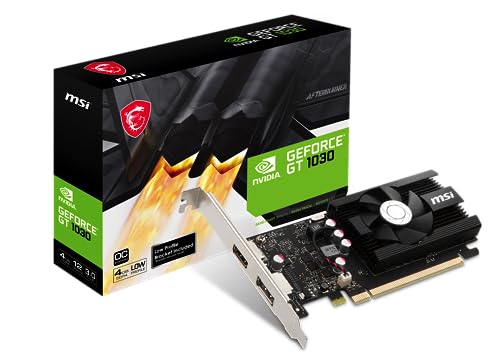
Designed for content creators and casual editors, the MSI Gaming GeForce GT 1030 Graphics Card delivers impressive performance without breaking the bank. Featuring a 4GB DDR4 memory and NVIDIA Pascal architecture, it’s perfect for HD video and picture editing. With a boost clock of 1430 MHz, you’ll enjoy smooth visuals at a max resolution of 3840×2160. The low-profile design makes it ideal for compact builds, while the DisplayPort and HDMI outputs guarantee versatility. Plus, GeForce Experience simplifies driver management. With a solid 4.5-star rating, the GT 1030 is a reliable choice for enhancing your creative workflow.
Best For: The MSI Gaming GeForce GT 1030 is best for content creators and casual editors seeking an affordable graphics card that delivers solid performance for HD video and picture editing.
Pros:
- Affordable price point for budget-conscious users looking to enhance their editing capabilities.
- Compact, low-profile design suitable for small form factor builds.
- Easy driver management with GeForce Experience for automatic updates and performance optimization.
Cons:
- Limited memory interface of 64-bit may restrict performance in more demanding applications.
- Not suited for high-end gaming or intensive graphic tasks due to its entry-level specifications.
- Single fan design could lead to higher temperatures under heavy loads compared to dual-fan models.
Kelinx AISURIX RX 580 Graphics Card (8GB GDDR5)

When tackling demanding video editing projects, the Kelinx AISURIX RX 580 Graphics Card proves to be an excellent choice, especially with its robust 8GB GDDR5 memory. Its 2048 stream processors and Polaris 20 architecture guarantee smooth performance, while the 1750 MHz memory clock enhances efficiency. You can connect up to two monitors via its DisplayPort and HDMI outputs, achieving stunning 4K visuals. Plus, with a semi-automatic fan system, you’ll enjoy low noise during operation. This dual-slot card, rated for just 185 W, offers impressive power efficiency, making it a fantastic addition to your creative workflow.
Best For: The Kelinx AISURIX RX 580 Graphics Card is best for gamers and content creators seeking high performance and efficiency in demanding applications.
Pros:
- Supports high frame rates and smooth gameplay for an enhanced gaming experience.
- Capable of 4K display with vibrant visuals, ideal for video editing and gaming.
- Low noise operation thanks to the semi-automatic fan system, providing a comfortable environment.
Cons:
- Limited to dual monitor support, which may not suffice for multi-tasking professionals.
- Maximum power draw of 185 W may require a suitable power supply for optimal performance.
- Older architecture may not support the latest features found in newer graphics cards.
SAPLOS GT 730 4GB Graphics Card
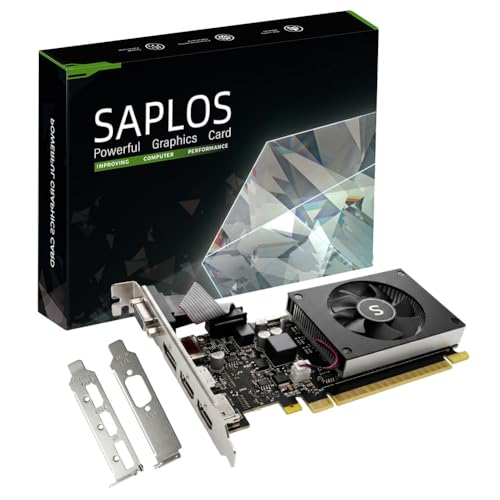
The SAPLOS GT 730 4GB Graphics Card stands out for those seeking an affordable, entry-level solution for video editing and everyday computing tasks. Powered by Kepler architecture with 384 CUDA cores, it supports DirectX 12 and is compatible with multiple Windows versions. You’ll appreciate its 4GB DDR3 memory and ability to connect up to four displays simultaneously via dual HDMI and DisplayPort. Its low-profile design fits small cases, and it operates quietly, making it ideal for any workspace. Plus, with low power consumption and easy installation, this card is perfect for enhancing your creative workflow without breaking the bank.
Best For: Entry-level users looking for an affordable graphics card for everyday computing and video editing tasks.
Pros:
- Supports up to four displays simultaneously for enhanced multitasking.
- Low power consumption with no additional power connector required, making it energy-efficient.
- Quiet operation with a slow-moving fan, ensuring a peaceful working environment.
Cons:
- Limited gaming performance compared to higher-end graphics cards.
- Only 4GB DDR3 memory, which may not be sufficient for more demanding applications.
- Removable VGA output may not be compatible with newer monitors without adapters.
GPVHOSO GTX 750Ti 4GB Graphics Card

For budget-conscious video editors seeking a reliable graphics solution, the GPVHOSO GTX 750Ti 4GB Graphics Card stands out with its 4K HDR technology. This card features GDDR5 memory, 640 stream processors, and a dual-fan design for ideal cooling. With a GPU clock speed of 1072MHz and support for up to three monitors, you’ll enjoy enhanced image processing capabilities. Its low-power design means you won’t need a power supply upgrade, making it cost-efficient. Plus, installation is straightforward on Windows 11 and earlier. This graphics card combines durability and performance, ensuring you can edit videos without interruptions.
Best For: Budget-conscious video editors and gamers seeking reliable performance without the need for a power supply upgrade.
Pros:
- Supports 4K HDR technology for enhanced video quality.
- Low power consumption makes it cost-efficient for long editing sessions.
- Easy installation on multiple Windows versions for quick setup.
Cons:
- Limited performance for high-end gaming or intensive graphic tasks.
- May not support the latest gaming titles at maximum settings.
- Only 4GB of memory may be insufficient for more demanding video editing projects.
SOYO Geforce GT 740 Low Profile Graphics Card

Designed with compact spaces in mind, the SOYO Geforce GT 740 Low Profile Graphics Card is an excellent choice for video editors using small form factor PCs or slim desktops. With 4GB DDR3 memory and a 128-bit interface, it guarantees fast data transfer and dependable performance. This card supports DirectX 12 and Vulkan, enhancing your graphic effects. Its low-profile design fits tight spaces while delivering basic graphics for office tasks and light gaming. Featuring standard HDMI, DVI, and VGA connectors, it offers flexibility for various monitors. Plus, its efficient cooling system keeps things running smoothly during your projects.
Best For: Video editors and users with small form factor PCs looking for basic graphics performance without sacrificing space.
Pros:
- Supports modern graphics APIs like DirectX 12 and Vulkan for enhanced visual effects.
- Low-profile design fits easily into compact systems, making it ideal for slim desktops.
- Efficient cooling system ensures reliable performance and longevity during demanding tasks.
Cons:
- Limited gaming performance may not satisfy users looking for high-end gaming capabilities.
- Only 4GB DDR3 memory may be insufficient for more demanding applications or multitasking.
- Legacy mode adjustment in BIOS may be necessary for proper installation, which could be a hassle for some users.
PNY NVIDIA GeForce RTX 5050 Graphics Card (8GB GDDR6)
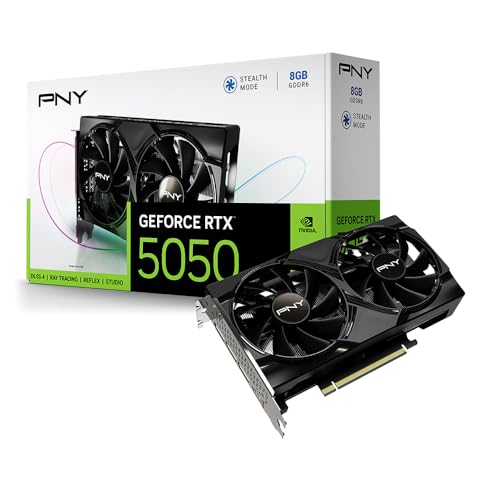
If you’re a video editor seeking enhanced performance and efficiency, the PNY NVIDIA GeForce RTX™ 5050 Graphics Card stands out with its remarkable 8GB GDDR6 memory and advanced AI-driven features. With a max screen resolution of 7680×4320, this GPU delivers stunning visuals. It boasts 4th-gen Ray Tracing and 5th-gen Tensor Cores, ensuring exceptional rendering and responsiveness. DLSS 4 technology enhances frame rates while reducing latency, perfect for smooth editing. Weighing only 1.7 pounds and utilizing PCIe® 5.0, it fits seamlessly into your setup. Rated 4.5 stars by users, it’s a fantastic addition to any creative workflow.
Best For: Video editors and creative professionals seeking enhanced performance and efficiency in their workflows.
Pros:
- Advanced AI-driven features: DLSS 4 technology enhances frame rates and reduces latency, providing smoother editing experiences.
- High memory capacity: 8GB GDDR6 memory ensures stunning visuals and exceptional rendering capabilities.
- Lightweight and compact design: Weighing only 1.7 pounds and utilizing PCIe® 5.0, it fits seamlessly into various setups.
Cons:
- Higher price point: As a high-performance graphics card, it may be more expensive compared to entry-level options.
- Limited availability: With a release date of September 18, 2025, it may be difficult to find in stock.
- Restocking fees: The Amazon return policy includes a 15% restocking fee for misrepresented conditions, which can be a drawback for buyers.
Glorto GeForce GT 730 4G Low Profile Graphics Card

The Glorto GeForce GT 730 4G Low Profile Graphics Card stands out as an ideal entry-level GPU for video editing enthusiasts seeking a compact solution. Measuring just 6.03 x 4.73 inches and weighing 8.1 ounces, it fits easily in small form factor PCs and HTPCs. With 4GB of DDR3 memory and support for DirectX 12 and OpenGL 4.6, you’ll enjoy smooth video playback. Its dual HDMI and DisplayPort outputs allow for multi-screen setups, enhancing your workflow. With a solid customer rating of 4.4 stars, this GPU is a reliable choice for those starting their video editing journey.
Best For: The Glorto GeForce GT 730 4G Low Profile Graphics Card is best for video editing enthusiasts looking for a compact and affordable GPU solution.
Pros:
- Compact Design: Fits easily in small form factor PCs and HTPCs, making it ideal for limited space setups.
- Multi-Screen Support: Dual HDMI and DisplayPort outputs allow for enhanced multitasking with up to 4 screens.
- Good Performance for Entry Level: Supports DirectX 12 and OpenGL 4.6 for smooth video playback and editing.
Cons:
- Limited Memory Bandwidth: The 64-bit bus width may restrict performance in more demanding applications.
- Entry-Level GPU: Not suitable for high-end gaming or intensive graphic design tasks.
- Potential Compatibility Issues: May not fit in micro form factor PCs.
Factors to Consider When Choosing a Professional GPU for Video Editing
When choosing a professional GPU for video editing, you need to weigh several important factors. Consider memory capacity, processing power, and cooling solutions to guarantee smooth performance. Don’t forget to check compatibility with your editing software and assess the price versus performance ratio to get the best value for your investment.
Memory Capacity Importance
While tackling high-resolution video projects, understanding memory capacity is essential for selecting the right professional GPU. A higher memory capacity directly impacts your ability to handle demanding 4K and 8K footage, guaranteeing smoother playback without lag. When you work with video editing software, larger memory sizes allow for quicker rendering times and enable you to manage multiple layers and effects simultaneously. Insufficient memory can lead to significant slowdowns during editing, rendering, and exporting phases, which can hurt your productivity. As video editing tasks grow more complex, opting for a GPU with at least 8GB of memory is highly recommended. This guarantees you can efficiently manage the challenges of modern video editing without compromise.
Processing Power Requirements
Choosing a professional GPU for video editing means considering its processing power, which is vital for handling complex tasks efficiently. Look for a GPU with a high number of cores and memory bandwidth to guarantee smooth rendering, effects processing, and real-time playback. A dedicated GPU with at least 6GB of GDDR6 memory is recommended, particularly for high-resolution footage and demanding formats. Pay attention to floating-point performance, measured in TFLOPS, as it indicates the GPU’s capability for calculations needed in video rendering. Modern architectures, like NVIDIA’s Ampere, offer improved parallel processing, essential for multitasking. Finally, consider GPUs that support AI-driven features, such as NVIDIA’s DLSS, to greatly enhance performance and rendering speed in your video editing workflows.
Cooling Solutions Efficiency
To guarantee your GPU performs at its best during video editing, efficient cooling solutions are essential. Look for advanced thermal pads and multiple fans to prevent thermal throttling during intensive tasks. GPUs featuring axial-tech fan designs enhance airflow by creating increased downward air pressure, critical for sustained high performance. Consider a dual-slot or larger form factor, as these designs typically dissipate heat more effectively than single-slot options. Additionally, selecting GPUs made with military-grade components and protective coatings guarantees durability and reliability under heavy use. Finally, models equipped with 0dB technology provide silent operation during low load periods, which is a significant advantage in professional editing environments where minimizing noise is essential.
Compatibility With Software
When selecting a professional GPU for video editing, it’s crucial to guarantee compatibility with popular editing software like Adobe Premiere Pro, Final Cut Pro, and DaVinci Resolve. These applications often rely on specific GPU capabilities for rendering and effects, so choose wisely. Look for GPUs that support CUDA cores or OpenCL, as they enhance rendering and playback performance. Additionally, consider the GPU’s memory capacity; 8GB or more of VRAM is recommended for handling high-resolution footage and complex projects effectively. Verify the GPU meets the latest API standards, such as DirectX 12 and OpenGL 4.6, to stay compatible with future software updates. Finally, check for adequate output options like HDMI or DisplayPort to connect multiple monitors for a more efficient editing workflow.
Price vs. Performance Ratio
While you navigate the landscape of professional GPUs for video editing, understanding the price-to-performance ratio is essential for making an informed decision. Higher-end models often deliver faster rendering times and smoother playback, enhancing your productivity. To find the best value, utilize benchmarks and metrics like frames per second (FPS) and rendering speeds tailored to your specific editing tasks. A GPU that balances cost and performance effectively can lead to long-term savings by cutting down editing time and improving workflow efficiency. Additionally, consider investing in GPUs with advanced features, like AI-driven rendering and high-resolution support, as these can justify a higher price tag through significant performance gains. Ultimately, assess your project’s demands to choose wisely.